Ledicia Pereira , Gabriel Blázquez , Ventura Castillo , Francisco Miguel González-Pernas , María González-Lucas , M. Ángeles Martín-Lara , Mónica Calero , Rafael R. Solís
{"title":"Unraveling the lab-scaling up production of activated carbon from plastic-enriched waste","authors":"Ledicia Pereira , Gabriel Blázquez , Ventura Castillo , Francisco Miguel González-Pernas , María González-Lucas , M. Ángeles Martín-Lara , Mónica Calero , Rafael R. Solís","doi":"10.1016/j.jclepro.2025.145088","DOIUrl":null,"url":null,"abstract":"<div><div>This work explores the preparation of activated carbon from the pyrolysis char residues in two different scale scenarios, i.e. a laboratory furnace and a scaled-up version in a lab-pilot plant rotatory furnace. As the activating method, K<sub>2</sub>CO<sub>3</sub> was added to the carbonaceous precursor. The activation temperature (700-800 °C) and the impregnation char: K<sub>2</sub>CO<sub>3</sub> ratio (1:0.25–1:2) were modified in both setups, comparing the attained results of textural development and chemical composition by elemental analysis and XPS. The effect of the agitation during the activation process was also evaluated at the lab-pilot plant scale. The results pointed out a better definition of the textural properties at the lab-pilot plant scale, with an important influence on the agitation in the process. Thus, the optimum temperature was set as 750 °C, and the char: K<sub>2</sub>CO<sub>3</sub> ratio as 1:0.5, leading to a material with an area of ∼1100 m<sup>2</sup> g<sup>−1</sup>, and a pore volume of ∼0.8 cm<sup>3</sup> g<sup>−1</sup>. The resulting activated carbon could adsorb up to 270 mg CO<sub>2</sub> g<sup>−1</sup>. Dynamic tests of CO<sub>2</sub>-CH<sub>4</sub> mixtures (from 20:80 to 40:60) were carried out with the optimized material prepared at the lab-pilot plant scale, demonstrating the suitability of the valorized residue as activated carbon for biogas upgrading, with high stability in sequential reusing assays.</div></div>","PeriodicalId":349,"journal":{"name":"Journal of Cleaner Production","volume":"496 ","pages":"Article 145088"},"PeriodicalIF":10.0000,"publicationDate":"2025-03-10","publicationTypes":"Journal Article","fieldsOfStudy":null,"isOpenAccess":false,"openAccessPdf":"","citationCount":"0","resultStr":null,"platform":"Semanticscholar","paperid":null,"PeriodicalName":"Journal of Cleaner Production","FirstCategoryId":"93","ListUrlMain":"https://www.sciencedirect.com/science/article/pii/S095965262500438X","RegionNum":1,"RegionCategory":"环境科学与生态学","ArticlePicture":[],"TitleCN":null,"AbstractTextCN":null,"PMCID":null,"EPubDate":"2025/2/21 0:00:00","PubModel":"Epub","JCR":"Q1","JCRName":"ENGINEERING, ENVIRONMENTAL","Score":null,"Total":0}
引用次数: 0
Abstract
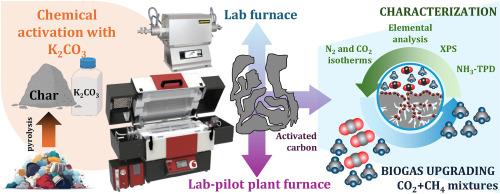
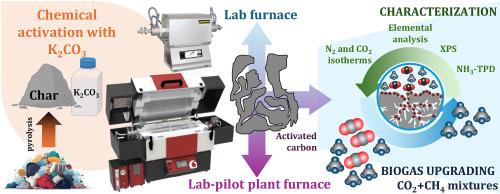
This work explores the preparation of activated carbon from the pyrolysis char residues in two different scale scenarios, i.e. a laboratory furnace and a scaled-up version in a lab-pilot plant rotatory furnace. As the activating method, K2CO3 was added to the carbonaceous precursor. The activation temperature (700-800 °C) and the impregnation char: K2CO3 ratio (1:0.25–1:2) were modified in both setups, comparing the attained results of textural development and chemical composition by elemental analysis and XPS. The effect of the agitation during the activation process was also evaluated at the lab-pilot plant scale. The results pointed out a better definition of the textural properties at the lab-pilot plant scale, with an important influence on the agitation in the process. Thus, the optimum temperature was set as 750 °C, and the char: K2CO3 ratio as 1:0.5, leading to a material with an area of ∼1100 m2 g−1, and a pore volume of ∼0.8 cm3 g−1. The resulting activated carbon could adsorb up to 270 mg CO2 g−1. Dynamic tests of CO2-CH4 mixtures (from 20:80 to 40:60) were carried out with the optimized material prepared at the lab-pilot plant scale, demonstrating the suitability of the valorized residue as activated carbon for biogas upgrading, with high stability in sequential reusing assays.
期刊介绍:
The Journal of Cleaner Production is an international, transdisciplinary journal that addresses and discusses theoretical and practical Cleaner Production, Environmental, and Sustainability issues. It aims to help societies become more sustainable by focusing on the concept of 'Cleaner Production', which aims at preventing waste production and increasing efficiencies in energy, water, resources, and human capital use. The journal serves as a platform for corporations, governments, education institutions, regions, and societies to engage in discussions and research related to Cleaner Production, environmental, and sustainability practices.




 京公网安备 11010802042870号
京ICP备2023020795号-1
京公网安备 11010802042870号
京ICP备2023020795号-1

 分享
分享
 求助内容:
求助内容: 应助结果提醒方式:
 扫码关注我们
