Ruofan Yu, Shelby Roseman, Allison P. Siegenfeld, Zachary Gardner, Son C. Nguyen, Khoa A. Tran, Eric F. Joyce, Rajan Jain, Brian B. Liau, Ian D. Krantz, Katherine A. Alexander, Shelley L. Berger
{"title":"CTCF/RAD21 organize the ground state of chromatin–nuclear speckle association","authors":"Ruofan Yu, Shelby Roseman, Allison P. Siegenfeld, Zachary Gardner, Son C. Nguyen, Khoa A. Tran, Eric F. Joyce, Rajan Jain, Brian B. Liau, Ian D. Krantz, Katherine A. Alexander, Shelley L. Berger","doi":"10.1038/s41594-024-01465-6","DOIUrl":null,"url":null,"abstract":"Recent findings indicate that nuclear speckles, a distinct type of nuclear body, interact with certain chromatin regions in a ground state. Here, we report that the chromatin structural factors CTCF and cohesin are required for full ground-state association between DNA and nuclear speckles. We identified a putative speckle-targeting motif (STM) within cohesin subunit RAD21 and demonstrated that the STM is required for chromatin–nuclear speckle association, disruption of which also impaired induction of speckle-associated genes. Depletion of the cohesin-releasing factor WAPL, which stabilizes cohesin on chromatin, resulted in reinforcement of DNA–speckle contacts and enhanced inducibility of speckle-associated genes. Additionally, we observed disruption of chromatin–nuclear speckle association in patient-derived cells with Cornelia de Lange syndrome, a congenital neurodevelopmental disorder involving defective cohesin pathways. In summary, our findings reveal a mechanism for establishing the ground state of chromatin–speckle association and promoting gene inducibility, with relevance to human disease. The authors reveal that the chromatin architectural proteins CTCF and RAD21 organize DNA around nuclear speckles to enhance gene induction. This structural organization, when disrupted as in Cornelia de Lange syndrome, impairs key gene functions, providing insight into potential disease mechanisms.","PeriodicalId":49141,"journal":{"name":"Nature Structural & Molecular Biology","volume":"32 6","pages":"1069-1080"},"PeriodicalIF":10.1000,"publicationDate":"2025-02-21","publicationTypes":"Journal Article","fieldsOfStudy":null,"isOpenAccess":false,"openAccessPdf":"","citationCount":"0","resultStr":null,"platform":"Semanticscholar","paperid":null,"PeriodicalName":"Nature Structural & Molecular Biology","FirstCategoryId":"99","ListUrlMain":"https://www.nature.com/articles/s41594-024-01465-6","RegionNum":1,"RegionCategory":"生物学","ArticlePicture":[],"TitleCN":null,"AbstractTextCN":null,"PMCID":null,"EPubDate":"","PubModel":"","JCR":"Q1","JCRName":"BIOCHEMISTRY & MOLECULAR BIOLOGY","Score":null,"Total":0}
引用次数: 0
Abstract
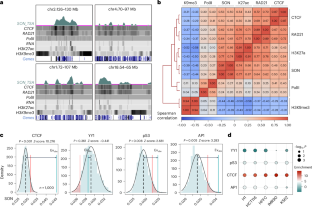
Recent findings indicate that nuclear speckles, a distinct type of nuclear body, interact with certain chromatin regions in a ground state. Here, we report that the chromatin structural factors CTCF and cohesin are required for full ground-state association between DNA and nuclear speckles. We identified a putative speckle-targeting motif (STM) within cohesin subunit RAD21 and demonstrated that the STM is required for chromatin–nuclear speckle association, disruption of which also impaired induction of speckle-associated genes. Depletion of the cohesin-releasing factor WAPL, which stabilizes cohesin on chromatin, resulted in reinforcement of DNA–speckle contacts and enhanced inducibility of speckle-associated genes. Additionally, we observed disruption of chromatin–nuclear speckle association in patient-derived cells with Cornelia de Lange syndrome, a congenital neurodevelopmental disorder involving defective cohesin pathways. In summary, our findings reveal a mechanism for establishing the ground state of chromatin–speckle association and promoting gene inducibility, with relevance to human disease. The authors reveal that the chromatin architectural proteins CTCF and RAD21 organize DNA around nuclear speckles to enhance gene induction. This structural organization, when disrupted as in Cornelia de Lange syndrome, impairs key gene functions, providing insight into potential disease mechanisms.
期刊介绍:
Nature Structural & Molecular Biology is a comprehensive platform that combines structural and molecular research. Our journal focuses on exploring the functional and mechanistic aspects of biological processes, emphasizing how molecular components collaborate to achieve a particular function. While structural data can shed light on these insights, our publication does not require them as a prerequisite.




 京公网安备 11010802042870号
京ICP备2023020795号-1
京公网安备 11010802042870号
京ICP备2023020795号-1

 分享
分享
 求助内容:
求助内容: 应助结果提醒方式:
 扫码关注我们
