Alena Khmelinskaia, Neville P. Bethel, Farzad Fatehi, Bhoomika Basu Mallik, Aleksandar Antanasijevic, Andrew J. Borst, Szu-Hsueh Lai, Ho Yeung Chim, Jing Yang ‘John’ Wang, Marcos C. Miranda, Andrew M. Watkins, Cassandra Ogohara, Shane Caldwell, Mengyu Wu, Albert J. R. Heck, David Veesler, Andrew B. Ward, David Baker, Reidun Twarock, Neil P. King
{"title":"Local structural flexibility drives oligomorphism in computationally designed protein assemblies","authors":"Alena Khmelinskaia, Neville P. Bethel, Farzad Fatehi, Bhoomika Basu Mallik, Aleksandar Antanasijevic, Andrew J. Borst, Szu-Hsueh Lai, Ho Yeung Chim, Jing Yang ‘John’ Wang, Marcos C. Miranda, Andrew M. Watkins, Cassandra Ogohara, Shane Caldwell, Mengyu Wu, Albert J. R. Heck, David Veesler, Andrew B. Ward, David Baker, Reidun Twarock, Neil P. King","doi":"10.1038/s41594-025-01490-z","DOIUrl":null,"url":null,"abstract":"Many naturally occurring protein assemblies have dynamic structures that allow them to perform specialized functions. Although computational methods for designing novel self-assembling proteins have advanced substantially over the past decade, they primarily focus on designing static structures. Here we characterize three distinct computationally designed protein assemblies that exhibit unanticipated structural diversity arising from flexibility in their subunits. Cryo-EM single-particle reconstructions and native mass spectrometry reveal two distinct architectures for two assemblies, while six cryo-EM reconstructions for the third likely represent a subset of its solution-phase structures. Structural modeling and molecular dynamics simulations indicate that constrained flexibility within the subunits of each assembly promotes a defined range of architectures rather than nonspecific aggregation. Redesigning the flexible region in one building block rescues the intended monomorphic assembly. These findings highlight structural flexibility as a powerful design principle, enabling exploration of new structural and functional spaces in protein assembly design. This study reports unexpected structural diversity in computationally designed protein assemblies due to subunit flexibility. Fixing flexibility in one design restores the intended architecture, suggesting a strategy to design dynamic assemblies.","PeriodicalId":49141,"journal":{"name":"Nature Structural & Molecular Biology","volume":"32 6","pages":"1050-1060"},"PeriodicalIF":10.1000,"publicationDate":"2025-02-26","publicationTypes":"Journal Article","fieldsOfStudy":null,"isOpenAccess":false,"openAccessPdf":"https://www.nature.comhttps://www.nature.com/articles/s41594-025-01490-z.pdf","citationCount":"0","resultStr":null,"platform":"Semanticscholar","paperid":null,"PeriodicalName":"Nature Structural & Molecular Biology","FirstCategoryId":"99","ListUrlMain":"https://www.nature.com/articles/s41594-025-01490-z","RegionNum":1,"RegionCategory":"生物学","ArticlePicture":[],"TitleCN":null,"AbstractTextCN":null,"PMCID":null,"EPubDate":"","PubModel":"","JCR":"Q1","JCRName":"BIOCHEMISTRY & MOLECULAR BIOLOGY","Score":null,"Total":0}
引用次数: 0
Abstract
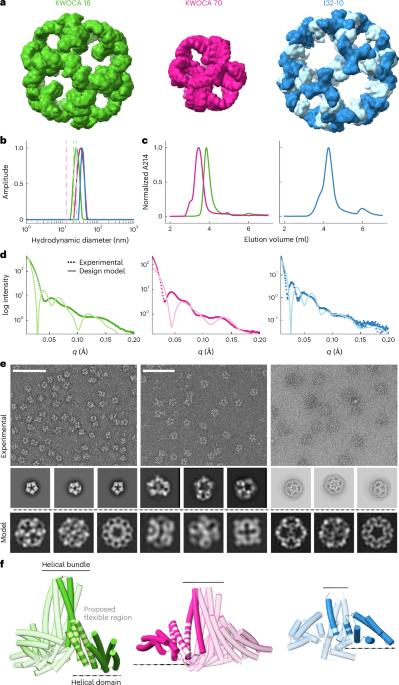
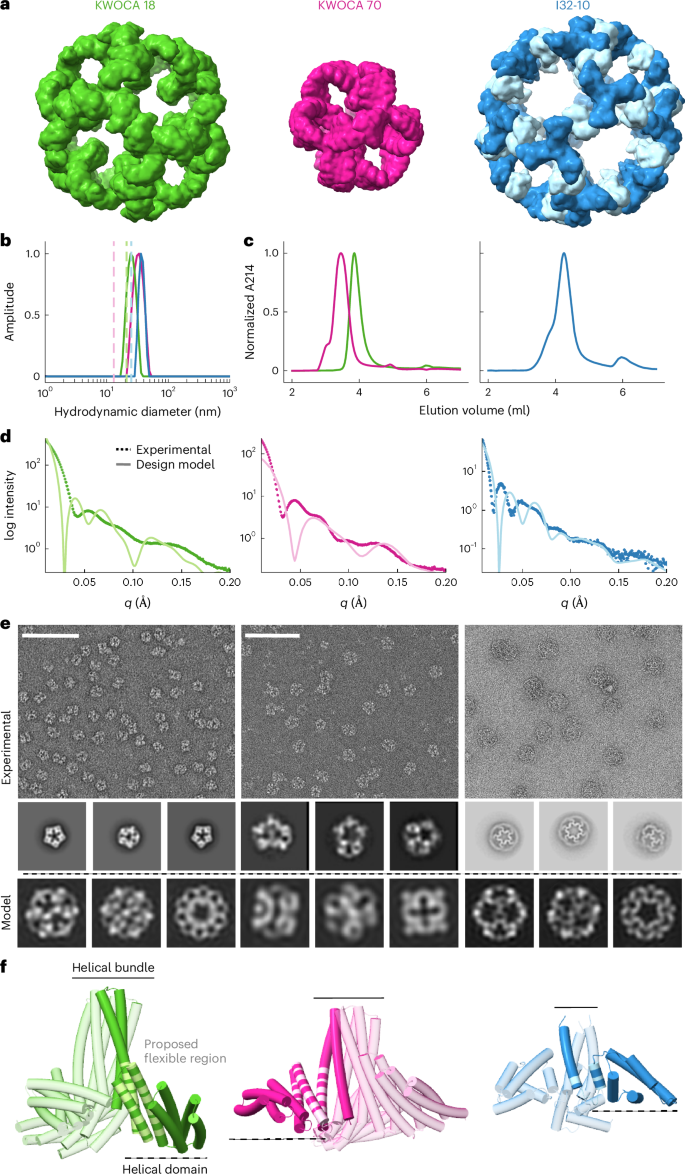
Many naturally occurring protein assemblies have dynamic structures that allow them to perform specialized functions. Although computational methods for designing novel self-assembling proteins have advanced substantially over the past decade, they primarily focus on designing static structures. Here we characterize three distinct computationally designed protein assemblies that exhibit unanticipated structural diversity arising from flexibility in their subunits. Cryo-EM single-particle reconstructions and native mass spectrometry reveal two distinct architectures for two assemblies, while six cryo-EM reconstructions for the third likely represent a subset of its solution-phase structures. Structural modeling and molecular dynamics simulations indicate that constrained flexibility within the subunits of each assembly promotes a defined range of architectures rather than nonspecific aggregation. Redesigning the flexible region in one building block rescues the intended monomorphic assembly. These findings highlight structural flexibility as a powerful design principle, enabling exploration of new structural and functional spaces in protein assembly design. This study reports unexpected structural diversity in computationally designed protein assemblies due to subunit flexibility. Fixing flexibility in one design restores the intended architecture, suggesting a strategy to design dynamic assemblies.
期刊介绍:
Nature Structural & Molecular Biology is a comprehensive platform that combines structural and molecular research. Our journal focuses on exploring the functional and mechanistic aspects of biological processes, emphasizing how molecular components collaborate to achieve a particular function. While structural data can shed light on these insights, our publication does not require them as a prerequisite.



 京公网安备 11010802042870号
京ICP备2023020795号-1
京公网安备 11010802042870号
京ICP备2023020795号-1

 分享
分享
 求助内容:
求助内容: 应助结果提醒方式:
 扫码关注我们
