Impact of dietary magnesium intake on depression risk in American adults: a cross-sectional study of the National Health and Nutrition Examination Survey 2005-2020.
Yanping Huang, Su Ruan, Yang Yang, Hui Liang, Su Chen, Qing Chang
{"title":"Impact of dietary magnesium intake on depression risk in American adults: a cross-sectional study of the National Health and Nutrition Examination Survey 2005-2020.","authors":"Yanping Huang, Su Ruan, Yang Yang, Hui Liang, Su Chen, Qing Chang","doi":"10.3389/fnut.2025.1484344","DOIUrl":null,"url":null,"abstract":"<p><strong>Introduction: </strong>Depression is a major global mental health challenge. Previous research suggests a link between magnesium consumption and depression, but the dose-response relationship remains unclear. This study investigates the relationship between dietary magnesium intake and depression risk among American adults.</p><p><strong>Methods: </strong>Data from the 2005-2020 National Health and Nutrition Examination Survey (NHANES) were examined. Depression was measured with the Patient Health Questionnaire-9 (PHQ-9), and dietary magnesium consumption was calculated from two 24-h meal recalls. We used restricted cubic spline models, logistic regression, and sensitivity analyses to assess the connection.</p><p><strong>Results: </strong>Among 35,252 participants (mean age: 49.5 ± 17.6 years; 49.9% women), we observed a nonlinearity in the relationship between dietary magnesium intake and depression. Below the inflection point (366.7 mg/day), the odds ratio (OR) was 0.998 (95% CI: 0.997-0.999, <i>p</i> < 0.001). Above this point, the OR was 1.001 (95% CI: 1.000-1.002, <i>p</i> = 0.007). In participants aged ≥60 years, the association was inverse L-shaped, with magnesium intake ≥270.7 mg/day increasing depression incidence by 0.1% per 1 mg/d increase.</p><p><strong>Conclusion: </strong>A nonlinear dose-response relationship exists between dietary magnesium intake and depression risk among US adults. Age significantly moderates this association, suggesting dietary recommendations should be tailored to different age groups.</p>","PeriodicalId":12473,"journal":{"name":"Frontiers in Nutrition","volume":"12 ","pages":"1484344"},"PeriodicalIF":4.0000,"publicationDate":"2025-02-06","publicationTypes":"Journal Article","fieldsOfStudy":null,"isOpenAccess":false,"openAccessPdf":"https://www.ncbi.nlm.nih.gov/pmc/articles/PMC11839435/pdf/","citationCount":"0","resultStr":null,"platform":"Semanticscholar","paperid":null,"PeriodicalName":"Frontiers in Nutrition","FirstCategoryId":"97","ListUrlMain":"https://doi.org/10.3389/fnut.2025.1484344","RegionNum":2,"RegionCategory":"农林科学","ArticlePicture":[],"TitleCN":null,"AbstractTextCN":null,"PMCID":null,"EPubDate":"2025/1/1 0:00:00","PubModel":"eCollection","JCR":"Q2","JCRName":"NUTRITION & DIETETICS","Score":null,"Total":0}
引用次数: 0
Abstract
Introduction: Depression is a major global mental health challenge. Previous research suggests a link between magnesium consumption and depression, but the dose-response relationship remains unclear. This study investigates the relationship between dietary magnesium intake and depression risk among American adults.
Methods: Data from the 2005-2020 National Health and Nutrition Examination Survey (NHANES) were examined. Depression was measured with the Patient Health Questionnaire-9 (PHQ-9), and dietary magnesium consumption was calculated from two 24-h meal recalls. We used restricted cubic spline models, logistic regression, and sensitivity analyses to assess the connection.
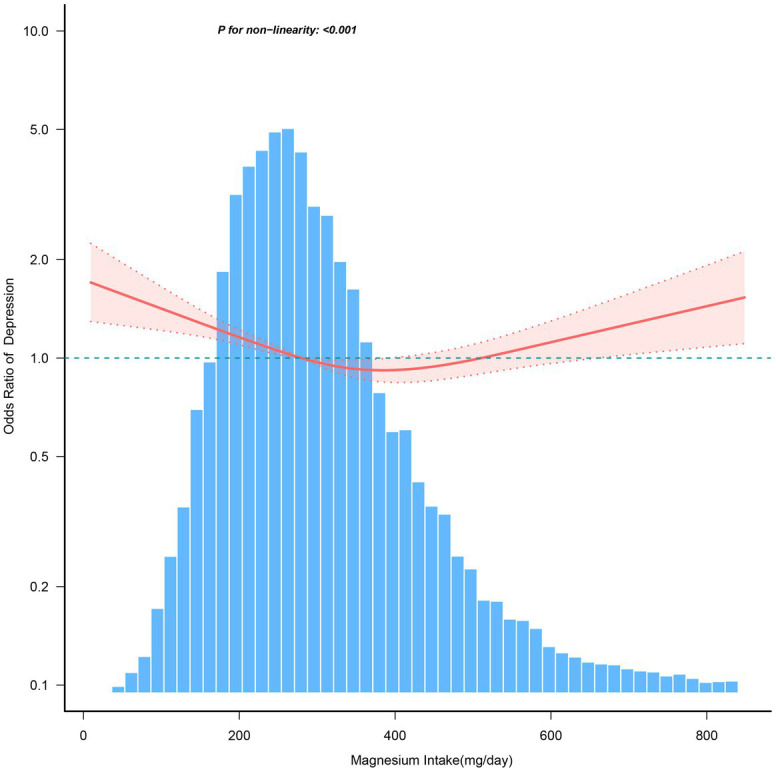
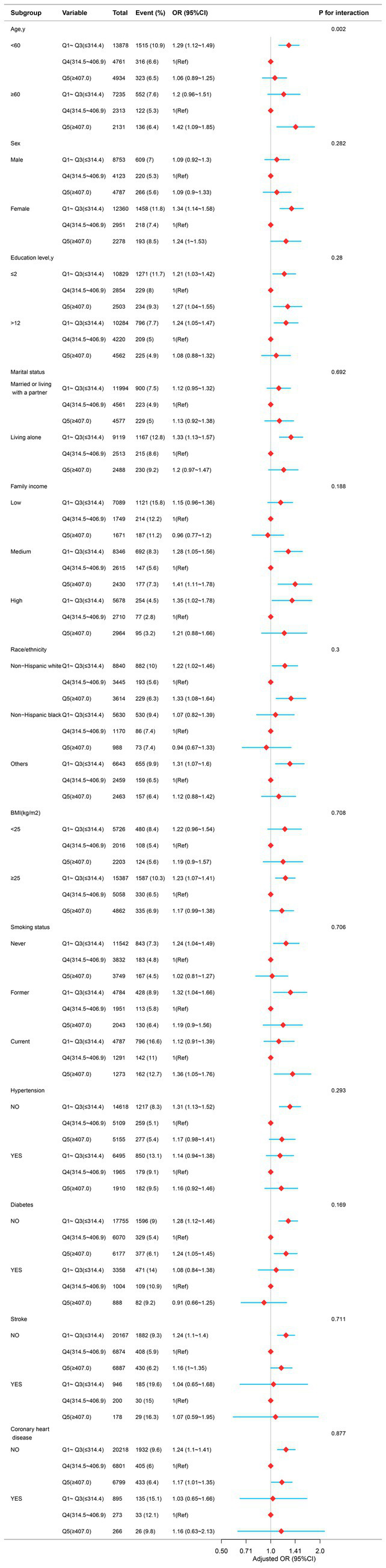
Results: Among 35,252 participants (mean age: 49.5 ± 17.6 years; 49.9% women), we observed a nonlinearity in the relationship between dietary magnesium intake and depression. Below the inflection point (366.7 mg/day), the odds ratio (OR) was 0.998 (95% CI: 0.997-0.999, p < 0.001). Above this point, the OR was 1.001 (95% CI: 1.000-1.002, p = 0.007). In participants aged ≥60 years, the association was inverse L-shaped, with magnesium intake ≥270.7 mg/day increasing depression incidence by 0.1% per 1 mg/d increase.
Conclusion: A nonlinear dose-response relationship exists between dietary magnesium intake and depression risk among US adults. Age significantly moderates this association, suggesting dietary recommendations should be tailored to different age groups.
期刊介绍:
No subject pertains more to human life than nutrition. The aim of Frontiers in Nutrition is to integrate major scientific disciplines in this vast field in order to address the most relevant and pertinent questions and developments. Our ambition is to create an integrated podium based on original research, clinical trials, and contemporary reviews to build a reputable knowledge forum in the domains of human health, dietary behaviors, agronomy & 21st century food science. Through the recognized open-access Frontiers platform we welcome manuscripts to our dedicated sections relating to different areas in the field of nutrition with a focus on human health.
Specialty sections in Frontiers in Nutrition include, for example, Clinical Nutrition, Nutrition & Sustainable Diets, Nutrition and Food Science Technology, Nutrition Methodology, Sport & Exercise Nutrition, Food Chemistry, and Nutritional Immunology. Based on the publication of rigorous scientific research, we thrive to achieve a visible impact on the global nutrition agenda addressing the grand challenges of our time, including obesity, malnutrition, hunger, food waste, sustainability and consumer health.




 京公网安备 11010802042870号
京ICP备2023020795号-1
京公网安备 11010802042870号
京ICP备2023020795号-1

 分享
分享
 求助内容:
求助内容: 应助结果提醒方式:
 扫码关注我们
