{"title":"Learning about causal relations that change over time: primacy and recency over long timeframes in causal judgments and memory.","authors":"Benjamin M Rottman, Yiwen Zhang","doi":"10.1186/s41235-025-00614-9","DOIUrl":null,"url":null,"abstract":"<p><p>Being able to notice that a cause-effect relation is getting stronger or weaker is important for adapting to one's environment and deciding how to use the cause in the future. We conducted an experiment in which participants learned about a cause-effect relation that either got stronger or weaker over time. The experiment was conducted with a typical procedure in which the learning cases were presented rapidly, and with a mobile phone procedure, in which participants experienced the cause-effect relation over 24 days. First, we found that people could detect the change in contingency. They were better at doing so in the artificial short timeframe task, but still could do so in the more realistic long timeframe task. Second, when making summary judgments about the cause-effect relation, participants exhibited a recency effect for most measures in the long timeframe, but did not exhibit a primacy or recency effect in the short timeframe. Third, though participants' episodic memories for individual cause-effect events in the learning sequence were quite poor, they did exhibit primacy and recency effects in the short timeframe; these were attenuated in the long timeframe. These findings raise fundamental questions about causal learning; they suggest that people automatically recognize changes and store representations of the contingency during different phases of learning, but this ability is not predicted by most existing theories of causal learning.</p>","PeriodicalId":46827,"journal":{"name":"Cognitive Research-Principles and Implications","volume":"10 1","pages":"9"},"PeriodicalIF":3.1000,"publicationDate":"2025-02-21","publicationTypes":"Journal Article","fieldsOfStudy":null,"isOpenAccess":false,"openAccessPdf":"https://www.ncbi.nlm.nih.gov/pmc/articles/PMC11845336/pdf/","citationCount":"0","resultStr":null,"platform":"Semanticscholar","paperid":null,"PeriodicalName":"Cognitive Research-Principles and Implications","FirstCategoryId":"102","ListUrlMain":"https://doi.org/10.1186/s41235-025-00614-9","RegionNum":2,"RegionCategory":"心理学","ArticlePicture":[],"TitleCN":null,"AbstractTextCN":null,"PMCID":null,"EPubDate":"","PubModel":"","JCR":"Q1","JCRName":"PSYCHOLOGY, EXPERIMENTAL","Score":null,"Total":0}
引用次数: 0
Abstract
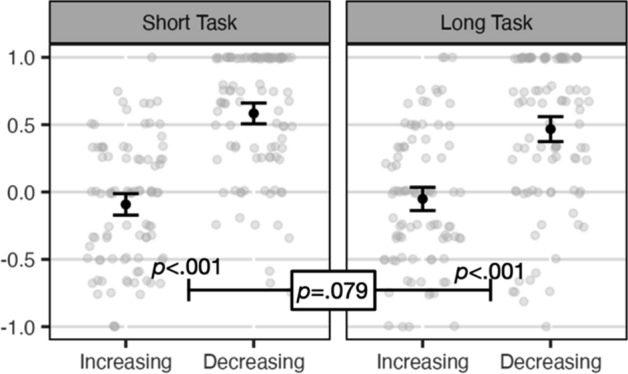
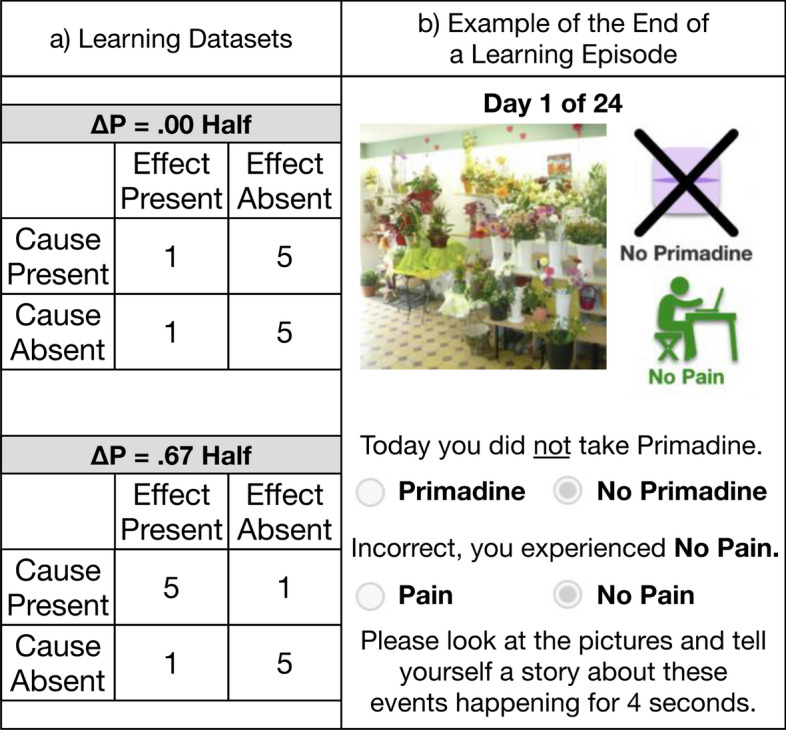
Being able to notice that a cause-effect relation is getting stronger or weaker is important for adapting to one's environment and deciding how to use the cause in the future. We conducted an experiment in which participants learned about a cause-effect relation that either got stronger or weaker over time. The experiment was conducted with a typical procedure in which the learning cases were presented rapidly, and with a mobile phone procedure, in which participants experienced the cause-effect relation over 24 days. First, we found that people could detect the change in contingency. They were better at doing so in the artificial short timeframe task, but still could do so in the more realistic long timeframe task. Second, when making summary judgments about the cause-effect relation, participants exhibited a recency effect for most measures in the long timeframe, but did not exhibit a primacy or recency effect in the short timeframe. Third, though participants' episodic memories for individual cause-effect events in the learning sequence were quite poor, they did exhibit primacy and recency effects in the short timeframe; these were attenuated in the long timeframe. These findings raise fundamental questions about causal learning; they suggest that people automatically recognize changes and store representations of the contingency during different phases of learning, but this ability is not predicted by most existing theories of causal learning.




 京公网安备 11010802042870号
京ICP备2023020795号-1
京公网安备 11010802042870号
京ICP备2023020795号-1

 分享
分享
 求助内容:
求助内容: 应助结果提醒方式:
 扫码关注我们
