{"title":"Comparison of an Emergency Medicine Asynchronous Learning Platform Usage Before and During the COVID-19 Pandemic: Retrospective Analysis Study.","authors":"Blake Briggs, Madhuri Mulekar, Hannah Morales, Iltifat Husain","doi":"10.2196/58100","DOIUrl":null,"url":null,"abstract":"<p><strong>Background: </strong>The COVID-19 pandemic challenged medical educators due to social distancing. Podcasts and asynchronous learning platforms help distill medical education in a socially distanced environment. Medical educators interested in providing asynchronous teaching should know how these methods performed during the pandemic.</p><p><strong>Objective: </strong>The purpose of this study was to assess the level of engagement for an emergency medicine (EM) board review podcast and website platform, before and during the COVID-19 pandemic. We measured engagement via website traffic, including such metrics as visits, bounce rate, unique visitors, and page views. We also evaluated podcast analytics, which included total listeners, engaged listeners, and number of plays.</p><p><strong>Methods: </strong>Content was designed after the American Board of EM Model, covering only 1 review question per episode. Website traffic and podcast analytics were studied monthly from 2 time periods of 20 months each, before the pandemic (July 11, 2018, to February 31, 2020) and during the pandemic (May 1, 2020, to December 31, 2021). March and April 2020 data were omitted from the analysis due to variations in closure at various domestic and international locations. Results underwent statistical analysis in March 2022.</p><p><strong>Results: </strong>A total of 132 podcast episodes and 93 handouts were released from July 11, 2018, to December 31, 2021. The mean number of listeners per podcast increased significantly from 2.11 (SD 1.19) to 3.77 (SD 0.76; t test, P<.001), the mean number engaged per podcast increased from 1.72 (SD 1.00) to 3.09 (SD 0.62; t test, P<.001), and the mean number of plays per podcast increased from 42.54 (SD 40.66) to 69.23 (SD 17.54; t test, P=.012). Similarly, the mean number of visits per posting increased from 5.85 (SD 3.28) to 15.39 (SD 3.06; t test, P<.001), the mean number of unique visitors per posting increased from 3.74 (SD 1.83) to 10.41 (SD 2.33; t test, P<.001), and the mean number of page views per posting increased from 17.13 (SD 10.63) to 33.32 (SD 7.01; t test, P<.001). Note that, all measures showed a decrease from November 2021 to December 2021.</p><p><strong>Conclusions: </strong>During the COVID-19 pandemic, there was an increased engagement for our EM board review podcast and website platform over a long-term period, specifically through website visitors and the number of podcast plays. Medical educators should be aware of the increasing usage of web-based education tools, and that asynchronous learning is favorably viewed by learners. Limitations include the inability to view Spotify (Spotify Technology S.A.) analytics during the study period, and confounding factors like increased popularity of social media inadvertently promoting the podcast.</p>","PeriodicalId":36236,"journal":{"name":"JMIR Medical Education","volume":"11 ","pages":"e58100"},"PeriodicalIF":3.2000,"publicationDate":"2025-02-21","publicationTypes":"Journal Article","fieldsOfStudy":null,"isOpenAccess":false,"openAccessPdf":"https://www.ncbi.nlm.nih.gov/pmc/articles/PMC11870596/pdf/","citationCount":"0","resultStr":null,"platform":"Semanticscholar","paperid":null,"PeriodicalName":"JMIR Medical Education","FirstCategoryId":"1085","ListUrlMain":"https://doi.org/10.2196/58100","RegionNum":0,"RegionCategory":null,"ArticlePicture":[],"TitleCN":null,"AbstractTextCN":null,"PMCID":null,"EPubDate":"","PubModel":"","JCR":"Q1","JCRName":"EDUCATION, SCIENTIFIC DISCIPLINES","Score":null,"Total":0}
引用次数: 0
Abstract
Background: The COVID-19 pandemic challenged medical educators due to social distancing. Podcasts and asynchronous learning platforms help distill medical education in a socially distanced environment. Medical educators interested in providing asynchronous teaching should know how these methods performed during the pandemic.
Objective: The purpose of this study was to assess the level of engagement for an emergency medicine (EM) board review podcast and website platform, before and during the COVID-19 pandemic. We measured engagement via website traffic, including such metrics as visits, bounce rate, unique visitors, and page views. We also evaluated podcast analytics, which included total listeners, engaged listeners, and number of plays.
Methods: Content was designed after the American Board of EM Model, covering only 1 review question per episode. Website traffic and podcast analytics were studied monthly from 2 time periods of 20 months each, before the pandemic (July 11, 2018, to February 31, 2020) and during the pandemic (May 1, 2020, to December 31, 2021). March and April 2020 data were omitted from the analysis due to variations in closure at various domestic and international locations. Results underwent statistical analysis in March 2022.
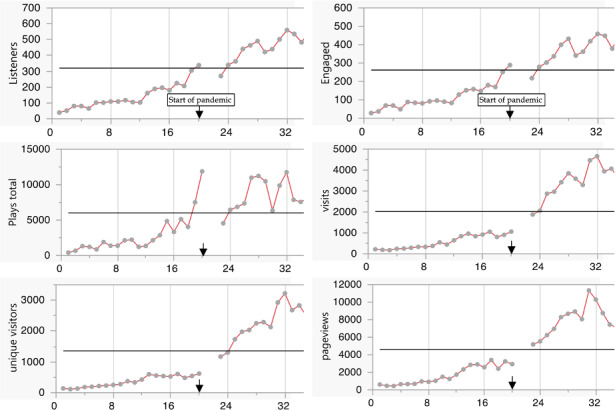
Results: A total of 132 podcast episodes and 93 handouts were released from July 11, 2018, to December 31, 2021. The mean number of listeners per podcast increased significantly from 2.11 (SD 1.19) to 3.77 (SD 0.76; t test, P<.001), the mean number engaged per podcast increased from 1.72 (SD 1.00) to 3.09 (SD 0.62; t test, P<.001), and the mean number of plays per podcast increased from 42.54 (SD 40.66) to 69.23 (SD 17.54; t test, P=.012). Similarly, the mean number of visits per posting increased from 5.85 (SD 3.28) to 15.39 (SD 3.06; t test, P<.001), the mean number of unique visitors per posting increased from 3.74 (SD 1.83) to 10.41 (SD 2.33; t test, P<.001), and the mean number of page views per posting increased from 17.13 (SD 10.63) to 33.32 (SD 7.01; t test, P<.001). Note that, all measures showed a decrease from November 2021 to December 2021.
Conclusions: During the COVID-19 pandemic, there was an increased engagement for our EM board review podcast and website platform over a long-term period, specifically through website visitors and the number of podcast plays. Medical educators should be aware of the increasing usage of web-based education tools, and that asynchronous learning is favorably viewed by learners. Limitations include the inability to view Spotify (Spotify Technology S.A.) analytics during the study period, and confounding factors like increased popularity of social media inadvertently promoting the podcast.




 京公网安备 11010802042870号
京ICP备2023020795号-1
京公网安备 11010802042870号
京ICP备2023020795号-1

 分享
分享
 求助内容:
求助内容: 应助结果提醒方式:
 扫码关注我们
