A L Petrin, L A Machado-Paula, J Romanowska, R T Lie, L Hovey, B Doolittle, W Awotoye, L Dunlay, X J Xie, E Zeng, A Butali, M L Marazita, J C Murray, L M Moreno-Uribe
{"title":"Genetic-epigenetic interactions (meQTLs) in orofacial clefts etiology.","authors":"A L Petrin, L A Machado-Paula, J Romanowska, R T Lie, L Hovey, B Doolittle, W Awotoye, L Dunlay, X J Xie, E Zeng, A Butali, M L Marazita, J C Murray, L M Moreno-Uribe","doi":"10.1101/2025.02.09.25321494","DOIUrl":null,"url":null,"abstract":"<p><strong>Objectives: </strong>Nonsyndromic orofacial clefts (OFCs) involve complex genetic and environmental factors, with over 60 risk loci accounting for only a minority of estimated heritability and residing in non-coding regions with unclear functional relevance. We hypothesize that some genetic variants alter orofacial cleft risk by modifying DNA methylation (DNAm) at regulatory sequences essential for craniofacial development, acting as methylation quantitative trait loci (meQTLs).</p><p><strong>Methods: </strong>We analyzed 10 well-established OFC-associated SNPs against genome-wide DNAm profiles in 409 cases and 456 controls, identifying 23 potential meQTLs. We validated findings using 358 cleft-discordant sibling pairs analyzed with quantitative MethyLight assays. Cross-referencing with the mQTL Database assessed temporal patterns across human development. Functional annotation used GeneHancer and craniofacial enhancer databases.</p><p><strong>Results: </strong>Nine meQTLs were successfully replicated, including the highly significant rs987525 (8q24) - cg16561172 (<i>MYC</i>) association (P = 9.610E-6). This association mapped to a mesendoderm-active enhancer upstream of <i>MYC</i>, providing mechanistic explanation for the longstanding 8q24 cleft locus. Additional validated associations involved <i>MAFB-PLCG1</i>, <i>NOG-PPM1E</i>, <i>FOXE1-FRZB</i>, and <i>SPRY2-LGR4</i> interactions. Independent differential methylation analysis revealed significant differences between discordant siblings at three CpG sites. Cross-referencing confirmed concordance with population-level methylation effects, with childhood representing the critical developmental window for most associations.</p><p><strong>Conclusions: </strong>This systematic meQTL characterization in OFCs demonstrates that genetic variants influence disease risk through epigenetic mechanisms. The 8q24-<i>MYC</i> regulatory pathway evidence provides crucial mechanistic insight into a major OFC risk locus. These findings bridge genetic associations with functional consequences, address missing heritability challenges, and suggest potential biomarkers and therapeutic targets for OFC prevention and treatment.</p>","PeriodicalId":94281,"journal":{"name":"medRxiv : the preprint server for health sciences","volume":" ","pages":""},"PeriodicalIF":0.0000,"publicationDate":"2025-09-17","publicationTypes":"Journal Article","fieldsOfStudy":null,"isOpenAccess":false,"openAccessPdf":"https://www.ncbi.nlm.nih.gov/pmc/articles/PMC11844571/pdf/","citationCount":"0","resultStr":null,"platform":"Semanticscholar","paperid":null,"PeriodicalName":"medRxiv : the preprint server for health sciences","FirstCategoryId":"1085","ListUrlMain":"https://doi.org/10.1101/2025.02.09.25321494","RegionNum":0,"RegionCategory":null,"ArticlePicture":[],"TitleCN":null,"AbstractTextCN":null,"PMCID":null,"EPubDate":"","PubModel":"","JCR":"","JCRName":"","Score":null,"Total":0}
引用次数: 0
Abstract
Objectives: Nonsyndromic orofacial clefts (OFCs) involve complex genetic and environmental factors, with over 60 risk loci accounting for only a minority of estimated heritability and residing in non-coding regions with unclear functional relevance. We hypothesize that some genetic variants alter orofacial cleft risk by modifying DNA methylation (DNAm) at regulatory sequences essential for craniofacial development, acting as methylation quantitative trait loci (meQTLs).
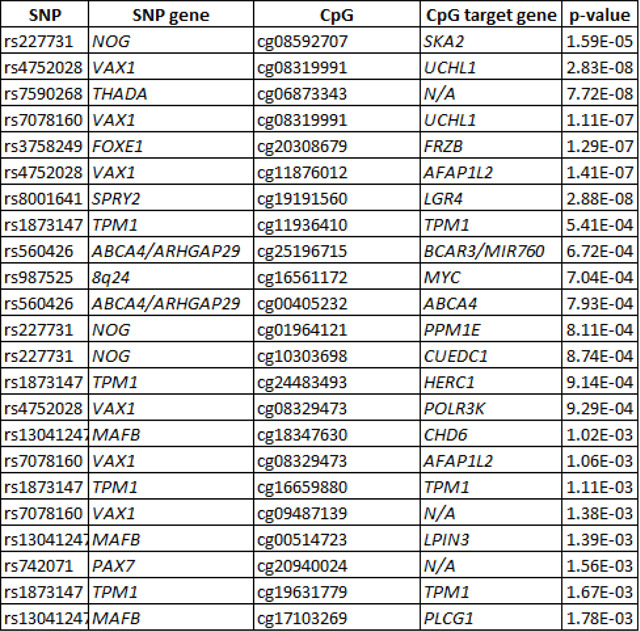
Methods: We analyzed 10 well-established OFC-associated SNPs against genome-wide DNAm profiles in 409 cases and 456 controls, identifying 23 potential meQTLs. We validated findings using 358 cleft-discordant sibling pairs analyzed with quantitative MethyLight assays. Cross-referencing with the mQTL Database assessed temporal patterns across human development. Functional annotation used GeneHancer and craniofacial enhancer databases.
Results: Nine meQTLs were successfully replicated, including the highly significant rs987525 (8q24) - cg16561172 (MYC) association (P = 9.610E-6). This association mapped to a mesendoderm-active enhancer upstream of MYC, providing mechanistic explanation for the longstanding 8q24 cleft locus. Additional validated associations involved MAFB-PLCG1, NOG-PPM1E, FOXE1-FRZB, and SPRY2-LGR4 interactions. Independent differential methylation analysis revealed significant differences between discordant siblings at three CpG sites. Cross-referencing confirmed concordance with population-level methylation effects, with childhood representing the critical developmental window for most associations.
Conclusions: This systematic meQTL characterization in OFCs demonstrates that genetic variants influence disease risk through epigenetic mechanisms. The 8q24-MYC regulatory pathway evidence provides crucial mechanistic insight into a major OFC risk locus. These findings bridge genetic associations with functional consequences, address missing heritability challenges, and suggest potential biomarkers and therapeutic targets for OFC prevention and treatment.



 京公网安备 11010802042870号
京ICP备2023020795号-1
京公网安备 11010802042870号
京ICP备2023020795号-1

 分享
分享

 求助内容:
求助内容: 应助结果提醒方式:
 扫码关注我们
