Anna Manelis, Hang Hu, Skye Satz, Iyengar Satish, Swartz Holly A
{"title":"Distinct White Matter Fiber Density Patterns in Bipolar and Depressive Disorders: Insights from Fixel-Based Analysis.","authors":"Anna Manelis, Hang Hu, Skye Satz, Iyengar Satish, Swartz Holly A","doi":"10.1101/2025.02.19.25322569","DOIUrl":null,"url":null,"abstract":"<p><strong>Background: </strong>Differentiating Bipolar (BD) and depressive (DD) disorders remains challenging in clinical practice due to overlapping symptoms. Our study employs fixel-based analysis (FBA) to examine fiber-specific white matter differences in BD and DD and gain insights into the ability of FBA metrics to predict future spectrum mood symptoms.</p><p><strong>Methods: </strong>163 individuals between 18 and 45 years with BD, DD, and healthy controls (HC) underwent Diffusion Magnetic Resonance Imaging. FBA was used to assess fiber density (FD), fiber cross-section (FC), and fiber density cross-section (FDC) in major white matter tracts. A longitudinal follow-up evaluated whether FBA measures predicted future spectrum depressive and hypomanic symptom trajectories over six months.</p><p><strong>Results: </strong>Direct comparisons between BD and DD indicated lower FD in the right superior longitudinal and uncinate fasciculi and left thalamo-occipital tract in BD versus DD. Individuals with DD exhibited lower FD in the left arcuate fasciculus than those with BD. Compared to HC, both groups showed lower FD in the splenium of the corpus callosum and left striato-occipital and optic radiation tracts. FD in these tracts predicted future spectrum symptom severity. Exploratory analyses revealed associations between FD, medication use, and marijuana exposure.</p><p><strong>Conclusions: </strong>Our findings highlight distinct and overlapping white matter alterations in BD and DD. Furthermore, FD in key tracts may serve as a predictor of future symptom trajectories, supporting the potential clinical utility of FD as a biomarker for mood disorder prognosis. Future longitudinal studies are needed to explore the impact of treatment and disease progression on white matter microstructure.</p>","PeriodicalId":94281,"journal":{"name":"medRxiv : the preprint server for health sciences","volume":" ","pages":""},"PeriodicalIF":0.0000,"publicationDate":"2025-02-23","publicationTypes":"Journal Article","fieldsOfStudy":null,"isOpenAccess":false,"openAccessPdf":"https://www.ncbi.nlm.nih.gov/pmc/articles/PMC11875326/pdf/","citationCount":"0","resultStr":null,"platform":"Semanticscholar","paperid":null,"PeriodicalName":"medRxiv : the preprint server for health sciences","FirstCategoryId":"1085","ListUrlMain":"https://doi.org/10.1101/2025.02.19.25322569","RegionNum":0,"RegionCategory":null,"ArticlePicture":[],"TitleCN":null,"AbstractTextCN":null,"PMCID":null,"EPubDate":"","PubModel":"","JCR":"","JCRName":"","Score":null,"Total":0}
引用次数: 0
Abstract
Background: Differentiating Bipolar (BD) and depressive (DD) disorders remains challenging in clinical practice due to overlapping symptoms. Our study employs fixel-based analysis (FBA) to examine fiber-specific white matter differences in BD and DD and gain insights into the ability of FBA metrics to predict future spectrum mood symptoms.
Methods: 163 individuals between 18 and 45 years with BD, DD, and healthy controls (HC) underwent Diffusion Magnetic Resonance Imaging. FBA was used to assess fiber density (FD), fiber cross-section (FC), and fiber density cross-section (FDC) in major white matter tracts. A longitudinal follow-up evaluated whether FBA measures predicted future spectrum depressive and hypomanic symptom trajectories over six months.
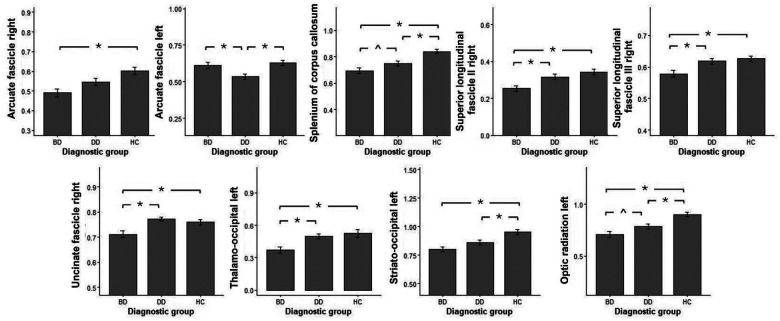
Results: Direct comparisons between BD and DD indicated lower FD in the right superior longitudinal and uncinate fasciculi and left thalamo-occipital tract in BD versus DD. Individuals with DD exhibited lower FD in the left arcuate fasciculus than those with BD. Compared to HC, both groups showed lower FD in the splenium of the corpus callosum and left striato-occipital and optic radiation tracts. FD in these tracts predicted future spectrum symptom severity. Exploratory analyses revealed associations between FD, medication use, and marijuana exposure.
Conclusions: Our findings highlight distinct and overlapping white matter alterations in BD and DD. Furthermore, FD in key tracts may serve as a predictor of future symptom trajectories, supporting the potential clinical utility of FD as a biomarker for mood disorder prognosis. Future longitudinal studies are needed to explore the impact of treatment and disease progression on white matter microstructure.





 京公网安备 11010802042870号
京ICP备2023020795号-1
京公网安备 11010802042870号
京ICP备2023020795号-1

 分享
分享

 求助内容:
求助内容: 应助结果提醒方式:
 扫码关注我们
