David Hein, Alana Christie, Michael Holcomb, Bingqing Xie, A J Jain, Joseph Vento, Neil Rakheja, Ameer Hamza Shakur, Scott Christley, Lindsay G Cowell, James Brugarolas, Andrew Jamieson, Payal Kapur
{"title":"Prompts to Table: Specification and Iterative Refinement for Clinical Information Extraction with Large Language Models.","authors":"David Hein, Alana Christie, Michael Holcomb, Bingqing Xie, A J Jain, Joseph Vento, Neil Rakheja, Ameer Hamza Shakur, Scott Christley, Lindsay G Cowell, James Brugarolas, Andrew Jamieson, Payal Kapur","doi":"10.1101/2025.02.11.25322107","DOIUrl":null,"url":null,"abstract":"<p><p>Extracting structured data from free-text medical records at scale is laborious, and traditional approaches struggle in complex clinical domains. We present a novel, end-to-end pipeline leveraging large language models (LLMs) for highly accurate information extraction and normalization from unstructured pathology reports, focusing initially on kidney tumors. Our innovation combines flexible prompt templates, the direct production of analysis-ready tabular data, and a rigorous, human-in-the-loop iterative refinement process guided by a comprehensive error ontology. Applying the finalized pipeline to 2,297 kidney tumor reports with pre-existing templated data available for validation yielded a macro-averaged F1 of 0.99 for six kidney tumor subtypes and 0.97 for detecting kidney metastasis. We further demonstrate flexibility with multiple LLM backbones and adaptability to new domains utilizing publicly available breast and prostate cancer reports. Beyond performance metrics or pipeline specifics, we emphasize the critical importance of task definition, interdisciplinary collaboration, and complexity management in LLM-based clinical workflows.</p>","PeriodicalId":94281,"journal":{"name":"medRxiv : the preprint server for health sciences","volume":" ","pages":""},"PeriodicalIF":0.0000,"publicationDate":"2025-04-01","publicationTypes":"Journal Article","fieldsOfStudy":null,"isOpenAccess":false,"openAccessPdf":"https://www.ncbi.nlm.nih.gov/pmc/articles/PMC11844613/pdf/","citationCount":"0","resultStr":null,"platform":"Semanticscholar","paperid":null,"PeriodicalName":"medRxiv : the preprint server for health sciences","FirstCategoryId":"1085","ListUrlMain":"https://doi.org/10.1101/2025.02.11.25322107","RegionNum":0,"RegionCategory":null,"ArticlePicture":[],"TitleCN":null,"AbstractTextCN":null,"PMCID":null,"EPubDate":"","PubModel":"","JCR":"","JCRName":"","Score":null,"Total":0}
引用次数: 0
Abstract
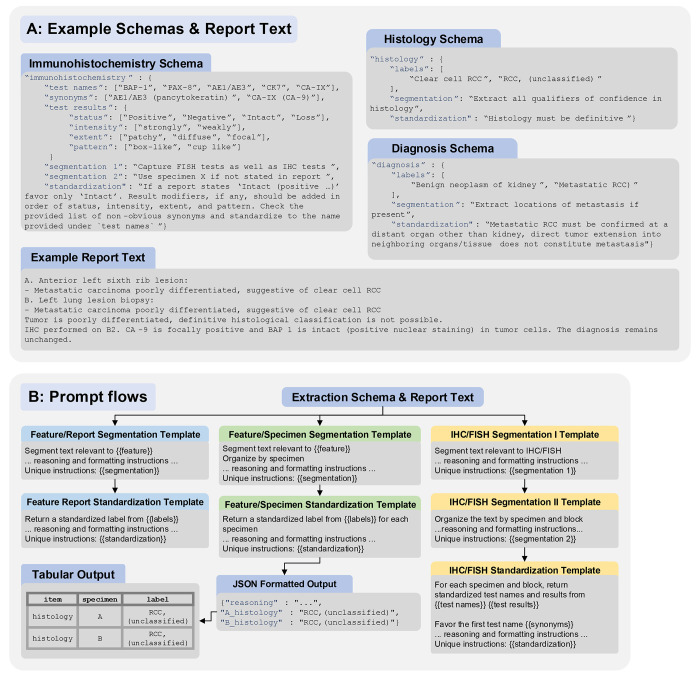
Extracting structured data from free-text medical records at scale is laborious, and traditional approaches struggle in complex clinical domains. We present a novel, end-to-end pipeline leveraging large language models (LLMs) for highly accurate information extraction and normalization from unstructured pathology reports, focusing initially on kidney tumors. Our innovation combines flexible prompt templates, the direct production of analysis-ready tabular data, and a rigorous, human-in-the-loop iterative refinement process guided by a comprehensive error ontology. Applying the finalized pipeline to 2,297 kidney tumor reports with pre-existing templated data available for validation yielded a macro-averaged F1 of 0.99 for six kidney tumor subtypes and 0.97 for detecting kidney metastasis. We further demonstrate flexibility with multiple LLM backbones and adaptability to new domains utilizing publicly available breast and prostate cancer reports. Beyond performance metrics or pipeline specifics, we emphasize the critical importance of task definition, interdisciplinary collaboration, and complexity management in LLM-based clinical workflows.





 京公网安备 11010802042870号
京ICP备2023020795号-1
京公网安备 11010802042870号
京ICP备2023020795号-1

 分享
分享

 求助内容:
求助内容: 应助结果提醒方式:
 扫码关注我们
