Edward Kerwin, Ting Yang, Nan Su, Jiawang Guo, Radha Adivikolanu, Malinda Longphre, Junying Wang, Jili Yun, Wuban Pan, Zheng Wei, Raúl Collazo
{"title":"Rademikibart Treatment for Moderate-to-Severe Uncontrolled Asthma: A Phase 2B Randomized Clinical Trial.","authors":"Edward Kerwin, Ting Yang, Nan Su, Jiawang Guo, Radha Adivikolanu, Malinda Longphre, Junying Wang, Jili Yun, Wuban Pan, Zheng Wei, Raúl Collazo","doi":"10.1164/rccm.202409-1708OC","DOIUrl":null,"url":null,"abstract":"<p><p><b>Rationale:</b> Rademikibart (formerly CBP-201) is an IL-4Rα-targeting antibody. <b>Objectives:</b> We sought to evaluate rademikibart in adults with moderate-to-severe, persistent, uncontrolled asthma. <b>Methods:</b> In this global Phase 2b trial, 322 patients were randomized 1:1:1 to two rademikibart groups (150 mg or 300 mg every other week, after a 600-mg loading dose) or a placebo group; rademikibart or placebo was administered subcutaneously for 24 weeks. <b>Measurements and Main Results:</b> Prebronchodilator (trough) forced expiratory volume in 1 second (FEV<sub>1</sub>) at Week 12 (primary endpoint) improved with rademikibart at 150 mg and 300 mg: Least squares mean changes (95% confidence interval), above placebo, were 140 ml (44-236 ml; <i>P</i> = 0.005) and 189 ml (92-286 ml; <i>P</i> < 0.001), respectively. Prebronchodilator (trough) FEV<sub>1</sub> improvements occurred rapidly during Week 1, were sustained through Week 24, and were greatest in patients with high baseline blood eosinophils (patients with ⩾300 eosinophils/ml experienced placebo-adjusted FEV<sub>1</sub> improvement at Week 24 of 420 ml [95% confidence interval = 239-600 ml] in the 300-mg group). Rapid and sustained statistically significant improvements were also observed in percent predicted FEV<sub>1</sub> and Asthma Control Questionnaire score across 24 weeks. Through Week 24, proportions of patients with one or more exacerbations were 7.5% (150 mg) and 9.3% (300 mg) versus 16.7% (placebo). Eighty-eight percent of patients completed treatment. Treatment-emergent adverse events were generally similar to placebo, and no eosinophilia was observed. Injection site reactions were mostly mild. The most common treatment-emergent adverse events (10-12% of patients) were cough, coronavirus disease (COVID-19), and dyspnea. <b>Conclusions:</b> Rapid and sustained improvements in lung function and asthma control were gained across 24 weeks of rademikibart therapy. Clinical trial registered with www.clinicaltrials.gov (NCT04773678).</p>","PeriodicalId":7664,"journal":{"name":"American journal of respiratory and critical care medicine","volume":" ","pages":"749-758"},"PeriodicalIF":21.7000,"publicationDate":"2025-05-01","publicationTypes":"Journal Article","fieldsOfStudy":null,"isOpenAccess":false,"openAccessPdf":"https://www.ncbi.nlm.nih.gov/pmc/articles/PMC12091008/pdf/","citationCount":"0","resultStr":null,"platform":"Semanticscholar","paperid":null,"PeriodicalName":"American journal of respiratory and critical care medicine","FirstCategoryId":"3","ListUrlMain":"https://doi.org/10.1164/rccm.202409-1708OC","RegionNum":1,"RegionCategory":"医学","ArticlePicture":[],"TitleCN":null,"AbstractTextCN":null,"PMCID":null,"EPubDate":"","PubModel":"","JCR":"Q1","JCRName":"CRITICAL CARE MEDICINE","Score":null,"Total":0}
引用次数: 0
Abstract
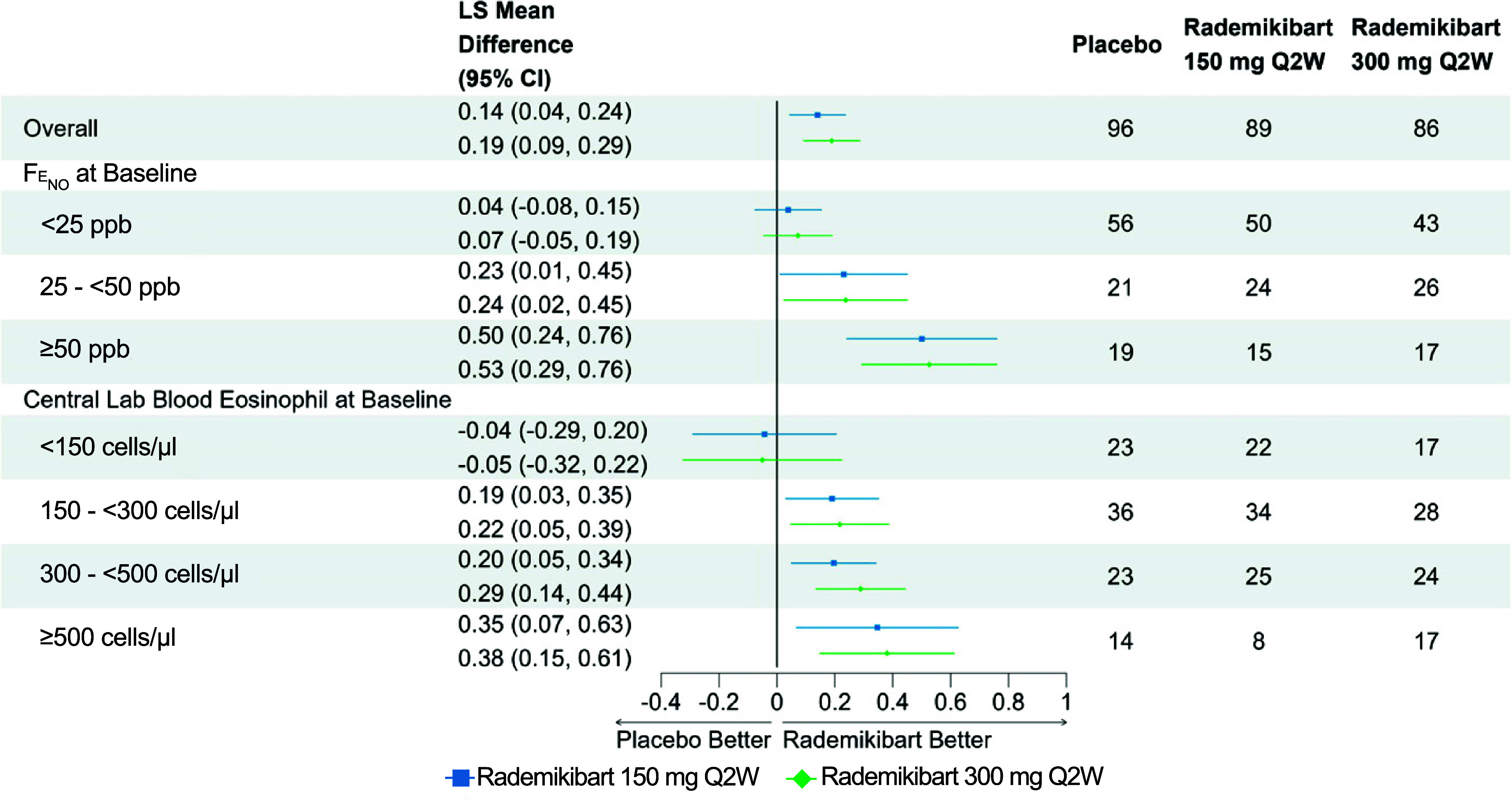
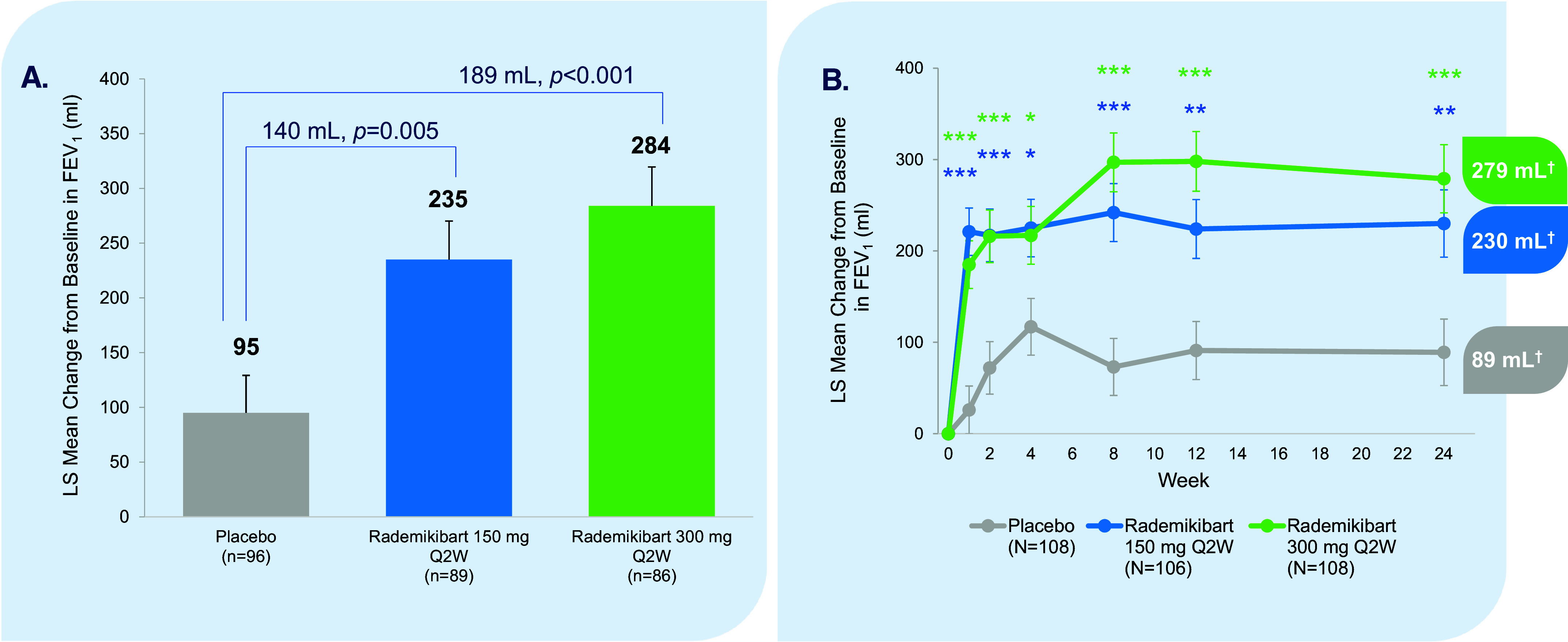
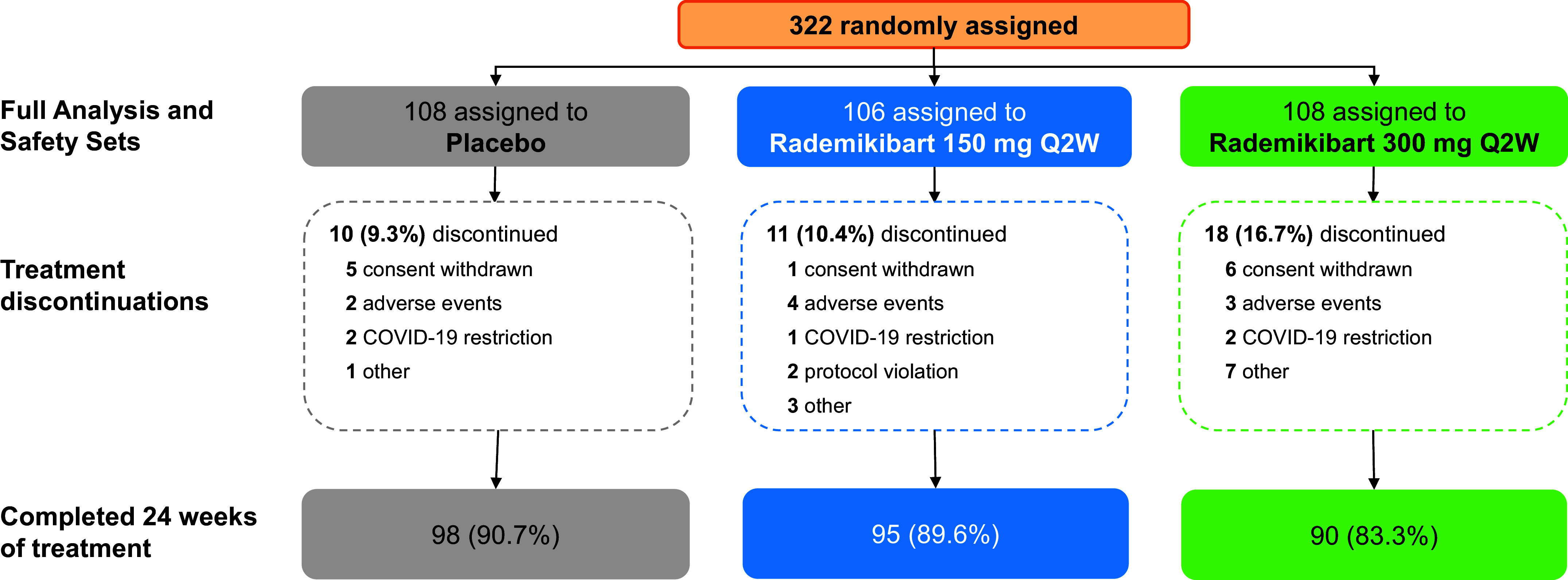
Rationale: Rademikibart (formerly CBP-201) is an IL-4Rα-targeting antibody. Objectives: We sought to evaluate rademikibart in adults with moderate-to-severe, persistent, uncontrolled asthma. Methods: In this global Phase 2b trial, 322 patients were randomized 1:1:1 to two rademikibart groups (150 mg or 300 mg every other week, after a 600-mg loading dose) or a placebo group; rademikibart or placebo was administered subcutaneously for 24 weeks. Measurements and Main Results: Prebronchodilator (trough) forced expiratory volume in 1 second (FEV1) at Week 12 (primary endpoint) improved with rademikibart at 150 mg and 300 mg: Least squares mean changes (95% confidence interval), above placebo, were 140 ml (44-236 ml; P = 0.005) and 189 ml (92-286 ml; P < 0.001), respectively. Prebronchodilator (trough) FEV1 improvements occurred rapidly during Week 1, were sustained through Week 24, and were greatest in patients with high baseline blood eosinophils (patients with ⩾300 eosinophils/ml experienced placebo-adjusted FEV1 improvement at Week 24 of 420 ml [95% confidence interval = 239-600 ml] in the 300-mg group). Rapid and sustained statistically significant improvements were also observed in percent predicted FEV1 and Asthma Control Questionnaire score across 24 weeks. Through Week 24, proportions of patients with one or more exacerbations were 7.5% (150 mg) and 9.3% (300 mg) versus 16.7% (placebo). Eighty-eight percent of patients completed treatment. Treatment-emergent adverse events were generally similar to placebo, and no eosinophilia was observed. Injection site reactions were mostly mild. The most common treatment-emergent adverse events (10-12% of patients) were cough, coronavirus disease (COVID-19), and dyspnea. Conclusions: Rapid and sustained improvements in lung function and asthma control were gained across 24 weeks of rademikibart therapy. Clinical trial registered with www.clinicaltrials.gov (NCT04773678).
期刊介绍:
The American Journal of Respiratory and Critical Care Medicine focuses on human biology and disease, as well as animal studies that contribute to the understanding of pathophysiology and treatment of diseases that affect the respiratory system and critically ill patients. Papers that are solely or predominantly based in cell and molecular biology are published in the companion journal, the American Journal of Respiratory Cell and Molecular Biology. The Journal also seeks to publish clinical trials and outstanding review articles on areas of interest in several forms. The State-of-the-Art review is a treatise usually covering a broad field that brings bench research to the bedside. Shorter reviews are published as Critical Care Perspectives or Pulmonary Perspectives. These are generally focused on a more limited area and advance a concerted opinion about care for a specific process. Concise Clinical Reviews provide an evidence-based synthesis of the literature pertaining to topics of fundamental importance to the practice of pulmonary, critical care, and sleep medicine. Images providing advances or unusual contributions to the field are published as Images in Pulmonary, Critical Care, Sleep Medicine and the Sciences.
A recent trend and future direction of the Journal has been to include debates of a topical nature on issues of importance in pulmonary and critical care medicine and to the membership of the American Thoracic Society. Other recent changes have included encompassing works from the field of critical care medicine and the extension of the editorial governing of journal policy to colleagues outside of the United States of America. The focus and direction of the Journal is to establish an international forum for state-of-the-art respiratory and critical care medicine.




 京公网安备 11010802042870号
京ICP备2023020795号-1
京公网安备 11010802042870号
京ICP备2023020795号-1

 分享
分享
 求助内容:
求助内容: 应助结果提醒方式:
 扫码关注我们
