The development and application of performance indicators to assess veterinarians' adherence to the clinical practice Streptococcus suis in weaned pigs guideline.
Isaura Y A Wayop, Jaap A Wagenaar, Emely de Vet, Anke Lambooij, David C Speksnijder
{"title":"The development and application of performance indicators to assess veterinarians' adherence to the clinical practice Streptococcus suis in weaned pigs guideline.","authors":"Isaura Y A Wayop, Jaap A Wagenaar, Emely de Vet, Anke Lambooij, David C Speksnijder","doi":"10.1186/s12917-025-04550-0","DOIUrl":null,"url":null,"abstract":"<p><strong>Background: </strong>To combat antimicrobial resistance, initiatives have been launched worldwide to reduce antimicrobial use in humans and animals. In the Netherlands, the pig industry has made significant strides in reducing antimicrobial use, yet considerable variation exists in usage and prescription of antimicrobials between different swine farms and swine veterinarians. Clinical practice guidelines have been developed to support veterinarians to further reduce prescription of antimicrobials. In 2014, the Streptococcus suis (S. suis) clinical practice guideline was introduced. To date, no information has been collected about the extent to which veterinarians were using this guideline. Therefore, we developed performance indicators involving a six-step approach using a modified RAND/UCLA method aimed at assessing veterinarians' adherence to the S. suis guideline. To support our results and to provide a more comprehensive understanding, we developed and circulated a questionnaire. The performance indicators and questionnaire were completed by 33 active swine veterinarians.</p><p><strong>Results: </strong>The final set of five performance indicators encompassed antimicrobial use, the ratio 1st to 2nd or 3rd choice antimicrobials, the argumentation for using 2nd choice antimicrobials, bacteriological examination including susceptibility testing, and the use of corticosteroids. In the questionnaire, 16 questions were included about veterinarians' behavior linked to these five performance indicators. The results revealed a wide range in antimicrobial prescription among veterinarians dealing with S. suis-related issues on farms, suggesting that further improvement of antimicrobial stewardship is possible. Our findings show a discrepancy between the performance indicators based on observed data and veterinarians' self-reported behaviors, particularly concerning the initiation of group treatments and the possibility that the advice provided by veterinarians may not always be consistently implemented in practice.</p><p><strong>Conclusions: </strong>The developed performance indicators on their own may not adequately reflect veterinarians' adherence to the guideline, but collectively, they serve as a reliable indicator of adherence. By generating reliable and accurate outcomes, they complement self-reported behavior, which may be subject to unconscious self-report biases. Therefore, performance indicators are essential for use in intervention programs to measure veterinarians' guideline adherence and should be incorporated into the development process of all clinical veterinary guidelines.</p>","PeriodicalId":9041,"journal":{"name":"BMC Veterinary Research","volume":"21 1","pages":"101"},"PeriodicalIF":2.6000,"publicationDate":"2025-02-25","publicationTypes":"Journal Article","fieldsOfStudy":null,"isOpenAccess":false,"openAccessPdf":"https://www.ncbi.nlm.nih.gov/pmc/articles/PMC11854134/pdf/","citationCount":"0","resultStr":null,"platform":"Semanticscholar","paperid":null,"PeriodicalName":"BMC Veterinary Research","FirstCategoryId":"97","ListUrlMain":"https://doi.org/10.1186/s12917-025-04550-0","RegionNum":2,"RegionCategory":"农林科学","ArticlePicture":[],"TitleCN":null,"AbstractTextCN":null,"PMCID":null,"EPubDate":"","PubModel":"","JCR":"Q1","JCRName":"VETERINARY SCIENCES","Score":null,"Total":0}
引用次数: 0
Abstract
Background: To combat antimicrobial resistance, initiatives have been launched worldwide to reduce antimicrobial use in humans and animals. In the Netherlands, the pig industry has made significant strides in reducing antimicrobial use, yet considerable variation exists in usage and prescription of antimicrobials between different swine farms and swine veterinarians. Clinical practice guidelines have been developed to support veterinarians to further reduce prescription of antimicrobials. In 2014, the Streptococcus suis (S. suis) clinical practice guideline was introduced. To date, no information has been collected about the extent to which veterinarians were using this guideline. Therefore, we developed performance indicators involving a six-step approach using a modified RAND/UCLA method aimed at assessing veterinarians' adherence to the S. suis guideline. To support our results and to provide a more comprehensive understanding, we developed and circulated a questionnaire. The performance indicators and questionnaire were completed by 33 active swine veterinarians.
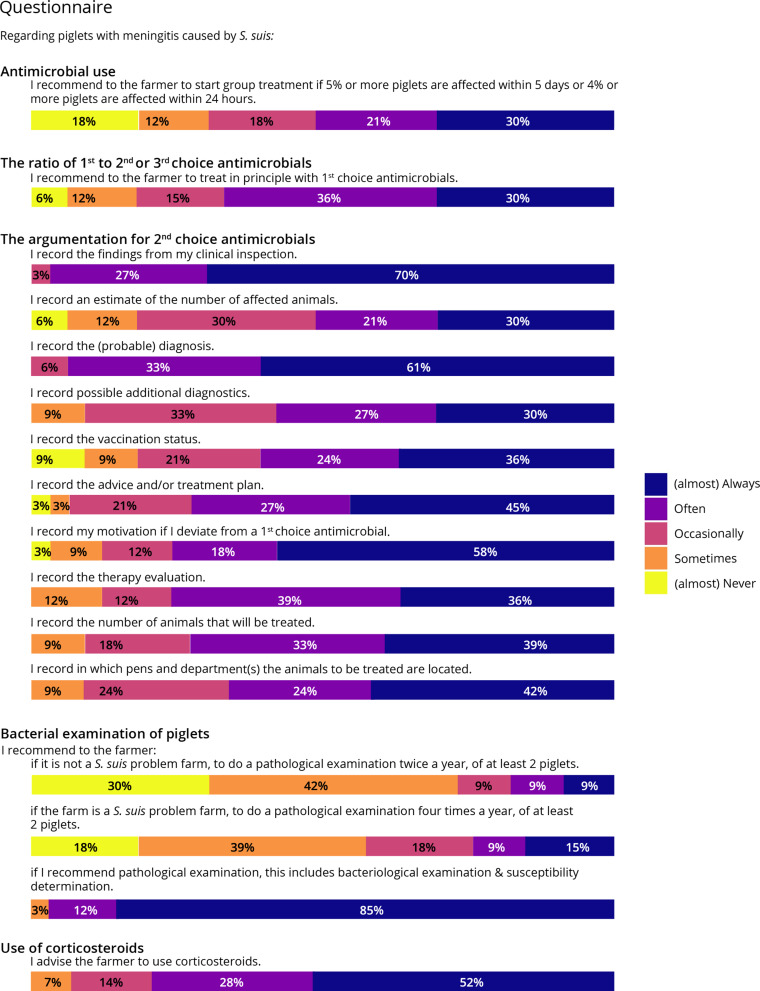
Results: The final set of five performance indicators encompassed antimicrobial use, the ratio 1st to 2nd or 3rd choice antimicrobials, the argumentation for using 2nd choice antimicrobials, bacteriological examination including susceptibility testing, and the use of corticosteroids. In the questionnaire, 16 questions were included about veterinarians' behavior linked to these five performance indicators. The results revealed a wide range in antimicrobial prescription among veterinarians dealing with S. suis-related issues on farms, suggesting that further improvement of antimicrobial stewardship is possible. Our findings show a discrepancy between the performance indicators based on observed data and veterinarians' self-reported behaviors, particularly concerning the initiation of group treatments and the possibility that the advice provided by veterinarians may not always be consistently implemented in practice.
Conclusions: The developed performance indicators on their own may not adequately reflect veterinarians' adherence to the guideline, but collectively, they serve as a reliable indicator of adherence. By generating reliable and accurate outcomes, they complement self-reported behavior, which may be subject to unconscious self-report biases. Therefore, performance indicators are essential for use in intervention programs to measure veterinarians' guideline adherence and should be incorporated into the development process of all clinical veterinary guidelines.
期刊介绍:
BMC Veterinary Research is an open access, peer-reviewed journal that considers articles on all aspects of veterinary science and medicine, including the epidemiology, diagnosis, prevention and treatment of medical conditions of domestic, companion, farm and wild animals, as well as the biomedical processes that underlie their health.





 京公网安备 11010802042870号
京ICP备2023020795号-1
京公网安备 11010802042870号
京ICP备2023020795号-1

 分享
分享
 求助内容:
求助内容: 应助结果提醒方式:
 扫码关注我们
