Guohui Zhao, Cheng Ge, Wenzheng Han, Rilei Yu, Hao Liu
{"title":"ConoGPT: Fine-Tuning a Protein Language Model by Incorporating Disulfide Bond Information for Conotoxin Sequence Generation.","authors":"Guohui Zhao, Cheng Ge, Wenzheng Han, Rilei Yu, Hao Liu","doi":"10.3390/toxins17020093","DOIUrl":null,"url":null,"abstract":"<p><p>Conotoxins are a class of peptide toxins secreted by marine mollusks of the Conus genus, characterized by their unique mechanism of action and significant biological activity, making them highly valuable for drug development. However, traditional methods of acquiring conotoxins, such as in vivo extraction or chemical synthesis, face challenges of high costs, long cycles, and limited exploration of sequence diversity. To address these issues, we propose the ConoGPT model, a conotoxin sequence generation model that fine-tunes the ProtGPT2 model by incorporating disulfide bond information. Experimental results demonstrate that sequences generated by ConoGPT exhibit high consistency with authentic conotoxins in physicochemical properties and show considerable potential for generating novel conotoxins. Furthermore, compared to models without disulfide bond information, ConoGPT outperforms in terms of generating sequences with ordered structures. The majority of the filtered sequences were shown to possess significant binding affinities to nicotinic acetylcholine receptor (nAChR) targets based on molecular docking. Molecular dynamics simulations of the selected sequences further confirmed the dynamic stability of the generated sequences in complex with their respective targets. This study not only provides a new technological approach for conotoxin design but also offers a novel strategy for generating functional peptides.</p>","PeriodicalId":23119,"journal":{"name":"Toxins","volume":"17 2","pages":""},"PeriodicalIF":4.0000,"publicationDate":"2025-02-17","publicationTypes":"Journal Article","fieldsOfStudy":null,"isOpenAccess":false,"openAccessPdf":"https://www.ncbi.nlm.nih.gov/pmc/articles/PMC11860916/pdf/","citationCount":"0","resultStr":null,"platform":"Semanticscholar","paperid":null,"PeriodicalName":"Toxins","FirstCategoryId":"3","ListUrlMain":"https://doi.org/10.3390/toxins17020093","RegionNum":3,"RegionCategory":"医学","ArticlePicture":[],"TitleCN":null,"AbstractTextCN":null,"PMCID":null,"EPubDate":"","PubModel":"","JCR":"Q2","JCRName":"FOOD SCIENCE & TECHNOLOGY","Score":null,"Total":0}
引用次数: 0
Abstract
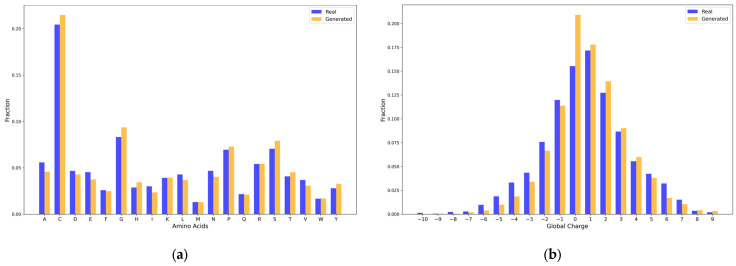
Conotoxins are a class of peptide toxins secreted by marine mollusks of the Conus genus, characterized by their unique mechanism of action and significant biological activity, making them highly valuable for drug development. However, traditional methods of acquiring conotoxins, such as in vivo extraction or chemical synthesis, face challenges of high costs, long cycles, and limited exploration of sequence diversity. To address these issues, we propose the ConoGPT model, a conotoxin sequence generation model that fine-tunes the ProtGPT2 model by incorporating disulfide bond information. Experimental results demonstrate that sequences generated by ConoGPT exhibit high consistency with authentic conotoxins in physicochemical properties and show considerable potential for generating novel conotoxins. Furthermore, compared to models without disulfide bond information, ConoGPT outperforms in terms of generating sequences with ordered structures. The majority of the filtered sequences were shown to possess significant binding affinities to nicotinic acetylcholine receptor (nAChR) targets based on molecular docking. Molecular dynamics simulations of the selected sequences further confirmed the dynamic stability of the generated sequences in complex with their respective targets. This study not only provides a new technological approach for conotoxin design but also offers a novel strategy for generating functional peptides.
期刊介绍:
Toxins (ISSN 2072-6651) is an international, peer-reviewed open access journal which provides an advanced forum for studies related to toxins and toxinology. It publishes reviews, regular research papers and short communications. Our aim is to encourage scientists to publish their experimental and theoretical results in as much detail as possible. There is no restriction on the length of the papers. The full experimental details must be provided so that the results can be reproduced.





 京公网安备 11010802042870号
京ICP备2023020795号-1
京公网安备 11010802042870号
京ICP备2023020795号-1

 分享
分享
 求助内容:
求助内容: 应助结果提醒方式:
 扫码关注我们
