Wenkui Dong , Zaihua Duan , Shuhua Peng , Yuan Chen , Dewei Chu , Huiling Tai , Wengui Li
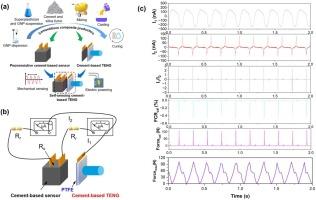
{"title":"Triboelectric nanogenerator-powering piezoresistive cement-based sensors for energy harvesting and structural health monitoring","authors":"Wenkui Dong , Zaihua Duan , Shuhua Peng , Yuan Chen , Dewei Chu , Huiling Tai , Wengui Li","doi":"10.1016/j.nanoen.2025.110823","DOIUrl":null,"url":null,"abstract":"<div><div>Piezoresistive cement-based pressure sensors can detect traffic flow and structural changes in concrete structures. However, their reliance on significant external energy inputs limits practical adoption. This study develops an integrated cement-based device that implies a cement-based triboelectric nanogenerator (TENG) to harvest mechanical energy and power the piezoresistive cement-based sensor through a specially designed circuit, enabling electrical resistance monitoring under external mechanical loads. The device determines the fractional changes of resistivity (FCR) by analysing current changes in two separate branches. The optimized 1.0 wt% graphene nanoplates (GNP) incorporated into cementitious composites enhance electrical conductivity and the dielectric constant, while excessive GNP reduces impedance and dielectric properties. The resulting TENG achieves a short-circuit current of 7.0 µA and a peak-to-peak open-circuit voltage of 330 V. The piezoresistive sensor exhibits repeatable, reversible, and sensitive performance under high-range static and low-range dynamic loads. The force and FCR measurements recorded by the integrated device under various mechanical stimulations closely match the calculated results. This work advances the development of self-powering cement-based sensors without external energy inputs for traffic condition detection and structural health monitoring.</div></div>","PeriodicalId":394,"journal":{"name":"Nano Energy","volume":"137 ","pages":"Article 110823"},"PeriodicalIF":17.1000,"publicationDate":"2025-05-01","publicationTypes":"Journal Article","fieldsOfStudy":null,"isOpenAccess":false,"openAccessPdf":"","citationCount":"0","resultStr":null,"platform":"Semanticscholar","paperid":null,"PeriodicalName":"Nano Energy","FirstCategoryId":"88","ListUrlMain":"https://www.sciencedirect.com/science/article/pii/S221128552500182X","RegionNum":1,"RegionCategory":"材料科学","ArticlePicture":[],"TitleCN":null,"AbstractTextCN":null,"PMCID":null,"EPubDate":"2025/2/25 0:00:00","PubModel":"Epub","JCR":"Q1","JCRName":"CHEMISTRY, PHYSICAL","Score":null,"Total":0}
引用次数: 0
Abstract
Piezoresistive cement-based pressure sensors can detect traffic flow and structural changes in concrete structures. However, their reliance on significant external energy inputs limits practical adoption. This study develops an integrated cement-based device that implies a cement-based triboelectric nanogenerator (TENG) to harvest mechanical energy and power the piezoresistive cement-based sensor through a specially designed circuit, enabling electrical resistance monitoring under external mechanical loads. The device determines the fractional changes of resistivity (FCR) by analysing current changes in two separate branches. The optimized 1.0 wt% graphene nanoplates (GNP) incorporated into cementitious composites enhance electrical conductivity and the dielectric constant, while excessive GNP reduces impedance and dielectric properties. The resulting TENG achieves a short-circuit current of 7.0 µA and a peak-to-peak open-circuit voltage of 330 V. The piezoresistive sensor exhibits repeatable, reversible, and sensitive performance under high-range static and low-range dynamic loads. The force and FCR measurements recorded by the integrated device under various mechanical stimulations closely match the calculated results. This work advances the development of self-powering cement-based sensors without external energy inputs for traffic condition detection and structural health monitoring.
期刊介绍:
Nano Energy is a multidisciplinary, rapid-publication forum of original peer-reviewed contributions on the science and engineering of nanomaterials and nanodevices used in all forms of energy harvesting, conversion, storage, utilization and policy. Through its mixture of articles, reviews, communications, research news, and information on key developments, Nano Energy provides a comprehensive coverage of this exciting and dynamic field which joins nanoscience and nanotechnology with energy science. The journal is relevant to all those who are interested in nanomaterials solutions to the energy problem.
Nano Energy publishes original experimental and theoretical research on all aspects of energy-related research which utilizes nanomaterials and nanotechnology. Manuscripts of four types are considered: review articles which inform readers of the latest research and advances in energy science; rapid communications which feature exciting research breakthroughs in the field; full-length articles which report comprehensive research developments; and news and opinions which comment on topical issues or express views on the developments in related fields.



 京公网安备 11010802042870号
京ICP备2023020795号-1
京公网安备 11010802042870号
京ICP备2023020795号-1

 分享
分享
 求助内容:
求助内容: 应助结果提醒方式:
 扫码关注我们
