Yabo Li , Lili Wang , Emayavaramban Indubala , Chao Ma , Chun Li , Luming Xiao , Bo Lv , Shanshan Yao
{"title":"Highly dispersed CuO nanoparticles embedded within porous nitrogen doped carbon as effective electrocatalyst for lithium sulfur batteries","authors":"Yabo Li , Lili Wang , Emayavaramban Indubala , Chao Ma , Chun Li , Luming Xiao , Bo Lv , Shanshan Yao","doi":"10.1016/j.electacta.2025.145936","DOIUrl":null,"url":null,"abstract":"<div><div>Lithium sulfur batteries face several challenges, including significant volumetric expansion during cycling, slow kinetics of sulfur redox reactions, and the shuttle effect of solubility lithium polysulfides. Polar metal oxides, due to their hydrophilic surface, can effectively adsorb polysulfides, facilitating their confinement and reducing their mobility, which helps to mitigate the shuttle effect. In this study, CuO nanoparticles embedded within porous nitrogen-doped porous carbon (CuO@NC) composite with a high specific surface area of 865.68 m<sup>2</sup> g<sup>-1</sup> are successfully synthesized without use of additional template. The CuO@NC composite enables the synergy between the physical adsorption provided by the porous carbon framework and the chemical adsorption-catalysis of CuO, thereby enhancing polysulfide immobilization and improving electrochemical performance. Cells fabricated with CuO@NC modified separator show a high specific capacity of 969.8 mAh g<sup>-1</sup> at 0.5 C, excellent rate capability (937.9 mAh g<sup>-1</sup> at 1 C), and a stable capacity of 793.2 mAh g<sup>-1</sup> after 200 cycles with a low decay rate of 0.09 % per cycle. Furthermore, the CuO@NC modified separator maintains a discharge capacity of 725.6 mAh g<sup>-1</sup> at -10 °C. Even with sulfur loading up to 5.6 mg cm<sup>-2</sup>, it can still exhibit remarkable cycling stability. This study demonstrates the design of metal oxides-decorated porous heteroatoms doped carbon materials as an effective strategy for fabricating highly functional separator that inhibit the polysulfides shuttle effect.</div></div>","PeriodicalId":305,"journal":{"name":"Electrochimica Acta","volume":"521 ","pages":"Article 145936"},"PeriodicalIF":5.6000,"publicationDate":"2025-05-01","publicationTypes":"Journal Article","fieldsOfStudy":null,"isOpenAccess":false,"openAccessPdf":"","citationCount":"0","resultStr":null,"platform":"Semanticscholar","paperid":null,"PeriodicalName":"Electrochimica Acta","FirstCategoryId":"88","ListUrlMain":"https://www.sciencedirect.com/science/article/pii/S0013468625002993","RegionNum":3,"RegionCategory":"材料科学","ArticlePicture":[],"TitleCN":null,"AbstractTextCN":null,"PMCID":null,"EPubDate":"2025/2/25 0:00:00","PubModel":"Epub","JCR":"Q1","JCRName":"ELECTROCHEMISTRY","Score":null,"Total":0}
引用次数: 0
Abstract
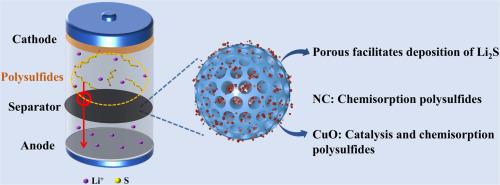
Lithium sulfur batteries face several challenges, including significant volumetric expansion during cycling, slow kinetics of sulfur redox reactions, and the shuttle effect of solubility lithium polysulfides. Polar metal oxides, due to their hydrophilic surface, can effectively adsorb polysulfides, facilitating their confinement and reducing their mobility, which helps to mitigate the shuttle effect. In this study, CuO nanoparticles embedded within porous nitrogen-doped porous carbon (CuO@NC) composite with a high specific surface area of 865.68 m2 g-1 are successfully synthesized without use of additional template. The CuO@NC composite enables the synergy between the physical adsorption provided by the porous carbon framework and the chemical adsorption-catalysis of CuO, thereby enhancing polysulfide immobilization and improving electrochemical performance. Cells fabricated with CuO@NC modified separator show a high specific capacity of 969.8 mAh g-1 at 0.5 C, excellent rate capability (937.9 mAh g-1 at 1 C), and a stable capacity of 793.2 mAh g-1 after 200 cycles with a low decay rate of 0.09 % per cycle. Furthermore, the CuO@NC modified separator maintains a discharge capacity of 725.6 mAh g-1 at -10 °C. Even with sulfur loading up to 5.6 mg cm-2, it can still exhibit remarkable cycling stability. This study demonstrates the design of metal oxides-decorated porous heteroatoms doped carbon materials as an effective strategy for fabricating highly functional separator that inhibit the polysulfides shuttle effect.
锂硫电池面临着几个挑战,包括循环过程中显著的体积膨胀,硫氧化还原反应的缓慢动力学,以及溶解性锂多硫化物的穿梭效应。极性金属氧化物由于其亲水表面,可以有效吸附多硫化物,有利于其约束,降低其迁移率,有助于减轻穿梭效应。在本研究中,在不使用额外模板的情况下,成功地合成了嵌入氮掺杂多孔碳(CuO@NC)复合材料中的CuO纳米颗粒,其比表面积高达865.68 m2 g-1。CuO@NC复合材料使多孔碳框架提供的物理吸附与CuO的化学吸附催化协同作用,从而增强多硫化物的固定化,提高电化学性能。使用CuO@NC改性隔膜制备的电池在0.5 C时的比容量为969.8 mAh g-1,在1 C时的倍率容量为937.9 mAh g-1,在200次循环后的稳定容量为793.2 mAh g-1,每循环的衰减率为0.09%。此外,CuO@NC改性分离器在-10°C下保持725.6 mAh g-1的放电容量。即使硫负载高达5.6 mg cm-2,它仍然可以表现出显著的循环稳定性。本研究表明,设计金属氧化物修饰的多孔杂原子掺杂碳材料是一种有效的策略,可以制造出抑制多硫化物穿梭效应的高功能分离器。
期刊介绍:
Electrochimica Acta is an international journal. It is intended for the publication of both original work and reviews in the field of electrochemistry. Electrochemistry should be interpreted to mean any of the research fields covered by the Divisions of the International Society of Electrochemistry listed below, as well as emerging scientific domains covered by ISE New Topics Committee.




 京公网安备 11010802042870号
京ICP备2023020795号-1
京公网安备 11010802042870号
京ICP备2023020795号-1

 分享
分享
 求助内容:
求助内容: 应助结果提醒方式:
 扫码关注我们
