Minghui Liu , Xinyu Feng , Bosi Yin , Jiazhuo Li , Mudi Li , Yaxi Ding , Ying Sun , Hui Li , Wensheng Li , Siwen Zhang , Tianyi Ma
{"title":"Regulation of Cobalt-Nickel-Based Compounds via Glucose-Induced Phase Transitions for Enhanced Performance in Zinc-Based Alkaline Batteries","authors":"Minghui Liu , Xinyu Feng , Bosi Yin , Jiazhuo Li , Mudi Li , Yaxi Ding , Ying Sun , Hui Li , Wensheng Li , Siwen Zhang , Tianyi Ma","doi":"10.1016/j.apsusc.2025.162812","DOIUrl":null,"url":null,"abstract":"<div><div>Zinc-based alkaline batteries (ZABs) have experienced tremendous breakthroughs in the past few years, particularly in the context of new energy storage solutions. Among various cathode materials, cobalt–nickel-based compounds have emerged as highly promising candidates. In this study, we introduce the novel synthesis of NiCo<sub>2</sub>O<sub>4</sub> (NCO) and phase-transition CoNiO<sub>2</sub> (PT-CNO) via glucose and hydrothermal methods for the first time in aqueous zinc-based alkaline batteries. The phase transition process effectively regulates the morphology of the material. Specifically, glucose reduction transforms the material’s structure from nanoflowers composed of stacked nanowires (NCO) to self-assembled sheet-like formations (PT-CNO). This morphological transformation enhances the electrochemical activity specific surface area of the electrode, increases the number of active sites, and facilitates the electrochemical energy storage process. Furthermore, the phase transition and resulting morphological changes enhance charge transfer and electrolyte penetration, significantly reducing side reactions between the material and the electrolyte and thereby improving electrode stability. The Zn//PT-CNO configuration demonstrated a remarkable capacity retention rate of 70% after 10,000 cycles at a current density of 6 A/g. The phase transition strategy employed and the cobalt–nickel-based materials developed in this study offer valuable insights for designing advanced cathode materials in the realm of renewable and sustainable energy.</div></div>","PeriodicalId":247,"journal":{"name":"Applied Surface Science","volume":"693 ","pages":"Article 162812"},"PeriodicalIF":6.9000,"publicationDate":"2025-06-01","publicationTypes":"Journal Article","fieldsOfStudy":null,"isOpenAccess":false,"openAccessPdf":"","citationCount":"0","resultStr":null,"platform":"Semanticscholar","paperid":null,"PeriodicalName":"Applied Surface Science","FirstCategoryId":"88","ListUrlMain":"https://www.sciencedirect.com/science/article/pii/S0169433225005264","RegionNum":2,"RegionCategory":"材料科学","ArticlePicture":[],"TitleCN":null,"AbstractTextCN":null,"PMCID":null,"EPubDate":"2025/2/26 0:00:00","PubModel":"Epub","JCR":"Q2","JCRName":"CHEMISTRY, PHYSICAL","Score":null,"Total":0}
引用次数: 0
Abstract
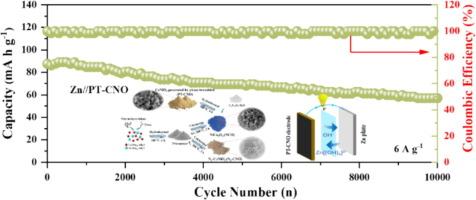
Zinc-based alkaline batteries (ZABs) have experienced tremendous breakthroughs in the past few years, particularly in the context of new energy storage solutions. Among various cathode materials, cobalt–nickel-based compounds have emerged as highly promising candidates. In this study, we introduce the novel synthesis of NiCo2O4 (NCO) and phase-transition CoNiO2 (PT-CNO) via glucose and hydrothermal methods for the first time in aqueous zinc-based alkaline batteries. The phase transition process effectively regulates the morphology of the material. Specifically, glucose reduction transforms the material’s structure from nanoflowers composed of stacked nanowires (NCO) to self-assembled sheet-like formations (PT-CNO). This morphological transformation enhances the electrochemical activity specific surface area of the electrode, increases the number of active sites, and facilitates the electrochemical energy storage process. Furthermore, the phase transition and resulting morphological changes enhance charge transfer and electrolyte penetration, significantly reducing side reactions between the material and the electrolyte and thereby improving electrode stability. The Zn//PT-CNO configuration demonstrated a remarkable capacity retention rate of 70% after 10,000 cycles at a current density of 6 A/g. The phase transition strategy employed and the cobalt–nickel-based materials developed in this study offer valuable insights for designing advanced cathode materials in the realm of renewable and sustainable energy.
锌基碱性电池(ZABs)在过去几年中取得了巨大的突破,特别是在新的储能解决方案方面。在各种阴极材料中,钴镍基化合物已成为极有前途的候选者。在本研究中,我们首次在锌基碱性电池中采用葡萄糖和水热法合成了NiCo2O4 (NCO)和相变CoNiO2 (PT-CNO)。相变过程有效地调节了材料的形貌。具体来说,葡萄糖还原将材料的结构从堆叠纳米线(NCO)组成的纳米花转变为自组装的片状结构(PT-CNO)。这种形态转变增强了电极的电化学活性比表面积,增加了活性位点的数量,有利于电化学储能过程。此外,相变和由此产生的形态变化增强了电荷转移和电解质渗透,显著减少了材料与电解质之间的副反应,从而提高了电极的稳定性。在6 a /g电流密度下,经过10000次循环后,Zn//PT-CNO的容量保持率达到70%。本研究中采用的相变策略和开发的钴镍基材料为设计可再生和可持续能源领域的先进阴极材料提供了有价值的见解。
期刊介绍:
Applied Surface Science covers topics contributing to a better understanding of surfaces, interfaces, nanostructures and their applications. The journal is concerned with scientific research on the atomic and molecular level of material properties determined with specific surface analytical techniques and/or computational methods, as well as the processing of such structures.





 京公网安备 11010802042870号
京ICP备2023020795号-1
京公网安备 11010802042870号
京ICP备2023020795号-1

 分享
分享
 求助内容:
求助内容: 应助结果提醒方式:
 扫码关注我们
