Parham Koochak, Mariia S. Kiseleva, Sakari Lepikko, Mika Latikka, Robin H. A. Ras, William S. Y. Wong
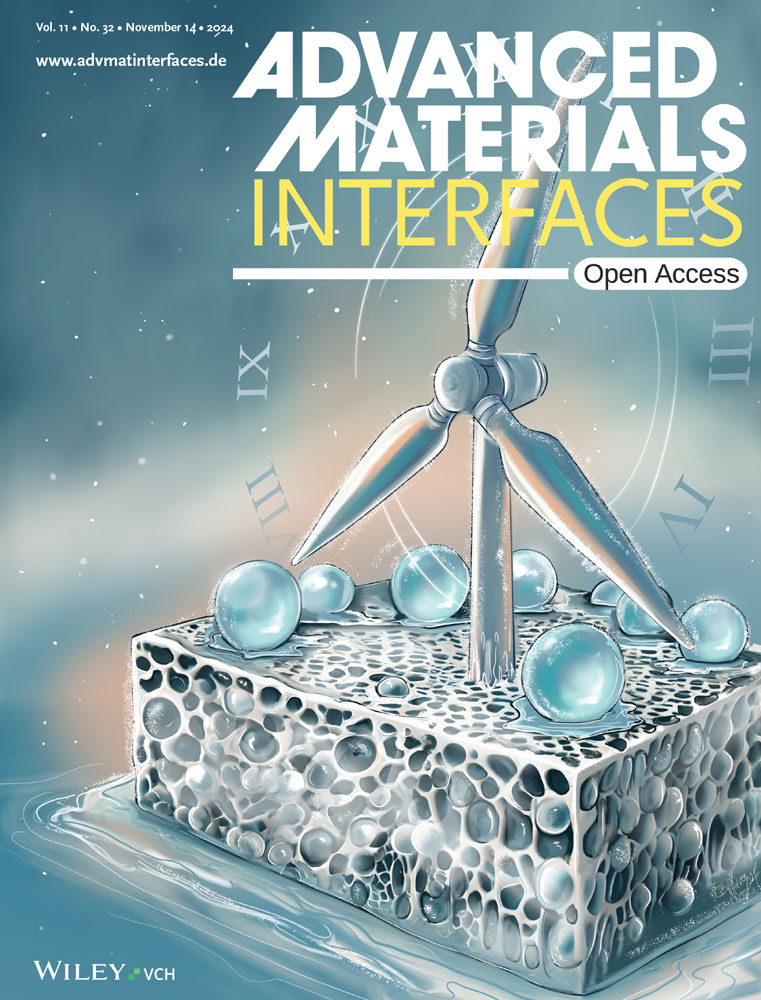
{"title":"Smoothening Perfluoroalkylated Surfaces: Liquid-Like Despite Molecular Rigidity?","authors":"Parham Koochak, Mariia S. Kiseleva, Sakari Lepikko, Mika Latikka, Robin H. A. Ras, William S. Y. Wong","doi":"10.1002/admi.202400619","DOIUrl":null,"url":null,"abstract":"<p>The rational design of surfaces at the molecular level is essential toward realizing many engineering applications. However, molecular-scale defects affect processes such as triboelectrification, scaling, and condensation. These defects are often detectable via contact angle hysteresis (CAH) measurements. Liquid-like surfaces exhibit extremely low CAH (≤5°) and rely on the use of highly flexible molecular species such as long-chain alkyls or siloxanes. Their low glass transition temperatures lead to the so-termed self-smoothing behavior, reducing sensitivity to defects formed during fabrication. However, utilizing rigid molecular species such as perfluoroalkyl chains often results in higher hysteresis (10° to 60°) as defects are not self-smoothed after fabrication. Consequently, state-of-the-art perfluoroalkylated surfaces often show sub-optimal interfacial properties. Here, a customizable chemical vapor deposition process creates molecularly-thick, low-defect surfaces from trichloro(1<i>H</i>,1<i>H</i>,2<i>H</i>,2<i>H</i>-perfluorooctyl)silane. By implementing moisture-exposure controls, highly homogenous surfaces with root-mean-square roughness below 1 nm are fabricated. CAH is achieved down to ≈4° (average: 6°), surpassing the state-of-the-art by ≈5°. Reduction of CAH (26° to 6°) results in condensation suppression, decreasing surface droplet density by one order and surface droplet coverage by 40%. This work guides the synthesis of high-quality surfaces from tri-functional perfluoroalkylsilanes with liquid-like properties despite their molecular rigidity.</p>","PeriodicalId":115,"journal":{"name":"Advanced Materials Interfaces","volume":"12 5","pages":""},"PeriodicalIF":4.4000,"publicationDate":"2024-11-04","publicationTypes":"Journal Article","fieldsOfStudy":null,"isOpenAccess":false,"openAccessPdf":"https://onlinelibrary.wiley.com/doi/epdf/10.1002/admi.202400619","citationCount":"0","resultStr":null,"platform":"Semanticscholar","paperid":null,"PeriodicalName":"Advanced Materials Interfaces","FirstCategoryId":"88","ListUrlMain":"https://advanced.onlinelibrary.wiley.com/doi/10.1002/admi.202400619","RegionNum":3,"RegionCategory":"材料科学","ArticlePicture":[],"TitleCN":null,"AbstractTextCN":null,"PMCID":null,"EPubDate":"","PubModel":"","JCR":"Q2","JCRName":"CHEMISTRY, MULTIDISCIPLINARY","Score":null,"Total":0}
引用次数: 0
Abstract
The rational design of surfaces at the molecular level is essential toward realizing many engineering applications. However, molecular-scale defects affect processes such as triboelectrification, scaling, and condensation. These defects are often detectable via contact angle hysteresis (CAH) measurements. Liquid-like surfaces exhibit extremely low CAH (≤5°) and rely on the use of highly flexible molecular species such as long-chain alkyls or siloxanes. Their low glass transition temperatures lead to the so-termed self-smoothing behavior, reducing sensitivity to defects formed during fabrication. However, utilizing rigid molecular species such as perfluoroalkyl chains often results in higher hysteresis (10° to 60°) as defects are not self-smoothed after fabrication. Consequently, state-of-the-art perfluoroalkylated surfaces often show sub-optimal interfacial properties. Here, a customizable chemical vapor deposition process creates molecularly-thick, low-defect surfaces from trichloro(1H,1H,2H,2H-perfluorooctyl)silane. By implementing moisture-exposure controls, highly homogenous surfaces with root-mean-square roughness below 1 nm are fabricated. CAH is achieved down to ≈4° (average: 6°), surpassing the state-of-the-art by ≈5°. Reduction of CAH (26° to 6°) results in condensation suppression, decreasing surface droplet density by one order and surface droplet coverage by 40%. This work guides the synthesis of high-quality surfaces from tri-functional perfluoroalkylsilanes with liquid-like properties despite their molecular rigidity.
期刊介绍:
Advanced Materials Interfaces publishes top-level research on interface technologies and effects. Considering any interface formed between solids, liquids, and gases, the journal ensures an interdisciplinary blend of physics, chemistry, materials science, and life sciences. Advanced Materials Interfaces was launched in 2014 and received an Impact Factor of 4.834 in 2018.
The scope of Advanced Materials Interfaces is dedicated to interfaces and surfaces that play an essential role in virtually all materials and devices. Physics, chemistry, materials science and life sciences blend to encourage new, cross-pollinating ideas, which will drive forward our understanding of the processes at the interface.
Advanced Materials Interfaces covers all topics in interface-related research:
Oil / water separation,
Applications of nanostructured materials,
2D materials and heterostructures,
Surfaces and interfaces in organic electronic devices,
Catalysis and membranes,
Self-assembly and nanopatterned surfaces,
Composite and coating materials,
Biointerfaces for technical and medical applications.
Advanced Materials Interfaces provides a forum for topics on surface and interface science with a wide choice of formats: Reviews, Full Papers, and Communications, as well as Progress Reports and Research News.





 京公网安备 11010802042870号
京ICP备2023020795号-1
京公网安备 11010802042870号
京ICP备2023020795号-1

 分享
分享
 求助内容:
求助内容: 应助结果提醒方式:
 扫码关注我们
