Exploring advanced nanostructures and functional materials for efficient hydrogen storage: a theoretical investigation on mechanisms, adsorption process, and future directions.
{"title":"Exploring advanced nanostructures and functional materials for efficient hydrogen storage: a theoretical investigation on mechanisms, adsorption process, and future directions.","authors":"Gourhari Jana, Pratim Kumar Chattaraj","doi":"10.3389/fchem.2025.1525140","DOIUrl":null,"url":null,"abstract":"<p><p>Hydrogen is a promising candidate for renewable energy storage and transportation due to its high energy density and zero carbon emissions. Its practical applications face challenges related to safe, efficient storage and release systems. This review article investigates advanced nanostructured materials for hydrogen storage, including metal acetylide and cyanide complexes, B,N-doped γ-graphyne nanotubes (γ-GNT), lithium-phosphide double helices, and Ni-decorated carbon-based clusters. Density Functional Theory (DFT) based computations are used to analyze binding energies, thermodynamic stability, and adsorption mechanisms. Ni-decorated C<sub>12</sub>N<sub>12</sub> nanoclusters demonstrate enhanced storage capacities, binding up to eight H<sub>2</sub> molecules with a favorable N-(μ-Ni)-N configuration. Lithium-phosphide double helices show potential for 9.6 wt% hydrogen storage within a stable, semiconducting framework. Functionalization of γ-GNT with OLi<sub>2</sub> at boron-doped sites significantly enhances storage potential, achieving optimal hydrogen binding energies for practical applications. Additionally, metal acetylide and cyanide complexes, stabilized by noble gas insertion, display thermodynamically favorable hydrogen adsorption. These results highlight the potential of these functionalized nanostructures for achieving high-capacity, reversible hydrogen storage. The nanostructures in this study, such as γ-graphyne nanotubes (γ-GNT), lithium-phosphide double helices, metal acetylide and cyanide complexes, and Ni-decorated carbon-based clusters, are selected based on their ability to exhibit complementary hydrogen adsorption mechanisms, including physisorption and chemisorption. γ-GNT offers high surface area and tunable electronic properties, ideal for physisorption enhanced by heteroatom doping. Lithium-phosphide double helices facilitate Kubas-like chemisorption through unsaturated lithium centers. Metal acetylide and cyanide complexes stabilize hydrogen adsorption via charge transfer and conjugated frameworks, while Ni-decorated clusters combine polarization-induced physisorption. These materials represent a strategic approach to addressing the challenges of hydrogen storage through diverse and synergistic mechanisms. The review also addresses challenges and outlines future directions to advance hydrogen's role as a sustainable fuel.</p>","PeriodicalId":12421,"journal":{"name":"Frontiers in Chemistry","volume":"13 ","pages":"1525140"},"PeriodicalIF":4.2000,"publicationDate":"2025-02-11","publicationTypes":"Journal Article","fieldsOfStudy":null,"isOpenAccess":false,"openAccessPdf":"https://www.ncbi.nlm.nih.gov/pmc/articles/PMC11850393/pdf/","citationCount":"0","resultStr":null,"platform":"Semanticscholar","paperid":null,"PeriodicalName":"Frontiers in Chemistry","FirstCategoryId":"92","ListUrlMain":"https://doi.org/10.3389/fchem.2025.1525140","RegionNum":3,"RegionCategory":"化学","ArticlePicture":[],"TitleCN":null,"AbstractTextCN":null,"PMCID":null,"EPubDate":"2025/1/1 0:00:00","PubModel":"eCollection","JCR":"Q2","JCRName":"CHEMISTRY, MULTIDISCIPLINARY","Score":null,"Total":0}
引用次数: 0
Abstract
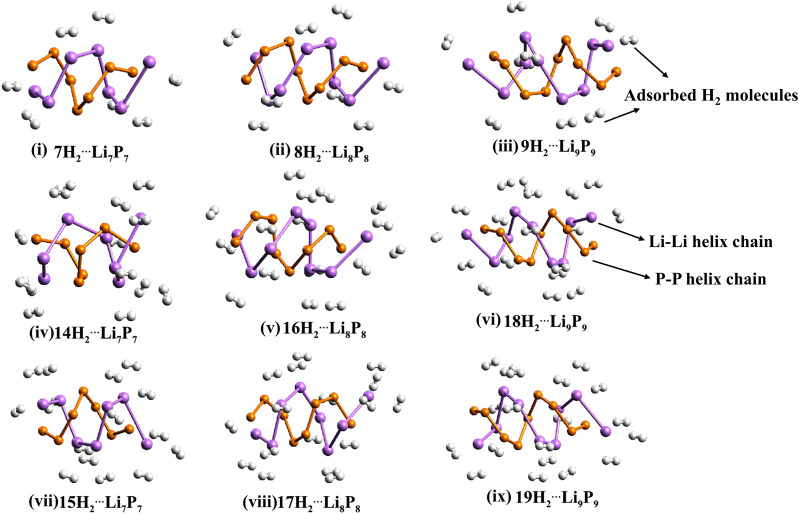
Hydrogen is a promising candidate for renewable energy storage and transportation due to its high energy density and zero carbon emissions. Its practical applications face challenges related to safe, efficient storage and release systems. This review article investigates advanced nanostructured materials for hydrogen storage, including metal acetylide and cyanide complexes, B,N-doped γ-graphyne nanotubes (γ-GNT), lithium-phosphide double helices, and Ni-decorated carbon-based clusters. Density Functional Theory (DFT) based computations are used to analyze binding energies, thermodynamic stability, and adsorption mechanisms. Ni-decorated C12N12 nanoclusters demonstrate enhanced storage capacities, binding up to eight H2 molecules with a favorable N-(μ-Ni)-N configuration. Lithium-phosphide double helices show potential for 9.6 wt% hydrogen storage within a stable, semiconducting framework. Functionalization of γ-GNT with OLi2 at boron-doped sites significantly enhances storage potential, achieving optimal hydrogen binding energies for practical applications. Additionally, metal acetylide and cyanide complexes, stabilized by noble gas insertion, display thermodynamically favorable hydrogen adsorption. These results highlight the potential of these functionalized nanostructures for achieving high-capacity, reversible hydrogen storage. The nanostructures in this study, such as γ-graphyne nanotubes (γ-GNT), lithium-phosphide double helices, metal acetylide and cyanide complexes, and Ni-decorated carbon-based clusters, are selected based on their ability to exhibit complementary hydrogen adsorption mechanisms, including physisorption and chemisorption. γ-GNT offers high surface area and tunable electronic properties, ideal for physisorption enhanced by heteroatom doping. Lithium-phosphide double helices facilitate Kubas-like chemisorption through unsaturated lithium centers. Metal acetylide and cyanide complexes stabilize hydrogen adsorption via charge transfer and conjugated frameworks, while Ni-decorated clusters combine polarization-induced physisorption. These materials represent a strategic approach to addressing the challenges of hydrogen storage through diverse and synergistic mechanisms. The review also addresses challenges and outlines future directions to advance hydrogen's role as a sustainable fuel.
期刊介绍:
Frontiers in Chemistry is a high visiblity and quality journal, publishing rigorously peer-reviewed research across the chemical sciences. Field Chief Editor Steve Suib at the University of Connecticut is supported by an outstanding Editorial Board of international researchers. This multidisciplinary open-access journal is at the forefront of disseminating and communicating scientific knowledge and impactful discoveries to academics, industry leaders and the public worldwide.
Chemistry is a branch of science that is linked to all other main fields of research. The omnipresence of Chemistry is apparent in our everyday lives from the electronic devices that we all use to communicate, to foods we eat, to our health and well-being, to the different forms of energy that we use. While there are many subtopics and specialties of Chemistry, the fundamental link in all these areas is how atoms, ions, and molecules come together and come apart in what some have come to call the “dance of life”.
All specialty sections of Frontiers in Chemistry are open-access with the goal of publishing outstanding research publications, review articles, commentaries, and ideas about various aspects of Chemistry. The past forms of publication often have specific subdisciplines, most commonly of analytical, inorganic, organic and physical chemistries, but these days those lines and boxes are quite blurry and the silos of those disciplines appear to be eroding. Chemistry is important to both fundamental and applied areas of research and manufacturing, and indeed the outlines of academic versus industrial research are also often artificial. Collaborative research across all specialty areas of Chemistry is highly encouraged and supported as we move forward. These are exciting times and the field of Chemistry is an important and significant contributor to our collective knowledge.






 京公网安备 11010802042870号
京ICP备2023020795号-1
京公网安备 11010802042870号
京ICP备2023020795号-1

 分享
分享
 求助内容:
求助内容: 应助结果提醒方式:
 扫码关注我们
