Suraj Negi , Yu-Chi Cheng , Shan-Li Wang , Shuay-Tsyr Ho , Shu-Yuan Pan
{"title":"Harvesting rice straw management synergies for lifecycle environmental and economic sustainability","authors":"Suraj Negi , Yu-Chi Cheng , Shan-Li Wang , Shuay-Tsyr Ho , Shu-Yuan Pan","doi":"10.1016/j.scitotenv.2025.178931","DOIUrl":null,"url":null,"abstract":"<div><div>Rice is a critical global staple food; however, its production is a substantial contributor to greenhouse gas emissions. The burning of rice straw (RS), a byproduct of the harvest, further exacerbates global warming by emitting greenhouse gases and air pollutants, such as particulate matter, contributing to biodiversity loss and soil fertility degradation in agricultural areas. To explore the synergies of RS bioresources, this study systematically evaluates various RS management practices, including open burning, soil organic amendment, and bioenergy production, from the perspective of their lifecycle environmental and economic performance. This study considers all stages of rice production, including different irrigation systems such as conventional flooding and alternate wetting and drying (AWD). The findings indicate that replacing conventional flooding with AWD irrigation results in reduced lifecycle environmental impacts across all midpoint indicators. Specifically, AWD irrigation combined with RS used as soil amendments exhibits the lowest global warming potential, at −435.2 kg CO<sub>2</sub>eq per ton-RS. In terms of economic costs, the lifecycle costs across all scenarios range from approximately 91.7 to 186.9 USD per tonne of RS. Furthermore, sensitivity analyses are conducted on RS portion allocation and transportation distance. The study also identifies the synergies between soil organic amendment and bioenergy production, leveraging global carbon pricing and feed-in tariffs, as crucial factors for optimizing both the environmental and economic performance of RS management. This study offers valuable insights into the potential of integrated RS management practices for achieving environmental sustainability and economic viability over the rice production lifecycle.</div></div>","PeriodicalId":422,"journal":{"name":"Science of the Total Environment","volume":"969 ","pages":"Article 178931"},"PeriodicalIF":8.0000,"publicationDate":"2025-03-15","publicationTypes":"Journal Article","fieldsOfStudy":null,"isOpenAccess":false,"openAccessPdf":"","citationCount":"0","resultStr":null,"platform":"Semanticscholar","paperid":null,"PeriodicalName":"Science of the Total Environment","FirstCategoryId":"93","ListUrlMain":"https://www.sciencedirect.com/science/article/pii/S0048969725005662","RegionNum":1,"RegionCategory":"环境科学与生态学","ArticlePicture":[],"TitleCN":null,"AbstractTextCN":null,"PMCID":null,"EPubDate":"2025/2/28 0:00:00","PubModel":"Epub","JCR":"Q1","JCRName":"ENVIRONMENTAL SCIENCES","Score":null,"Total":0}
引用次数: 0
Abstract
Rice is a critical global staple food; however, its production is a substantial contributor to greenhouse gas emissions. The burning of rice straw (RS), a byproduct of the harvest, further exacerbates global warming by emitting greenhouse gases and air pollutants, such as particulate matter, contributing to biodiversity loss and soil fertility degradation in agricultural areas. To explore the synergies of RS bioresources, this study systematically evaluates various RS management practices, including open burning, soil organic amendment, and bioenergy production, from the perspective of their lifecycle environmental and economic performance. This study considers all stages of rice production, including different irrigation systems such as conventional flooding and alternate wetting and drying (AWD). The findings indicate that replacing conventional flooding with AWD irrigation results in reduced lifecycle environmental impacts across all midpoint indicators. Specifically, AWD irrigation combined with RS used as soil amendments exhibits the lowest global warming potential, at −435.2 kg CO2eq per ton-RS. In terms of economic costs, the lifecycle costs across all scenarios range from approximately 91.7 to 186.9 USD per tonne of RS. Furthermore, sensitivity analyses are conducted on RS portion allocation and transportation distance. The study also identifies the synergies between soil organic amendment and bioenergy production, leveraging global carbon pricing and feed-in tariffs, as crucial factors for optimizing both the environmental and economic performance of RS management. This study offers valuable insights into the potential of integrated RS management practices for achieving environmental sustainability and economic viability over the rice production lifecycle.
大米是一种重要的全球主食;然而,它的生产是温室气体排放的重要贡献者。秸秆是收获的副产品,焚烧秸秆通过排放温室气体和空气污染物(如颗粒物)进一步加剧了全球变暖,导致农业地区生物多样性丧失和土壤肥力退化。为了探索RS生物资源的协同效应,本研究从生态环境和经济效益的角度系统评估了RS管理实践,包括露天焚烧、土壤有机修正和生物能源生产。这项研究考虑了水稻生产的所有阶段,包括不同的灌溉系统,如传统的洪水和交替干湿(AWD)。研究结果表明,用AWD灌溉取代常规灌溉可以降低所有中点指标的生命周期环境影响。具体而言,作为土壤改良剂的AWD灌溉与RS结合使用显示出最低的全球变暖潜势,每吨RS为- 435.2 kg co2当量。在经济成本方面,所有方案的生命周期成本约为每吨RS 91.7至186.9美元。此外,对RS部分分配和运输距离进行了敏感性分析。该研究还确定了土壤有机修正和生物能源生产之间的协同作用,利用全球碳定价和上网电价,这是优化RS管理的环境和经济绩效的关键因素。这项研究为综合RS管理实践在水稻生产生命周期内实现环境可持续性和经济可行性的潜力提供了有价值的见解。
期刊介绍:
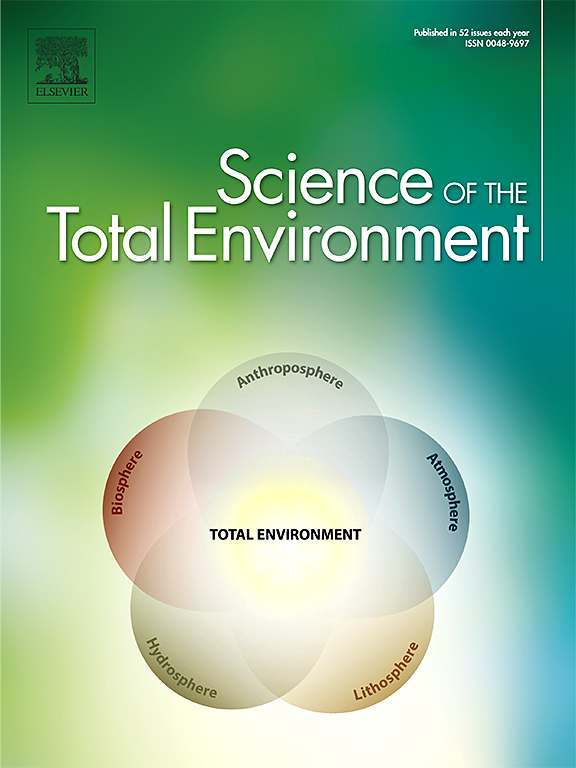
The Science of the Total Environment is an international journal dedicated to scientific research on the environment and its interaction with humanity. It covers a wide range of disciplines and seeks to publish innovative, hypothesis-driven, and impactful research that explores the entire environment, including the atmosphere, lithosphere, hydrosphere, biosphere, and anthroposphere.
The journal's updated Aims & Scope emphasizes the importance of interdisciplinary environmental research with broad impact. Priority is given to studies that advance fundamental understanding and explore the interconnectedness of multiple environmental spheres. Field studies are preferred, while laboratory experiments must demonstrate significant methodological advancements or mechanistic insights with direct relevance to the environment.




 京公网安备 11010802042870号
京ICP备2023020795号-1
京公网安备 11010802042870号
京ICP备2023020795号-1

 分享
分享
 求助内容:
求助内容: 应助结果提醒方式:
 扫码关注我们
