Fumitake Kato, Hiroshi Koibuchi, Elie Bretin, Camille Carvalho, Roland Denis, Simon Masnou, Madoka Nakayama, Sohei Tasaki and Tetsuya Uchimoto
{"title":"Turing patterns on polymerized membranes: coarse-grained lattice modelling with an internal degree of freedom for polymer direction†","authors":"Fumitake Kato, Hiroshi Koibuchi, Elie Bretin, Camille Carvalho, Roland Denis, Simon Masnou, Madoka Nakayama, Sohei Tasaki and Tetsuya Uchimoto","doi":"10.1039/D4SM01309C","DOIUrl":null,"url":null,"abstract":"<p >We numerically study Turing patterns (TPs) on two-dimensional surfaces with a square boundary in <strong>R</strong><small><sup>3</sup></small> using a surface model for polymerized membranes. The variables used to describe the membranes correspond to two distinct degrees of freedom: an internal degree of freedom for the polymer directions in addition to the positional degree of freedom. This generalised surface model enables us to identify non-trivial interference between the TP system and the membranes. To this end, we employ a hybrid numerical technique, utilising Monte Carlo updates for membrane configurations and discrete time iterations for the FitzHugh–Nagumo type Turing equation. The simulation results clearly show that anisotropies in the mechanical deformation properties, particularly the easy axes associated with the stretching and bending of the membranes, determine the direction of the TPs to be perpendicular or parallel to the easy axes. Additionally, by calculating the dependence of the maximum entropy on the internal degree of freedom, we can obtain information on the relaxation with respect to the polymer structure. This crucial information serves to remind us that non-equilibrium configurations can be captured within the canonical Monte Carlo simulations.</p>","PeriodicalId":103,"journal":{"name":"Soft Matter","volume":" 12","pages":" 2317-2338"},"PeriodicalIF":2.8000,"publicationDate":"2025-02-13","publicationTypes":"Journal Article","fieldsOfStudy":null,"isOpenAccess":false,"openAccessPdf":"","citationCount":"0","resultStr":null,"platform":"Semanticscholar","paperid":null,"PeriodicalName":"Soft Matter","FirstCategoryId":"92","ListUrlMain":"https://pubs.rsc.org/en/content/articlelanding/2025/sm/d4sm01309c","RegionNum":3,"RegionCategory":"化学","ArticlePicture":[],"TitleCN":null,"AbstractTextCN":null,"PMCID":null,"EPubDate":"","PubModel":"","JCR":"Q3","JCRName":"CHEMISTRY, PHYSICAL","Score":null,"Total":0}
引用次数: 0
Abstract
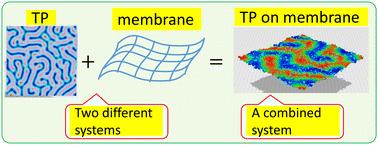
We numerically study Turing patterns (TPs) on two-dimensional surfaces with a square boundary in R3 using a surface model for polymerized membranes. The variables used to describe the membranes correspond to two distinct degrees of freedom: an internal degree of freedom for the polymer directions in addition to the positional degree of freedom. This generalised surface model enables us to identify non-trivial interference between the TP system and the membranes. To this end, we employ a hybrid numerical technique, utilising Monte Carlo updates for membrane configurations and discrete time iterations for the FitzHugh–Nagumo type Turing equation. The simulation results clearly show that anisotropies in the mechanical deformation properties, particularly the easy axes associated with the stretching and bending of the membranes, determine the direction of the TPs to be perpendicular or parallel to the easy axes. Additionally, by calculating the dependence of the maximum entropy on the internal degree of freedom, we can obtain information on the relaxation with respect to the polymer structure. This crucial information serves to remind us that non-equilibrium configurations can be captured within the canonical Monte Carlo simulations.
期刊介绍:
Soft Matter is an international journal published by the Royal Society of Chemistry using Engineering-Materials Science: A Synthesis as its research focus. It publishes original research articles, review articles, and synthesis articles related to this field, reporting the latest discoveries in the relevant theoretical, practical, and applied disciplines in a timely manner, and aims to promote the rapid exchange of scientific information in this subject area. The journal is an open access journal. The journal is an open access journal and has not been placed on the alert list in the last three years.



 京公网安备 11010802042870号
京ICP备2023020795号-1
京公网安备 11010802042870号
京ICP备2023020795号-1

 分享
分享
 求助内容:
求助内容: 应助结果提醒方式:
 扫码关注我们
