Riley Scherr, Aidin Spina, Allen Dao, Saman Andalib, Faris F Halaseh, Sarah Blair, Warren Wiechmann, Ronald Rivera
{"title":"Novel Evaluation Metric and Quantified Performance of ChatGPT-4 Patient Management Simulations for Early Clinical Education: Experimental Study.","authors":"Riley Scherr, Aidin Spina, Allen Dao, Saman Andalib, Faris F Halaseh, Sarah Blair, Warren Wiechmann, Ronald Rivera","doi":"10.2196/66478","DOIUrl":null,"url":null,"abstract":"<p><strong>Background: </strong>Case studies have shown ChatGPT can run clinical simulations at the medical student level. However, no data have assessed ChatGPT's reliability in meeting desired simulation criteria such as medical accuracy, simulation formatting, and robust feedback mechanisms.</p><p><strong>Objective: </strong>This study aims to quantify ChatGPT's ability to consistently follow formatting instructions and create simulations for preclinical medical student learners according to principles of medical simulation and multimedia educational technology.</p><p><strong>Methods: </strong>Using ChatGPT-4 and a prevalidated starting prompt, the authors ran 360 separate simulations of an acute asthma exacerbation. A total of 180 simulations were given correct answers and 180 simulations were given incorrect answers. ChatGPT was evaluated for its ability to adhere to basic simulation parameters (stepwise progression, free response, interactivity), advanced simulation parameters (autonomous conclusion, delayed feedback, comprehensive feedback), and medical accuracy (vignette, treatment updates, feedback). Significance was determined with χ² analyses using 95% CIs for odds ratios.</p><p><strong>Results: </strong>In total, 100% (n=360) of simulations met basic simulation parameters and were medically accurate. For advanced parameters, 55% (200/360) of all simulations delayed feedback, while the Correct arm (157/180, 87%) delayed feedback was significantly more than the Incorrect arm (43/180, 24%; P<.001). A total of 79% (285/360) of simulations concluded autonomously, and there was no difference between the Correct and Incorrect arms in autonomous conclusion (146/180, 81% and 139/180, 77%; P=.36). Overall, 78% (282/360) of simulations gave comprehensive feedback, and there was no difference between the Correct and Incorrect arms in comprehensive feedback (137/180, 76% and 145/180, 81%; P=.31). ChatGPT-4 was not significantly more likely to conclude simulations autonomously (P=.34) and provide comprehensive feedback (P=.27) when feedback was delayed compared to when feedback was not delayed.</p><p><strong>Conclusions: </strong>These simulations have the potential to be a reliable educational tool for simple simulations and can be evaluated by a novel 9-part metric. Per this metric, ChatGPT simulations performed perfectly on medical accuracy and basic simulation parameters. It performed well on comprehensive feedback and autonomous conclusion. Delayed feedback depended on the accuracy of user inputs. A simulation meeting one advanced parameter was not more likely to meet all advanced parameters. Further work must be done to ensure consistent performance across a broader range of simulation scenarios.</p>","PeriodicalId":14841,"journal":{"name":"JMIR Formative Research","volume":"9 ","pages":"e66478"},"PeriodicalIF":2.0000,"publicationDate":"2025-02-27","publicationTypes":"Journal Article","fieldsOfStudy":null,"isOpenAccess":false,"openAccessPdf":"https://www.ncbi.nlm.nih.gov/pmc/articles/PMC11884304/pdf/","citationCount":"0","resultStr":null,"platform":"Semanticscholar","paperid":null,"PeriodicalName":"JMIR Formative Research","FirstCategoryId":"1085","ListUrlMain":"https://doi.org/10.2196/66478","RegionNum":0,"RegionCategory":null,"ArticlePicture":[],"TitleCN":null,"AbstractTextCN":null,"PMCID":null,"EPubDate":"","PubModel":"","JCR":"Q3","JCRName":"HEALTH CARE SCIENCES & SERVICES","Score":null,"Total":0}
引用次数: 0
Abstract
Background: Case studies have shown ChatGPT can run clinical simulations at the medical student level. However, no data have assessed ChatGPT's reliability in meeting desired simulation criteria such as medical accuracy, simulation formatting, and robust feedback mechanisms.
Objective: This study aims to quantify ChatGPT's ability to consistently follow formatting instructions and create simulations for preclinical medical student learners according to principles of medical simulation and multimedia educational technology.
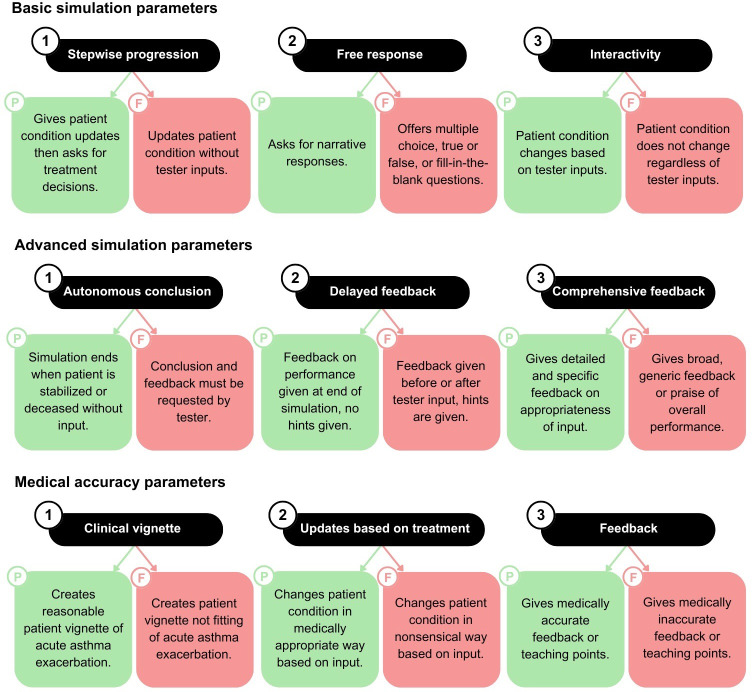
Methods: Using ChatGPT-4 and a prevalidated starting prompt, the authors ran 360 separate simulations of an acute asthma exacerbation. A total of 180 simulations were given correct answers and 180 simulations were given incorrect answers. ChatGPT was evaluated for its ability to adhere to basic simulation parameters (stepwise progression, free response, interactivity), advanced simulation parameters (autonomous conclusion, delayed feedback, comprehensive feedback), and medical accuracy (vignette, treatment updates, feedback). Significance was determined with χ² analyses using 95% CIs for odds ratios.
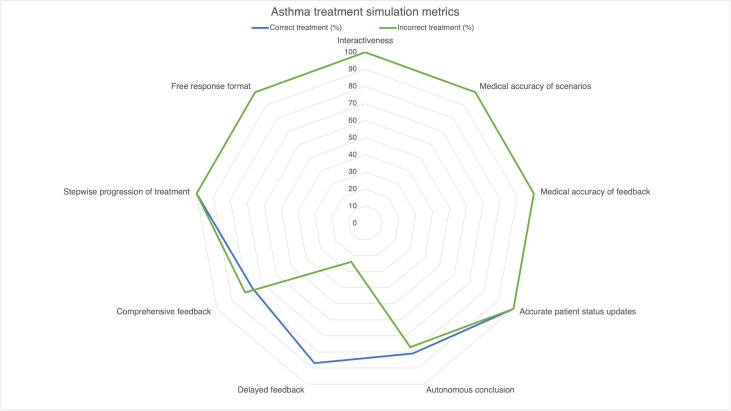
Results: In total, 100% (n=360) of simulations met basic simulation parameters and were medically accurate. For advanced parameters, 55% (200/360) of all simulations delayed feedback, while the Correct arm (157/180, 87%) delayed feedback was significantly more than the Incorrect arm (43/180, 24%; P<.001). A total of 79% (285/360) of simulations concluded autonomously, and there was no difference between the Correct and Incorrect arms in autonomous conclusion (146/180, 81% and 139/180, 77%; P=.36). Overall, 78% (282/360) of simulations gave comprehensive feedback, and there was no difference between the Correct and Incorrect arms in comprehensive feedback (137/180, 76% and 145/180, 81%; P=.31). ChatGPT-4 was not significantly more likely to conclude simulations autonomously (P=.34) and provide comprehensive feedback (P=.27) when feedback was delayed compared to when feedback was not delayed.
Conclusions: These simulations have the potential to be a reliable educational tool for simple simulations and can be evaluated by a novel 9-part metric. Per this metric, ChatGPT simulations performed perfectly on medical accuracy and basic simulation parameters. It performed well on comprehensive feedback and autonomous conclusion. Delayed feedback depended on the accuracy of user inputs. A simulation meeting one advanced parameter was not more likely to meet all advanced parameters. Further work must be done to ensure consistent performance across a broader range of simulation scenarios.






 京公网安备 11010802042870号
京ICP备2023020795号-1
京公网安备 11010802042870号
京ICP备2023020795号-1

 分享
分享
 求助内容:
求助内容: 应助结果提醒方式:
 扫码关注我们
