[Perioperative management of cochlear implantation and analysis on the influencing factors of efficacy in patients diagnosed as hereditary syndromic hearing loss].
Y Y Yuan, X G Li, B Gao, Q L Bi, S M Yang, D Y Han, P Dai
{"title":"[Perioperative management of cochlear implantation and analysis on the influencing factors of efficacy in patients diagnosed as hereditary syndromic hearing loss].","authors":"Y Y Yuan, X G Li, B Gao, Q L Bi, S M Yang, D Y Han, P Dai","doi":"10.3760/cma.j.cn115330-20240514-00279","DOIUrl":null,"url":null,"abstract":"<p><p><b>Objective:</b> To explore the perioperative precautions, rehabilitation effect, and affecting factors in cochlear implantation (CI) among patients with hereditary syndromic hearing loss. <b>Methods:</b> This was a retrospective cohort study. 47 patients diagnosed as hereditary syndromic deafness were treated in the Department of Otolaryngology-Head and Neck Surgery of the Chinese PLA General Hospital from 2010 to 2021, including 26 males and 21 females, aged 0.9-25 years. All patients received unilateral or bilateral CI. Clinical manifestation combined with genetic testing was used to diagnose syndromic hearing loss. The risks and precautions of CI in these patients were summarized from preoperative imaging, intraoperative observations, and postoperative complications. Single factor linear regression and multiple linear regression models in SPSS 26.0 software were used to evaluate the effects of various factors on auditory and speech rehabilitation after CI for syndromic hearing loss. The postoperative outcomes were analyzed through aided hearing thresholds, categories of auditory performance (CAP) scale, and speech intelligibility rate (SIR) scale. <b>Results:</b> Thirteen kinds of syndromes, totally 47 cases, including CHARGE (20 cases), Waardenburg (9 cases), Autosomal dominant deafness-onychodystrophy (DDOD, 4 cases), Pendred (3 cases), Noonan Syndrome with Multiple Lentigines (NSML, 2 cases), Branchio-Oto-Renal (BOR, 2 cases), Bart-Pumphery (1 case), Perrault (1 case), Kabuki (1 case), Frontometaphyseal dysplasia type 2 (FMD 2, 1 case), Mandibulofacial dysostosis Guion-Almeida type (MFDGA, 1 case), Coffin-Siris (1 case), and 10q26.12-q26.3 del (1 case), were enrolled. The perioperative special management included the following measures. For patients with cardiac and/or cartilage development issues, preoperative assessments of cardiac function and/or laryngeal cartilage development were performed to minimize anesthetic risks. For patients with mild intellectual disability and/or an auditory neuropathy phenotype, preoperative communication with the patients' families was conducted to explain the limitations of CI and assist in setting reasonable expectations. For syndromic hearing loss patients who commonly present with inner ear malformations, facial nerve anomalies, and/or intraoperative cerebrospinal fluid leakage, appropriate electrodes were selected prior to surgery, intraoperative facial nerve monitoring and careful cerebrospinal fluid leak repair were conducted, respectively. For patients with NSML accompanied by coagulation issues, the postoperative compression bandaging duration was extended to reduce the risk of hematoma formation. The daily duration of cochlear implant use, the presence of cochlear malformation, and developmental delay were independent factors influencing postoperative CAP scores. The daily duration of cochlear implant use, developmental delay, and unilateral or bilateral CI were independent factors influencing postoperative SIR scores. <b>Conclusions:</b> Hereditary syndrome deafness is a rare disease that affects multiple organs and causes extensive functional impairment. Before CI, a comprehensive evaluation of major affected organ functions is required to assess anesthetic and surgical risks. Genetic diagnosis not only identifies the molecular etiology of patients with syndromic hearing loss and reveals rare phenotypes, but also aids in prognostic evaluation. The main factors affecting CI outcomes in patients with syndromic hearing loss include the presence of cochlear malformations, developmental delays, daily duration of cochlear implant use, and bilateral implantation status.</p>","PeriodicalId":23987,"journal":{"name":"Chinese journal of otorhinolaryngology head and neck surgery","volume":"60 2","pages":"153-165"},"PeriodicalIF":0.0000,"publicationDate":"2025-02-07","publicationTypes":"Journal Article","fieldsOfStudy":null,"isOpenAccess":false,"openAccessPdf":"","citationCount":"0","resultStr":null,"platform":"Semanticscholar","paperid":null,"PeriodicalName":"Chinese journal of otorhinolaryngology head and neck surgery","FirstCategoryId":"3","ListUrlMain":"https://doi.org/10.3760/cma.j.cn115330-20240514-00279","RegionNum":0,"RegionCategory":null,"ArticlePicture":[],"TitleCN":null,"AbstractTextCN":null,"PMCID":null,"EPubDate":"","PubModel":"","JCR":"Q4","JCRName":"Medicine","Score":null,"Total":0}
引用次数: 0
Abstract
Objective: To explore the perioperative precautions, rehabilitation effect, and affecting factors in cochlear implantation (CI) among patients with hereditary syndromic hearing loss. Methods: This was a retrospective cohort study. 47 patients diagnosed as hereditary syndromic deafness were treated in the Department of Otolaryngology-Head and Neck Surgery of the Chinese PLA General Hospital from 2010 to 2021, including 26 males and 21 females, aged 0.9-25 years. All patients received unilateral or bilateral CI. Clinical manifestation combined with genetic testing was used to diagnose syndromic hearing loss. The risks and precautions of CI in these patients were summarized from preoperative imaging, intraoperative observations, and postoperative complications. Single factor linear regression and multiple linear regression models in SPSS 26.0 software were used to evaluate the effects of various factors on auditory and speech rehabilitation after CI for syndromic hearing loss. The postoperative outcomes were analyzed through aided hearing thresholds, categories of auditory performance (CAP) scale, and speech intelligibility rate (SIR) scale. Results: Thirteen kinds of syndromes, totally 47 cases, including CHARGE (20 cases), Waardenburg (9 cases), Autosomal dominant deafness-onychodystrophy (DDOD, 4 cases), Pendred (3 cases), Noonan Syndrome with Multiple Lentigines (NSML, 2 cases), Branchio-Oto-Renal (BOR, 2 cases), Bart-Pumphery (1 case), Perrault (1 case), Kabuki (1 case), Frontometaphyseal dysplasia type 2 (FMD 2, 1 case), Mandibulofacial dysostosis Guion-Almeida type (MFDGA, 1 case), Coffin-Siris (1 case), and 10q26.12-q26.3 del (1 case), were enrolled. The perioperative special management included the following measures. For patients with cardiac and/or cartilage development issues, preoperative assessments of cardiac function and/or laryngeal cartilage development were performed to minimize anesthetic risks. For patients with mild intellectual disability and/or an auditory neuropathy phenotype, preoperative communication with the patients' families was conducted to explain the limitations of CI and assist in setting reasonable expectations. For syndromic hearing loss patients who commonly present with inner ear malformations, facial nerve anomalies, and/or intraoperative cerebrospinal fluid leakage, appropriate electrodes were selected prior to surgery, intraoperative facial nerve monitoring and careful cerebrospinal fluid leak repair were conducted, respectively. For patients with NSML accompanied by coagulation issues, the postoperative compression bandaging duration was extended to reduce the risk of hematoma formation. The daily duration of cochlear implant use, the presence of cochlear malformation, and developmental delay were independent factors influencing postoperative CAP scores. The daily duration of cochlear implant use, developmental delay, and unilateral or bilateral CI were independent factors influencing postoperative SIR scores. Conclusions: Hereditary syndrome deafness is a rare disease that affects multiple organs and causes extensive functional impairment. Before CI, a comprehensive evaluation of major affected organ functions is required to assess anesthetic and surgical risks. Genetic diagnosis not only identifies the molecular etiology of patients with syndromic hearing loss and reveals rare phenotypes, but also aids in prognostic evaluation. The main factors affecting CI outcomes in patients with syndromic hearing loss include the presence of cochlear malformations, developmental delays, daily duration of cochlear implant use, and bilateral implantation status.
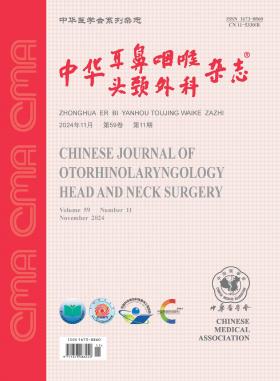
期刊介绍:
Chinese journal of otorhinolaryngology head and neck surgery is a high-level medical science and technology journal sponsored and published directly by the Chinese Medical Association, reflecting the significant research progress in the field of otorhinolaryngology head and neck surgery in China, and striving to promote the domestic and international academic exchanges for the purpose of running the journal.
Over the years, the journal has been ranked first in the total citation frequency list of national scientific and technical journals published by the Documentation and Intelligence Center of the Chinese Academy of Sciences and the China Science Citation Database, and has always ranked first among the scientific and technical journals in the related fields.
Chinese journal of otorhinolaryngology head and neck surgery has been included in the authoritative databases PubMed, Chinese core journals, CSCD.



 京公网安备 11010802042870号
京ICP备2023020795号-1
京公网安备 11010802042870号
京ICP备2023020795号-1

 分享
分享
 求助内容:
求助内容: 应助结果提醒方式:
 扫码关注我们
