I K M Reaz Rahman, Taehoon Kim, Inha Kim, Naoki Higashitarumizu, Shu Wang, Shifan Wang, Hyong Min Kim, James Bullock, Virginia Altoe, Joel W. Ager, III, Daryl C. Chrzan, Ali Javey
{"title":"Thermally Stable Ruthenium Contact for Robust p-Type Tellurium Transistors","authors":"I K M Reaz Rahman, Taehoon Kim, Inha Kim, Naoki Higashitarumizu, Shu Wang, Shifan Wang, Hyong Min Kim, James Bullock, Virginia Altoe, Joel W. Ager, III, Daryl C. Chrzan, Ali Javey","doi":"10.1021/acs.nanolett.4c06553","DOIUrl":null,"url":null,"abstract":"Tellurium (Te) is attractive for <i>p</i>-channel transistors due to its high hole mobility. Despite having a low thermal budget suitable for back-end-of-line (BEOL) monolithic integration, the practical realization of Te transistors is hindered by its thermal stability. In this work, we investigate thermal stability for Te thin films grown via scalable thermal evaporation. Our findings identify ruthenium as a more thermally stable contact for <i>p</i>-type Te transistors, capable of withstanding temperatures up to 250 °C. Ruthenium exhibits significantly lower diffusivity in Te compared to other contact metals commonly used such as nickel and palladium. Using the transfer-length method, we measured a contact resistance of 1.25 kΩ·μm at the ruthenium–tellurium interface. Additionally, the incorporation of high-κ ZrO<sub>2</sub> encapsulation not only suppresses the sublimation of the Te channel at elevated temperatures but also serves as the gate dielectric in top-gate devices operating at 1 V, achieving an on/off current ratio of 10<sup>5</sup>.","PeriodicalId":53,"journal":{"name":"Nano Letters","volume":"28 1","pages":""},"PeriodicalIF":9.1000,"publicationDate":"2025-02-28","publicationTypes":"Journal Article","fieldsOfStudy":null,"isOpenAccess":false,"openAccessPdf":"","citationCount":"0","resultStr":null,"platform":"Semanticscholar","paperid":null,"PeriodicalName":"Nano Letters","FirstCategoryId":"88","ListUrlMain":"https://doi.org/10.1021/acs.nanolett.4c06553","RegionNum":1,"RegionCategory":"材料科学","ArticlePicture":[],"TitleCN":null,"AbstractTextCN":null,"PMCID":null,"EPubDate":"","PubModel":"","JCR":"Q1","JCRName":"CHEMISTRY, MULTIDISCIPLINARY","Score":null,"Total":0}
引用次数: 0
Abstract
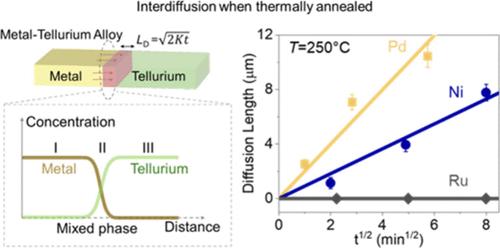
Tellurium (Te) is attractive for p-channel transistors due to its high hole mobility. Despite having a low thermal budget suitable for back-end-of-line (BEOL) monolithic integration, the practical realization of Te transistors is hindered by its thermal stability. In this work, we investigate thermal stability for Te thin films grown via scalable thermal evaporation. Our findings identify ruthenium as a more thermally stable contact for p-type Te transistors, capable of withstanding temperatures up to 250 °C. Ruthenium exhibits significantly lower diffusivity in Te compared to other contact metals commonly used such as nickel and palladium. Using the transfer-length method, we measured a contact resistance of 1.25 kΩ·μm at the ruthenium–tellurium interface. Additionally, the incorporation of high-κ ZrO2 encapsulation not only suppresses the sublimation of the Te channel at elevated temperatures but also serves as the gate dielectric in top-gate devices operating at 1 V, achieving an on/off current ratio of 105.
期刊介绍:
Nano Letters serves as a dynamic platform for promptly disseminating original results in fundamental, applied, and emerging research across all facets of nanoscience and nanotechnology. A pivotal criterion for inclusion within Nano Letters is the convergence of at least two different areas or disciplines, ensuring a rich interdisciplinary scope. The journal is dedicated to fostering exploration in diverse areas, including:
- Experimental and theoretical findings on physical, chemical, and biological phenomena at the nanoscale
- Synthesis, characterization, and processing of organic, inorganic, polymer, and hybrid nanomaterials through physical, chemical, and biological methodologies
- Modeling and simulation of synthetic, assembly, and interaction processes
- Realization of integrated nanostructures and nano-engineered devices exhibiting advanced performance
- Applications of nanoscale materials in living and environmental systems
Nano Letters is committed to advancing and showcasing groundbreaking research that intersects various domains, fostering innovation and collaboration in the ever-evolving field of nanoscience and nanotechnology.



 京公网安备 11010802042870号
京ICP备2023020795号-1
京公网安备 11010802042870号
京ICP备2023020795号-1

 分享
分享
 求助内容:
求助内容: 应助结果提醒方式:
 扫码关注我们
