{"title":"Regulating Interface Engineering by Helmholtz Plane Reconstructed Achieves Highly Reversible Zinc Metal Anodes","authors":"Zengguang Li, Zhongju Wang, Wenxuan Sun, Ying Ma, Wei Guo, Yongzhu Fu","doi":"10.1002/adma.202420489","DOIUrl":null,"url":null,"abstract":"<p>The rampant dendrite growth and notorious parasitic reactions significantly compromise the stability of zinc anodes in aqueous zinc metal batteries, presenting substantial for their practical applications. Herein, this work proposes a synergistic strategy that reconstructs the Helmholtz plane to precisely regulate the interface chemistry between the anode and the electrolyte. Experimental investigations and theoretical calculations demonstrate that even a small amount of pyridine oxide (PNO) additive effectively alters the coordination environment and reorganizes the solvation sheath in the Outer Helmholtz Plane (OHP). Simultaneously, PNO molecules preferentially adsorbed on the anode surface, displacing active water from the Inner Helmholtz Plane (IHP). Through synergistic regulation in both the OHP and IHP, zinc ions achieve compact and dense deposition along the Zn (002) crystal plane, while parasitic reactions catalyzed by active water are effectively suppressed. Consequently, the symmetric cell incorporating the PNO additive demonstrates stable cycling performance, maintaining more than 2300 h at 1 mA cm<sup>−2</sup> and sustaining over 400 h even at a high depth of discharge of 85%. Furthermore, the Zn||AQ cell retains 80% of its capacity after 3000 cycles and exhibits outstanding cycling stability even under the high active material mass loading (22 mg cm<sup>−2</sup>) using the modified electrolyte.</p>","PeriodicalId":114,"journal":{"name":"Advanced Materials","volume":"37 14","pages":""},"PeriodicalIF":26.8000,"publicationDate":"2025-02-28","publicationTypes":"Journal Article","fieldsOfStudy":null,"isOpenAccess":false,"openAccessPdf":"","citationCount":"0","resultStr":null,"platform":"Semanticscholar","paperid":null,"PeriodicalName":"Advanced Materials","FirstCategoryId":"88","ListUrlMain":"https://advanced.onlinelibrary.wiley.com/doi/10.1002/adma.202420489","RegionNum":1,"RegionCategory":"材料科学","ArticlePicture":[],"TitleCN":null,"AbstractTextCN":null,"PMCID":null,"EPubDate":"","PubModel":"","JCR":"Q1","JCRName":"CHEMISTRY, MULTIDISCIPLINARY","Score":null,"Total":0}
引用次数: 0
Abstract
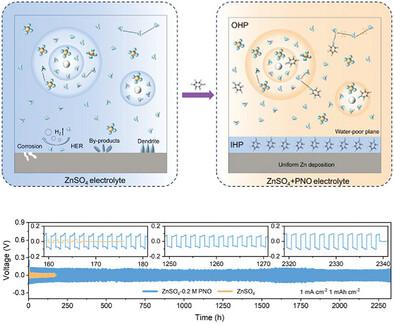
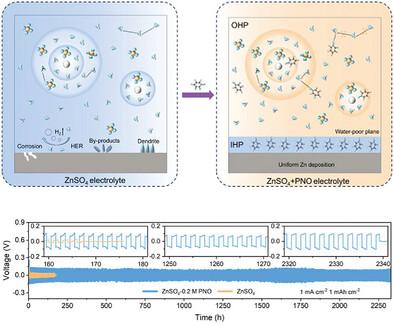
The rampant dendrite growth and notorious parasitic reactions significantly compromise the stability of zinc anodes in aqueous zinc metal batteries, presenting substantial for their practical applications. Herein, this work proposes a synergistic strategy that reconstructs the Helmholtz plane to precisely regulate the interface chemistry between the anode and the electrolyte. Experimental investigations and theoretical calculations demonstrate that even a small amount of pyridine oxide (PNO) additive effectively alters the coordination environment and reorganizes the solvation sheath in the Outer Helmholtz Plane (OHP). Simultaneously, PNO molecules preferentially adsorbed on the anode surface, displacing active water from the Inner Helmholtz Plane (IHP). Through synergistic regulation in both the OHP and IHP, zinc ions achieve compact and dense deposition along the Zn (002) crystal plane, while parasitic reactions catalyzed by active water are effectively suppressed. Consequently, the symmetric cell incorporating the PNO additive demonstrates stable cycling performance, maintaining more than 2300 h at 1 mA cm−2 and sustaining over 400 h even at a high depth of discharge of 85%. Furthermore, the Zn||AQ cell retains 80% of its capacity after 3000 cycles and exhibits outstanding cycling stability even under the high active material mass loading (22 mg cm−2) using the modified electrolyte.
水锌金属电池中猖獗的枝晶生长和臭名昭著的寄生反应严重影响了锌阳极的稳定性,给其实际应用带来了实质性的影响。在此,本研究提出了一种协同策略,重建亥姆霍兹平面以精确调节阳极和电解质之间的界面化学。实验研究和理论计算表明,即使是少量的氧化吡啶(PNO)添加剂也能有效地改变配位环境,重组外亥姆霍兹平面(OHP)的溶剂化鞘层。同时,PNO分子优先吸附在阳极表面,取代了内亥姆霍兹平面(IHP)上的活性水。通过OHP和IHP的协同调控,锌离子沿Zn(002)晶面致密沉积,活性水催化的寄生反应得到有效抑制。因此,含有PNO添加剂的对称电池表现出稳定的循环性能,在1 mA cm - 2下维持2300小时以上,即使在85%的高放电深度下也能维持400小时以上。此外,锌||AQ电池在3000次循环后仍保持80%的容量,并且即使在使用改性电解质的高活性物质质量负载(22 mg cm−2)下也表现出出色的循环稳定性。
期刊介绍:
Advanced Materials, one of the world's most prestigious journals and the foundation of the Advanced portfolio, is the home of choice for best-in-class materials science for more than 30 years. Following this fast-growing and interdisciplinary field, we are considering and publishing the most important discoveries on any and all materials from materials scientists, chemists, physicists, engineers as well as health and life scientists and bringing you the latest results and trends in modern materials-related research every week.






 京公网安备 11010802042870号
京ICP备2023020795号-1
京公网安备 11010802042870号
京ICP备2023020795号-1

 分享
分享
 求助内容:
求助内容: 应助结果提醒方式:
 扫码关注我们
