Lei Bian, Yu Bai, Jia-Yi Chen, Hong-Kai Guo, Shize Liu, Hao Tian, Nana Tian, Zhong-Li Wang
{"title":"Hierarchical Tandem Catalysis Promotes CO Spillover and Trapping for Efficient CO2 Reduction to C2+ Products","authors":"Lei Bian, Yu Bai, Jia-Yi Chen, Hong-Kai Guo, Shize Liu, Hao Tian, Nana Tian, Zhong-Li Wang","doi":"10.1021/acsnano.5c00696","DOIUrl":null,"url":null,"abstract":"The electrochemical CO<sub>2</sub> reduction reaction (CO<sub>2</sub>RR) to produce multicarbon (C<sub>2+</sub>) hydrocarbons or oxygenate compounds is a promising route to obtain a renewable fuel or valuable chemicals; however, producing C<sub>2+</sub> at high current densities is still a challenge. Herein, we design a hierarchically structured tandem catalysis electrode for greatly improved catalytic activity and selectivity for C<sub>2+</sub> products. The tandem catalysis electrode is constructed of a sputtered Ag nanoparticle layer on a hydrophobic polytetrafluoroethylene (PTFE) membrane and a layer of nitrogen-doped carbon (NC)-modified Cu nanowire arrays. The Cu nanowire arrays are <i>in situ</i> grown on PTFE by electrochemical oxidation of sputtered CuAl alloy, in which the chemical etching of metal Al induces the formation of a Cu nanowire array structure. Within hierarchical configuration, CO can be efficiently generated on an active Ag layer and then spillover and transfer to NC-modified Cu nanowire array layer, in which Cu/NC interfaces can enhance *CO trapping and adsorption. During the CO<sub>2</sub>RR, the optimized tandem catalysis electrode achieves superior Faradaic efficiencies of 53.5% and 87.5% for ethylene (C<sub>2</sub>H<sub>4</sub>) and C<sub>2+</sub> products at the current density of 519.0 mA cm<sup>–2</sup>, respectively, with a high C<sub>2+</sub>/C<sub>1</sub> ratio of 10.42 and long-term stability up to 50 h. <i>In situ</i> Raman and attenuated total reflection-surface enhanced infrared absorption spectroscopy (ATR-SEIRAS) confirm that the Ag–Cu–NC tandem catalysis system significantly enhances the linear adsorption of *CO intermediates and the dissociation of H<sub>2</sub>O, improves the C–C coupling capability, and stabilizes the key intermediate *OCCOH to produce C<sub>2+</sub> products.","PeriodicalId":21,"journal":{"name":"ACS Nano","volume":"33 1","pages":""},"PeriodicalIF":16.0000,"publicationDate":"2025-02-27","publicationTypes":"Journal Article","fieldsOfStudy":null,"isOpenAccess":false,"openAccessPdf":"","citationCount":"0","resultStr":null,"platform":"Semanticscholar","paperid":null,"PeriodicalName":"ACS Nano","FirstCategoryId":"88","ListUrlMain":"https://doi.org/10.1021/acsnano.5c00696","RegionNum":1,"RegionCategory":"材料科学","ArticlePicture":[],"TitleCN":null,"AbstractTextCN":null,"PMCID":null,"EPubDate":"","PubModel":"","JCR":"Q1","JCRName":"CHEMISTRY, MULTIDISCIPLINARY","Score":null,"Total":0}
引用次数: 0
Abstract
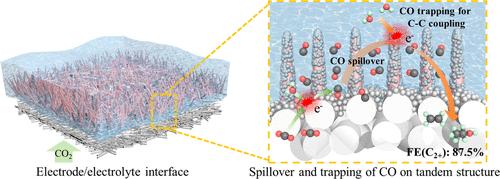
The electrochemical CO2 reduction reaction (CO2RR) to produce multicarbon (C2+) hydrocarbons or oxygenate compounds is a promising route to obtain a renewable fuel or valuable chemicals; however, producing C2+ at high current densities is still a challenge. Herein, we design a hierarchically structured tandem catalysis electrode for greatly improved catalytic activity and selectivity for C2+ products. The tandem catalysis electrode is constructed of a sputtered Ag nanoparticle layer on a hydrophobic polytetrafluoroethylene (PTFE) membrane and a layer of nitrogen-doped carbon (NC)-modified Cu nanowire arrays. The Cu nanowire arrays are in situ grown on PTFE by electrochemical oxidation of sputtered CuAl alloy, in which the chemical etching of metal Al induces the formation of a Cu nanowire array structure. Within hierarchical configuration, CO can be efficiently generated on an active Ag layer and then spillover and transfer to NC-modified Cu nanowire array layer, in which Cu/NC interfaces can enhance *CO trapping and adsorption. During the CO2RR, the optimized tandem catalysis electrode achieves superior Faradaic efficiencies of 53.5% and 87.5% for ethylene (C2H4) and C2+ products at the current density of 519.0 mA cm–2, respectively, with a high C2+/C1 ratio of 10.42 and long-term stability up to 50 h. In situ Raman and attenuated total reflection-surface enhanced infrared absorption spectroscopy (ATR-SEIRAS) confirm that the Ag–Cu–NC tandem catalysis system significantly enhances the linear adsorption of *CO intermediates and the dissociation of H2O, improves the C–C coupling capability, and stabilizes the key intermediate *OCCOH to produce C2+ products.
电化学CO2还原反应(CO2RR)生产多碳(C2+)烃或含氧化合物是获得可再生燃料或有价值化学品的一条有前途的途径;然而,在高电流密度下生产C2+仍然是一个挑战。在此,我们设计了一种分层结构的串联催化电极,大大提高了对C2+产物的催化活性和选择性。串联催化电极是由疏水性聚四氟乙烯(PTFE)膜上的溅射银纳米颗粒层和氮掺杂碳(NC)修饰的铜纳米线阵列层构成的。通过电化学氧化溅射CuAl合金在聚四氟乙烯上原位生长Cu纳米线阵列,其中金属Al的化学蚀刻诱导形成Cu纳米线阵列结构。在分层结构中,CO可以在活性Ag层上有效生成,然后溢出并转移到NC修饰的Cu纳米线阵列层中,Cu/NC界面可以增强CO的捕获和吸附。在CO2RR过程中,优化后的串联催化电极在519.0 mA cm-2电流密度下,对乙烯(C2H4)和C2+产物的法拉第效率分别达到了53.5%和87.5%。原位拉曼和衰减全反射-表面增强红外吸收光谱(ATR-SEIRAS)证实,Ag-Cu-NC串联催化体系显著增强了*CO中间体的线性吸附和H2O的解离,提高了C-C偶联能力,稳定了关键中间体*OCCOH生成C2+产物。
期刊介绍:
ACS Nano, published monthly, serves as an international forum for comprehensive articles on nanoscience and nanotechnology research at the intersections of chemistry, biology, materials science, physics, and engineering. The journal fosters communication among scientists in these communities, facilitating collaboration, new research opportunities, and advancements through discoveries. ACS Nano covers synthesis, assembly, characterization, theory, and simulation of nanostructures, nanobiotechnology, nanofabrication, methods and tools for nanoscience and nanotechnology, and self- and directed-assembly. Alongside original research articles, it offers thorough reviews, perspectives on cutting-edge research, and discussions envisioning the future of nanoscience and nanotechnology.



 京公网安备 11010802042870号
京ICP备2023020795号-1
京公网安备 11010802042870号
京ICP备2023020795号-1

 分享
分享
 求助内容:
求助内容: 应助结果提醒方式:
 扫码关注我们
