{"title":"Enhancing the cavitation erosion resistance of additive manufactured Al-Si alloys with strong connective Si networks","authors":"Cheng-Cheng Pan, Junwei Sha, Dezheng Sun, Zhenbo Qin, Wenbin Hu, Yashar Behnamian, Da-Hai Xia","doi":"10.1016/j.jmst.2025.02.006","DOIUrl":null,"url":null,"abstract":"Selective laser melting (SLM), a laser-powder bed fusion (L-PBF) additive manufacturing technique, demonstrates significant potential for enhancing the mechanical performance of Al-Si alloys. In this study, three representative hypoeutectic Al-Si alloys (AlSi7Mg, AlSi10Mg, and AlSi12) were fabricated via SLM additive manufacturing to systematically investigate the influence of silicon content on microstructural evolution and mechanical properties. Advanced characterization techniques including scanning electron microscopy (SEM), electron backscatter diffraction (EBSD), and transmission electron microscopy (TEM) were employed to systematically examine the cavitation erosion behavior of additive-manufactured Al-Si (AM Al-Si) alloys. The experimental findings reveal that varying silicon content predominantly alters the morphology and dimensions of the silicon network structure in AM Al-Si alloys, particularly through modulation of cellular silicon wall thickness. This microstructural modification was identified as the primary determinant in enhancing cavitation erosion (CE) resistance, with the refined silicon network architecture effectively impeding crack propagation and phase boundary delamination under CE conditions.","PeriodicalId":16154,"journal":{"name":"Journal of Materials Science & Technology","volume":"4 1","pages":""},"PeriodicalIF":14.3000,"publicationDate":"2025-02-28","publicationTypes":"Journal Article","fieldsOfStudy":null,"isOpenAccess":false,"openAccessPdf":"","citationCount":"0","resultStr":null,"platform":"Semanticscholar","paperid":null,"PeriodicalName":"Journal of Materials Science & Technology","FirstCategoryId":"88","ListUrlMain":"https://doi.org/10.1016/j.jmst.2025.02.006","RegionNum":1,"RegionCategory":"材料科学","ArticlePicture":[],"TitleCN":null,"AbstractTextCN":null,"PMCID":null,"EPubDate":"","PubModel":"","JCR":"Q1","JCRName":"MATERIALS SCIENCE, MULTIDISCIPLINARY","Score":null,"Total":0}
引用次数: 0
Abstract
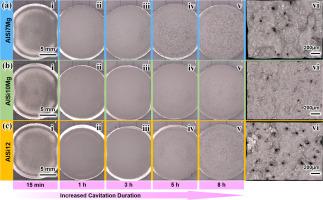
Selective laser melting (SLM), a laser-powder bed fusion (L-PBF) additive manufacturing technique, demonstrates significant potential for enhancing the mechanical performance of Al-Si alloys. In this study, three representative hypoeutectic Al-Si alloys (AlSi7Mg, AlSi10Mg, and AlSi12) were fabricated via SLM additive manufacturing to systematically investigate the influence of silicon content on microstructural evolution and mechanical properties. Advanced characterization techniques including scanning electron microscopy (SEM), electron backscatter diffraction (EBSD), and transmission electron microscopy (TEM) were employed to systematically examine the cavitation erosion behavior of additive-manufactured Al-Si (AM Al-Si) alloys. The experimental findings reveal that varying silicon content predominantly alters the morphology and dimensions of the silicon network structure in AM Al-Si alloys, particularly through modulation of cellular silicon wall thickness. This microstructural modification was identified as the primary determinant in enhancing cavitation erosion (CE) resistance, with the refined silicon network architecture effectively impeding crack propagation and phase boundary delamination under CE conditions.
期刊介绍:
Journal of Materials Science & Technology strives to promote global collaboration in the field of materials science and technology. It primarily publishes original research papers, invited review articles, letters, research notes, and summaries of scientific achievements. The journal covers a wide range of materials science and technology topics, including metallic materials, inorganic nonmetallic materials, and composite materials.



 京公网安备 11010802042870号
京ICP备2023020795号-1
京公网安备 11010802042870号
京ICP备2023020795号-1

 分享
分享
 求助内容:
求助内容: 应助结果提醒方式:
 扫码关注我们
