Qing–fei Sun , Ke–yong Wang , Chen–guang Zhao , Nan Wang , Zhi-bo Liu , Ju-xing Tang , Bao–ping Gan , Qiu-ming Pei , Dong Xu
{"title":"Role of methane-rich fluids in mesothermal gold mineralization: Insights from the Chaihulanzi gold deposit, North China Craton","authors":"Qing–fei Sun , Ke–yong Wang , Chen–guang Zhao , Nan Wang , Zhi-bo Liu , Ju-xing Tang , Bao–ping Gan , Qiu-ming Pei , Dong Xu","doi":"10.1016/j.oregeorev.2025.106536","DOIUrl":null,"url":null,"abstract":"<div><div>Lode gold deposits in low-grade greenschist belt account for an estimated 40–45 % of the global gold endowment. Au-migrating fluids are commonly metamorphic, low-salinity, and aqueous-carbonic in nature, and flow along high-permeability fault zones where methane-rich fluids may appear under special physicochemical conditions. The Chaihulanzi deposit located in the northern margin of the North China Craton is a large lode Au deposit characterized by abundant methane-rich inclusions. In this study, we examined the nature and isotopic composition of ore-forming fluids to identify their origins, evolution, and roles in Au mineralization. Based on their nature and phase transition patterns, three types of fluid inclusion (FI) were identified: H<sub>2</sub>O–NaCl (type I), H<sub>2</sub>O–NaCl–CH<sub>4</sub>–CO<sub>2</sub> (type II), and CH<sub>4</sub>–CO<sub>2</sub> (type III). The primary type I FIs in stage I indicate that the initial hydrothermal fluids were a mesothermal low salinity NaCl–H<sub>2</sub>O–CO<sub>2</sub> system. Stage II fluids are characterized by coexisting assemblages of type I, IIa (carbon phase occupying 20–50 vol%), IIb (carbon phase occupying 50–80 vol%), IIIa (CO<sub>2</sub>–rich), and IIIb (CH<sub>4</sub>–rich) FIs, which display different homogenization modes at similar homogenization temperatures. The wide range of X<sub>CH4</sub> suggests the addition of a foreign methane-rich fluid, indicating that the ore-forming fluids evolved into a medium-to-low-temperature and low-salinity NaCl–H<sub>2</sub>O–CH<sub>4</sub>–CO<sub>2</sub> system. Abundant CH<sub>4</sub>–rich FIs in stage III indicate that the fluid was transformed into a medium-to-low temperature and low-salinity NaCl–H<sub>2</sub>O–CH<sub>4</sub> ± CO<sub>2</sub> system. The properties of stage IV FIs indicated a low-temperature and low-salinity NaCl–H<sub>2</sub>O system. The H–O–C isotope data of stage I suggest that the primary fluids were derived from a dominant magmatic origin. The increasingly depleted H–O–C isotope data indicate the progressive involvement of a foreign methane-rich fluid in stage II. The fluids in stage III show an increased degree of fluid mixing. In conclusion, our data confirmed that the primary ore-forming fluids were oxidizing mesothermal low-salinity NaCl–H<sub>2</sub>O–CO<sub>2</sub> systems. With the mixing process of wall-rock buffered fluids, the main metallogenic stage fluids evolved into a reductive medium-to-low temperature and low-salinity NaCl–H<sub>2</sub>O–CH<sub>4</sub>–CO<sub>2</sub> system. The precipitation of Au was attributed to the combined effects of phase separation, reducing methane agent, and sulfidation of iron-containing minerals.</div></div>","PeriodicalId":19644,"journal":{"name":"Ore Geology Reviews","volume":"179 ","pages":"Article 106536"},"PeriodicalIF":3.6000,"publicationDate":"2025-04-01","publicationTypes":"Journal Article","fieldsOfStudy":null,"isOpenAccess":false,"openAccessPdf":"","citationCount":"0","resultStr":null,"platform":"Semanticscholar","paperid":null,"PeriodicalName":"Ore Geology Reviews","FirstCategoryId":"89","ListUrlMain":"https://www.sciencedirect.com/science/article/pii/S0169136825000964","RegionNum":2,"RegionCategory":"地球科学","ArticlePicture":[],"TitleCN":null,"AbstractTextCN":null,"PMCID":null,"EPubDate":"2025/2/26 0:00:00","PubModel":"Epub","JCR":"Q1","JCRName":"GEOLOGY","Score":null,"Total":0}
引用次数: 0
Abstract
Lode gold deposits in low-grade greenschist belt account for an estimated 40–45 % of the global gold endowment. Au-migrating fluids are commonly metamorphic, low-salinity, and aqueous-carbonic in nature, and flow along high-permeability fault zones where methane-rich fluids may appear under special physicochemical conditions. The Chaihulanzi deposit located in the northern margin of the North China Craton is a large lode Au deposit characterized by abundant methane-rich inclusions. In this study, we examined the nature and isotopic composition of ore-forming fluids to identify their origins, evolution, and roles in Au mineralization. Based on their nature and phase transition patterns, three types of fluid inclusion (FI) were identified: H2O–NaCl (type I), H2O–NaCl–CH4–CO2 (type II), and CH4–CO2 (type III). The primary type I FIs in stage I indicate that the initial hydrothermal fluids were a mesothermal low salinity NaCl–H2O–CO2 system. Stage II fluids are characterized by coexisting assemblages of type I, IIa (carbon phase occupying 20–50 vol%), IIb (carbon phase occupying 50–80 vol%), IIIa (CO2–rich), and IIIb (CH4–rich) FIs, which display different homogenization modes at similar homogenization temperatures. The wide range of XCH4 suggests the addition of a foreign methane-rich fluid, indicating that the ore-forming fluids evolved into a medium-to-low-temperature and low-salinity NaCl–H2O–CH4–CO2 system. Abundant CH4–rich FIs in stage III indicate that the fluid was transformed into a medium-to-low temperature and low-salinity NaCl–H2O–CH4 ± CO2 system. The properties of stage IV FIs indicated a low-temperature and low-salinity NaCl–H2O system. The H–O–C isotope data of stage I suggest that the primary fluids were derived from a dominant magmatic origin. The increasingly depleted H–O–C isotope data indicate the progressive involvement of a foreign methane-rich fluid in stage II. The fluids in stage III show an increased degree of fluid mixing. In conclusion, our data confirmed that the primary ore-forming fluids were oxidizing mesothermal low-salinity NaCl–H2O–CO2 systems. With the mixing process of wall-rock buffered fluids, the main metallogenic stage fluids evolved into a reductive medium-to-low temperature and low-salinity NaCl–H2O–CH4–CO2 system. The precipitation of Au was attributed to the combined effects of phase separation, reducing methane agent, and sulfidation of iron-containing minerals.
期刊介绍:
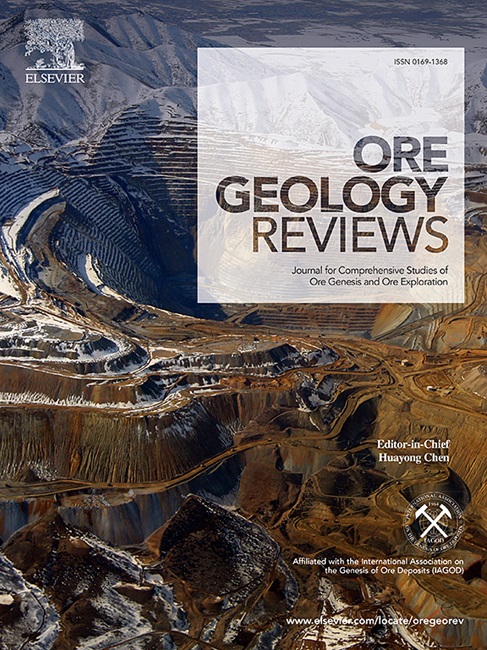
Ore Geology Reviews aims to familiarize all earth scientists with recent advances in a number of interconnected disciplines related to the study of, and search for, ore deposits. The reviews range from brief to longer contributions, but the journal preferentially publishes manuscripts that fill the niche between the commonly shorter journal articles and the comprehensive book coverages, and thus has a special appeal to many authors and readers.




 京公网安备 11010802042870号
京ICP备2023020795号-1
京公网安备 11010802042870号
京ICP备2023020795号-1

 分享
分享
 求助内容:
求助内容: 应助结果提醒方式:
 扫码关注我们
