Hang Truong, Alperen Abaci, Hadis Gharacheh and Murat Guvendiren
{"title":"Embedded bioprinting of dense cellular constructs in bone allograft-enhanced hydrogel matrices for bone tissue engineering†","authors":"Hang Truong, Alperen Abaci, Hadis Gharacheh and Murat Guvendiren","doi":"10.1039/D4BM01616E","DOIUrl":null,"url":null,"abstract":"<p >Bone tissue engineering aims to address critical-sized defects by developing biomimetic scaffolds that promote repair and regeneration. This study introduces a material extrusion-based embedded bioprinting approach to fabricate dense cellular constructs within methacrylated hyaluronic acid (MeHA) hydrogels enhanced with bioactive microparticles. Composite matrices containing human bone allograft or tricalcium phosphate (TCP) particles were evaluated for their rheological, mechanical, and osteoinductive properties. High cell viability (>95%) and uniform strand dimensions were achieved across all bioprinting conditions, demonstrating the method's ability to preserve cellular integrity and structural fidelity. The inclusion of bone or TCP particles did not significantly alter the viscosity, crosslinking kinetics, or compressive modulus of the MeHA hydrogels, ensuring robust mechanical stability and shape retention. However, bone allograft particles significantly enhanced osteogenic differentiation of human mesenchymal stem cells (hMSCs), as evidenced by increased alkaline phosphatase (ALP) activity and calcium deposition. Notably, osteogenesis was observed even in basal media, with a dose-dependent response to bone particle concentration, highlighting the intrinsic bioactivity of allograft particles. This study demonstrates the potential of combining embedded bioprinting with bioactive matrices to create dense, osteoinductive cellular constructs. The ability to induce osteogenesis without external growth factors positions this platform as a scalable and clinically relevant solution for bone repair and regeneration.</p>","PeriodicalId":65,"journal":{"name":"Biomaterials Science","volume":" 12","pages":" 3213-3222"},"PeriodicalIF":5.7000,"publicationDate":"2025-02-25","publicationTypes":"Journal Article","fieldsOfStudy":null,"isOpenAccess":false,"openAccessPdf":"","citationCount":"0","resultStr":null,"platform":"Semanticscholar","paperid":null,"PeriodicalName":"Biomaterials Science","FirstCategoryId":"5","ListUrlMain":"https://pubs.rsc.org/en/content/articlelanding/2025/bm/d4bm01616e","RegionNum":3,"RegionCategory":"医学","ArticlePicture":[],"TitleCN":null,"AbstractTextCN":null,"PMCID":null,"EPubDate":"","PubModel":"","JCR":"Q1","JCRName":"MATERIALS SCIENCE, BIOMATERIALS","Score":null,"Total":0}
引用次数: 0
Abstract
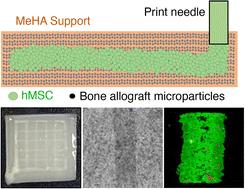
Bone tissue engineering aims to address critical-sized defects by developing biomimetic scaffolds that promote repair and regeneration. This study introduces a material extrusion-based embedded bioprinting approach to fabricate dense cellular constructs within methacrylated hyaluronic acid (MeHA) hydrogels enhanced with bioactive microparticles. Composite matrices containing human bone allograft or tricalcium phosphate (TCP) particles were evaluated for their rheological, mechanical, and osteoinductive properties. High cell viability (>95%) and uniform strand dimensions were achieved across all bioprinting conditions, demonstrating the method's ability to preserve cellular integrity and structural fidelity. The inclusion of bone or TCP particles did not significantly alter the viscosity, crosslinking kinetics, or compressive modulus of the MeHA hydrogels, ensuring robust mechanical stability and shape retention. However, bone allograft particles significantly enhanced osteogenic differentiation of human mesenchymal stem cells (hMSCs), as evidenced by increased alkaline phosphatase (ALP) activity and calcium deposition. Notably, osteogenesis was observed even in basal media, with a dose-dependent response to bone particle concentration, highlighting the intrinsic bioactivity of allograft particles. This study demonstrates the potential of combining embedded bioprinting with bioactive matrices to create dense, osteoinductive cellular constructs. The ability to induce osteogenesis without external growth factors positions this platform as a scalable and clinically relevant solution for bone repair and regeneration.
期刊介绍:
Biomaterials Science is an international high impact journal exploring the science of biomaterials and their translation towards clinical use. Its scope encompasses new concepts in biomaterials design, studies into the interaction of biomaterials with the body, and the use of materials to answer fundamental biological questions.





 京公网安备 11010802042870号
京ICP备2023020795号-1
京公网安备 11010802042870号
京ICP备2023020795号-1

 分享
分享
 求助内容:
求助内容: 应助结果提醒方式:
 扫码关注我们
