Yifan Li, Weiwei Wang, Jiale Xu, Bei Zhao, Longying Xiong, Dan Ge, Yanping Wu, Xiaotan Dou, Yuping Fu, Lei Wang, Cheng Zhao and Min Chen
{"title":"Tumor signal amplification and immune decoy strategy using bacterial membrane-coated nanoparticles for immunotherapy†","authors":"Yifan Li, Weiwei Wang, Jiale Xu, Bei Zhao, Longying Xiong, Dan Ge, Yanping Wu, Xiaotan Dou, Yuping Fu, Lei Wang, Cheng Zhao and Min Chen","doi":"10.1039/D4BM01535E","DOIUrl":null,"url":null,"abstract":"<p >In cancer therapy, tumor cells can diminish their signals through mechanisms such as immune escape, thereby evading recognition and elimination by the immune system. Providing tumor signals to enhance the recognition of tumor sites is considered a crucial approach in cancer treatment. Inspired by the decoy-induced directed feeding of fish, we propose a biomimetic nanoparticle system for tumor signal amplification. This biomimetic system comprises magnetically responsive nanoparticles and immune-inducing bacterial membranes. These designs work together to create a baiting effect at the tumor site, attracting and activating immune cells to attack. It has been demonstrated that the generated nanoparticles have the potential to be targeted and delivered to the tumor site under the influence of an external magnetic field, as demonstrated in preliminary <em>in vitro</em> and <em>in vivo</em> studies. Moreover, the nanoparticles utilize the bacterial membrane and cell membrane-translocated calreticulin to induce an immune response, simulating a decoy mechanism to recruit immune cells. The nanoparticles were proved to be effective in recruiting macrophages and neutrophils and reducing tumor size in animal experiments. These features make the nanoparticles an ideal candidate for treating tumors.</p>","PeriodicalId":65,"journal":{"name":"Biomaterials Science","volume":" 9","pages":" 2368-2380"},"PeriodicalIF":5.7000,"publicationDate":"2025-03-19","publicationTypes":"Journal Article","fieldsOfStudy":null,"isOpenAccess":false,"openAccessPdf":"","citationCount":"0","resultStr":null,"platform":"Semanticscholar","paperid":null,"PeriodicalName":"Biomaterials Science","FirstCategoryId":"5","ListUrlMain":"https://pubs.rsc.org/en/content/articlelanding/2025/bm/d4bm01535e","RegionNum":3,"RegionCategory":"医学","ArticlePicture":[],"TitleCN":null,"AbstractTextCN":null,"PMCID":null,"EPubDate":"","PubModel":"","JCR":"Q1","JCRName":"MATERIALS SCIENCE, BIOMATERIALS","Score":null,"Total":0}
引用次数: 0
Abstract
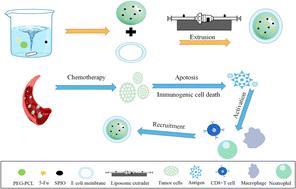
In cancer therapy, tumor cells can diminish their signals through mechanisms such as immune escape, thereby evading recognition and elimination by the immune system. Providing tumor signals to enhance the recognition of tumor sites is considered a crucial approach in cancer treatment. Inspired by the decoy-induced directed feeding of fish, we propose a biomimetic nanoparticle system for tumor signal amplification. This biomimetic system comprises magnetically responsive nanoparticles and immune-inducing bacterial membranes. These designs work together to create a baiting effect at the tumor site, attracting and activating immune cells to attack. It has been demonstrated that the generated nanoparticles have the potential to be targeted and delivered to the tumor site under the influence of an external magnetic field, as demonstrated in preliminary in vitro and in vivo studies. Moreover, the nanoparticles utilize the bacterial membrane and cell membrane-translocated calreticulin to induce an immune response, simulating a decoy mechanism to recruit immune cells. The nanoparticles were proved to be effective in recruiting macrophages and neutrophils and reducing tumor size in animal experiments. These features make the nanoparticles an ideal candidate for treating tumors.
期刊介绍:
Biomaterials Science is an international high impact journal exploring the science of biomaterials and their translation towards clinical use. Its scope encompasses new concepts in biomaterials design, studies into the interaction of biomaterials with the body, and the use of materials to answer fundamental biological questions.



 京公网安备 11010802042870号
京ICP备2023020795号-1
京公网安备 11010802042870号
京ICP备2023020795号-1

 分享
分享
 求助内容:
求助内容: 应助结果提醒方式:
 扫码关注我们
