Achut Prasad Silwal, Siddhartha Kalpa Samadhi Thennakoon, Raunak Jahan, Satya Prakash Arya, Rick Mason Postema, Hari Prasad Timilsina, Andrew Michael Reynolds, Kaytelee Brooke Kokensparger and Xiaohong Tan*,
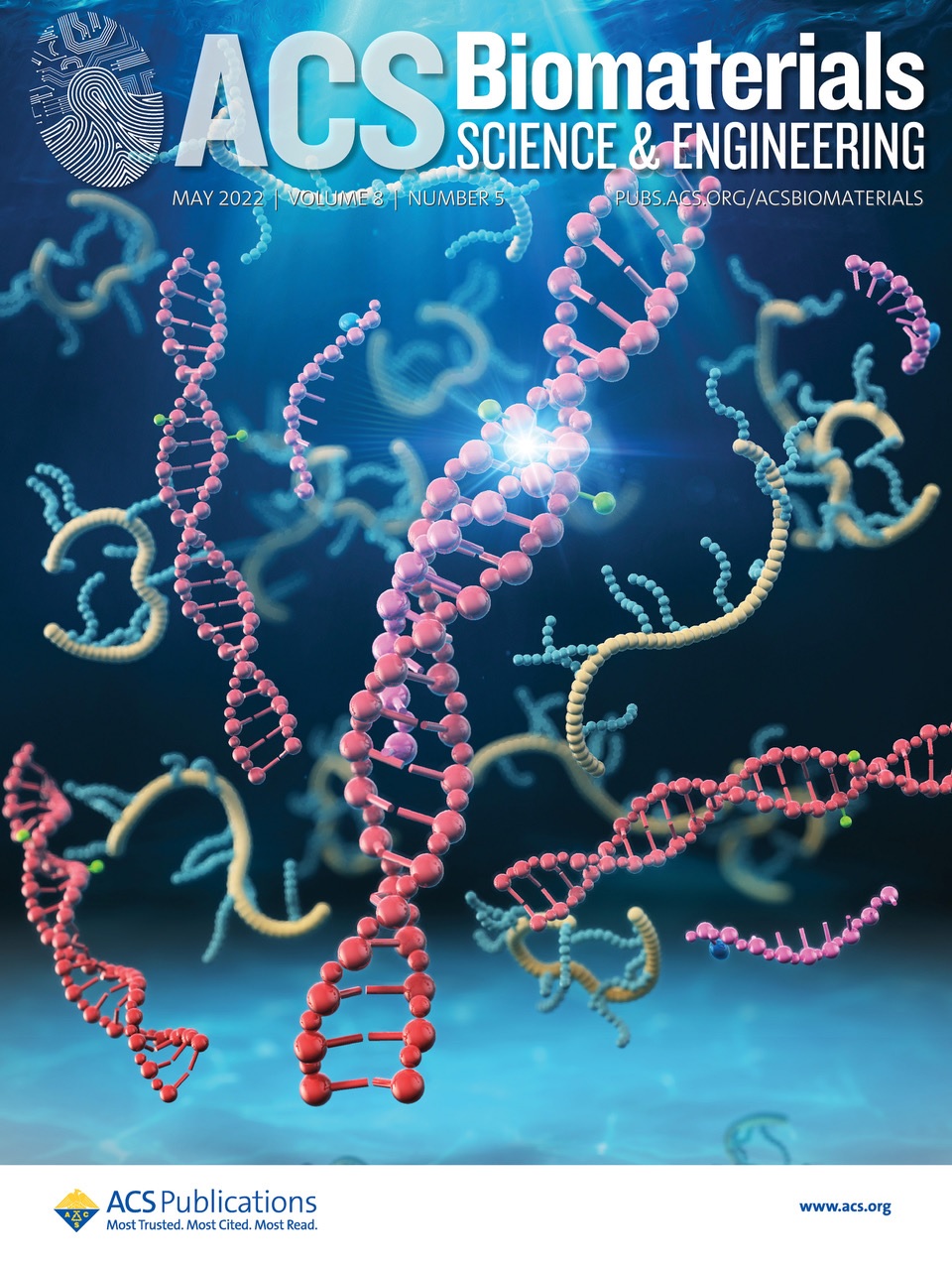
{"title":"Aptamer-Assisted DNA SELEX: Dual-Site Targeting of a Single Protein","authors":"Achut Prasad Silwal, Siddhartha Kalpa Samadhi Thennakoon, Raunak Jahan, Satya Prakash Arya, Rick Mason Postema, Hari Prasad Timilsina, Andrew Michael Reynolds, Kaytelee Brooke Kokensparger and Xiaohong Tan*, ","doi":"10.1021/acsbiomaterials.4c02053","DOIUrl":null,"url":null,"abstract":"<p >Heterobivalent fusion aptamers that target a single protein show significant promise for studying protein–protein interactions. However, a major challenge is finding two distinct aptamers that can simultaneously recognize the same protein. In this study, we used a novel technique called Aptamer-Assisted DNA SELEX (AADS) to isolate two distinct aptamers capable of recognizing different sites on the programmed death-ligand 1 (PD-L1) protein. Initially, Aptamer 1 (P1C2) was identified by using conventional DNA SELEX targeting the PD-L1 protein. Subsequently, Aptamer 2 (P1CSC) was obtained via AADS, which was designed to bind to the PD-L1/P1C2 complex. After confirming that both aptamers could simultaneously recognize the PD-L1 protein, we engineered fusion aptamers by optimizing their orientation and linker sequences, resulting in the creation of the optimized fusion aptamer, P1CSC-T7-P1C1. Our fusion aptamer targeting PD-L1 demonstrated remarkable specificity and affinity, effectively inhibiting PD-1/PD-L1 interactions at both the protein and cellular levels. These findings highlight the potential of fusion aptamers via AADS as powerful tools for targeting the PD-L1 protein and cancer cells (A549 cells). This represents a significant advancement in aptamer-based molecular recognition and has the potential to drive innovation as a versatile method for targeting a wide range of proteins.</p>","PeriodicalId":8,"journal":{"name":"ACS Biomaterials Science & Engineering","volume":"11 8","pages":"5085–5095"},"PeriodicalIF":5.5000,"publicationDate":"2025-02-27","publicationTypes":"Journal Article","fieldsOfStudy":null,"isOpenAccess":false,"openAccessPdf":"","citationCount":"0","resultStr":null,"platform":"Semanticscholar","paperid":null,"PeriodicalName":"ACS Biomaterials Science & Engineering","FirstCategoryId":"5","ListUrlMain":"https://pubs.acs.org/doi/10.1021/acsbiomaterials.4c02053","RegionNum":2,"RegionCategory":"医学","ArticlePicture":[],"TitleCN":null,"AbstractTextCN":null,"PMCID":null,"EPubDate":"","PubModel":"","JCR":"Q2","JCRName":"MATERIALS SCIENCE, BIOMATERIALS","Score":null,"Total":0}
引用次数: 0
Abstract
Heterobivalent fusion aptamers that target a single protein show significant promise for studying protein–protein interactions. However, a major challenge is finding two distinct aptamers that can simultaneously recognize the same protein. In this study, we used a novel technique called Aptamer-Assisted DNA SELEX (AADS) to isolate two distinct aptamers capable of recognizing different sites on the programmed death-ligand 1 (PD-L1) protein. Initially, Aptamer 1 (P1C2) was identified by using conventional DNA SELEX targeting the PD-L1 protein. Subsequently, Aptamer 2 (P1CSC) was obtained via AADS, which was designed to bind to the PD-L1/P1C2 complex. After confirming that both aptamers could simultaneously recognize the PD-L1 protein, we engineered fusion aptamers by optimizing their orientation and linker sequences, resulting in the creation of the optimized fusion aptamer, P1CSC-T7-P1C1. Our fusion aptamer targeting PD-L1 demonstrated remarkable specificity and affinity, effectively inhibiting PD-1/PD-L1 interactions at both the protein and cellular levels. These findings highlight the potential of fusion aptamers via AADS as powerful tools for targeting the PD-L1 protein and cancer cells (A549 cells). This represents a significant advancement in aptamer-based molecular recognition and has the potential to drive innovation as a versatile method for targeting a wide range of proteins.
期刊介绍:
ACS Biomaterials Science & Engineering is the leading journal in the field of biomaterials, serving as an international forum for publishing cutting-edge research and innovative ideas on a broad range of topics:
Applications and Health – implantable tissues and devices, prosthesis, health risks, toxicology
Bio-interactions and Bio-compatibility – material-biology interactions, chemical/morphological/structural communication, mechanobiology, signaling and biological responses, immuno-engineering, calcification, coatings, corrosion and degradation of biomaterials and devices, biophysical regulation of cell functions
Characterization, Synthesis, and Modification – new biomaterials, bioinspired and biomimetic approaches to biomaterials, exploiting structural hierarchy and architectural control, combinatorial strategies for biomaterials discovery, genetic biomaterials design, synthetic biology, new composite systems, bionics, polymer synthesis
Controlled Release and Delivery Systems – biomaterial-based drug and gene delivery, bio-responsive delivery of regulatory molecules, pharmaceutical engineering
Healthcare Advances – clinical translation, regulatory issues, patient safety, emerging trends
Imaging and Diagnostics – imaging agents and probes, theranostics, biosensors, monitoring
Manufacturing and Technology – 3D printing, inks, organ-on-a-chip, bioreactor/perfusion systems, microdevices, BioMEMS, optics and electronics interfaces with biomaterials, systems integration
Modeling and Informatics Tools – scaling methods to guide biomaterial design, predictive algorithms for structure-function, biomechanics, integrating bioinformatics with biomaterials discovery, metabolomics in the context of biomaterials
Tissue Engineering and Regenerative Medicine – basic and applied studies, cell therapies, scaffolds, vascularization, bioartificial organs, transplantation and functionality, cellular agriculture




 京公网安备 11010802042870号
京ICP备2023020795号-1
京公网安备 11010802042870号
京ICP备2023020795号-1

 分享
分享
 求助内容:
求助内容: 应助结果提醒方式:
 扫码关注我们
