Julio F Mateus-Nino, Julia Wynn, Jenny Wiggins-Smith, J Brett Bryant, J Kris Citty, J Kyle Citty, Samir Ahuja, Roger Newman
{"title":"Clinical Performance of Cell-Free DNA for Fetal RhD Detection in RhD-Negative Pregnant Individuals in the United States.","authors":"Julio F Mateus-Nino, Julia Wynn, Jenny Wiggins-Smith, J Brett Bryant, J Kris Citty, J Kyle Citty, Samir Ahuja, Roger Newman","doi":"10.1097/AOG.0000000000005850","DOIUrl":null,"url":null,"abstract":"<p><strong>Objective: </strong>To evaluate the performance of a cell-free DNA (cfDNA) assay that uses next-generation sequencing with quantitative counting templates for the clinical detection of the fetal RHD genotype in a diverse RhD-negative pregnant population in the United States.</p><p><strong>Methods: </strong>This retrospective cohort study was conducted in four U.S. health care centers. The same next-generation sequencing quantitative counting template cfDNA fetal RhD assay was offered to nonalloimmunized RhD-negative pregnant individuals as part of clinical care. Rh immune globulin (RhIG) was administered at the discretion of the clinician. The sensitivity, specificity, and accuracy of the assay were calculated considering the neonatal RhD serology results.</p><p><strong>Results: </strong>A total of 401 nonalloimmunized RhD-negative pregnant individuals who received clinical care in the period from August 2020 to November 2023 were included in the analysis. The D antigen cfDNA result was 100% concordant with the neonatal serology, resulting in 100% sensitivity, 100% positive predictive value (95% CI, 98.6-100% for both), 100% specificity, and 100% negative predictive value (95% CI, 97.4-100% for both). There were 10 pregnant individuals in whom the cfDNA analysis identified a non- RHD gene deletion, including RhDΨ (n=5) and RHD-CE-D hybrid variants (n=5). Rh immune globulin was administered antenatally to 93.1% of pregnant individuals, with cfDNA results indicating an RhD-positive fetus compared with 75.0% of pregnant individuals with cfDNA results indicating an RhD-negative fetus, signifying that clinicians were using the cfDNA results to guide pregnancy management.</p><p><strong>Conclusion: </strong>This next-generation sequencing with quantitative counting templates cfDNA analysis for detecting fetal RhD status is highly accurate with no false-positive or false-negative results in 401 racially and ethnically diverse pregnant individuals with 100% follow-up of all live births. This study and prior studies of this assay support a recommendation to offer cfDNA screening for fetal Rh status as an alternative option to prophylactic RhIG for all nonalloimmunized RhD-negative individuals, which will result in more efficient and targeted prenatal care with administration of RhIG only when medically indicated.</p>","PeriodicalId":19483,"journal":{"name":"Obstetrics and gynecology","volume":" ","pages":"402-408"},"PeriodicalIF":4.7000,"publicationDate":"2025-04-01","publicationTypes":"Journal Article","fieldsOfStudy":null,"isOpenAccess":false,"openAccessPdf":"https://www.ncbi.nlm.nih.gov/pmc/articles/PMC11913240/pdf/","citationCount":"0","resultStr":null,"platform":"Semanticscholar","paperid":null,"PeriodicalName":"Obstetrics and gynecology","FirstCategoryId":"3","ListUrlMain":"https://doi.org/10.1097/AOG.0000000000005850","RegionNum":2,"RegionCategory":"医学","ArticlePicture":[],"TitleCN":null,"AbstractTextCN":null,"PMCID":null,"EPubDate":"2025/2/27 0:00:00","PubModel":"Epub","JCR":"Q1","JCRName":"OBSTETRICS & GYNECOLOGY","Score":null,"Total":0}
引用次数: 0
Abstract
Objective: To evaluate the performance of a cell-free DNA (cfDNA) assay that uses next-generation sequencing with quantitative counting templates for the clinical detection of the fetal RHD genotype in a diverse RhD-negative pregnant population in the United States.
Methods: This retrospective cohort study was conducted in four U.S. health care centers. The same next-generation sequencing quantitative counting template cfDNA fetal RhD assay was offered to nonalloimmunized RhD-negative pregnant individuals as part of clinical care. Rh immune globulin (RhIG) was administered at the discretion of the clinician. The sensitivity, specificity, and accuracy of the assay were calculated considering the neonatal RhD serology results.
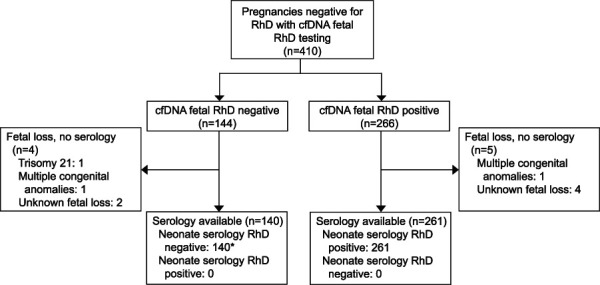
Results: A total of 401 nonalloimmunized RhD-negative pregnant individuals who received clinical care in the period from August 2020 to November 2023 were included in the analysis. The D antigen cfDNA result was 100% concordant with the neonatal serology, resulting in 100% sensitivity, 100% positive predictive value (95% CI, 98.6-100% for both), 100% specificity, and 100% negative predictive value (95% CI, 97.4-100% for both). There were 10 pregnant individuals in whom the cfDNA analysis identified a non- RHD gene deletion, including RhDΨ (n=5) and RHD-CE-D hybrid variants (n=5). Rh immune globulin was administered antenatally to 93.1% of pregnant individuals, with cfDNA results indicating an RhD-positive fetus compared with 75.0% of pregnant individuals with cfDNA results indicating an RhD-negative fetus, signifying that clinicians were using the cfDNA results to guide pregnancy management.
Conclusion: This next-generation sequencing with quantitative counting templates cfDNA analysis for detecting fetal RhD status is highly accurate with no false-positive or false-negative results in 401 racially and ethnically diverse pregnant individuals with 100% follow-up of all live births. This study and prior studies of this assay support a recommendation to offer cfDNA screening for fetal Rh status as an alternative option to prophylactic RhIG for all nonalloimmunized RhD-negative individuals, which will result in more efficient and targeted prenatal care with administration of RhIG only when medically indicated.
期刊介绍:
"Obstetrics & Gynecology," affectionately known as "The Green Journal," is the official publication of the American College of Obstetricians and Gynecologists (ACOG). Since its inception in 1953, the journal has been dedicated to advancing the clinical practice of obstetrics and gynecology, as well as related fields. The journal's mission is to promote excellence in these areas by publishing a diverse range of articles that cover translational and clinical topics.
"Obstetrics & Gynecology" provides a platform for the dissemination of evidence-based research, clinical guidelines, and expert opinions that are essential for the continuous improvement of women's health care. The journal's content is designed to inform and educate obstetricians, gynecologists, and other healthcare professionals, ensuring that they stay abreast of the latest developments and best practices in their field.





 京公网安备 11010802042870号
京ICP备2023020795号-1
京公网安备 11010802042870号
京ICP备2023020795号-1

 分享
分享
 求助内容:
求助内容: 应助结果提醒方式:
 扫码关注我们
