{"title":"Assessment of anxiety, depression, and sexual dysfunction in women undergoing fertility treatment.","authors":"Joon Cheol Park","doi":"10.5653/cerm.2024.07465","DOIUrl":null,"url":null,"abstract":"<p><strong>Objective: </strong>Infertility and fertility treatment can lead to considerable physical, emotional, and psychological distress. These effects may be influenced by personality, familial bonds, and support systems within a sociocultural context. This preliminary investigation examined anxiety, depression, and sexual dysfunction in Korean women undergoing in vitro fertilization (IVF)/intracytoplasmic sperm injection (ICSI).</p><p><strong>Methods: </strong>Women scheduled for IVF/ICSI and healthy women seeking general health screening (controls) were enrolled. Participants were asked to complete standardized, validated questionnaires-the Hospital Anxiety and Depression Scale (HADS), Depression Anxiety and Stress Scale (DASS), and Female Sexual Function Index (FSFI)-to assess their levels of anxiety, depression, and sexual function.</p><p><strong>Results: </strong>The mean HADS scores for women undergoing IVF/ICSI were 6.35±3.48 (range, 0 to 13) for anxiety and 8.32±3.78 (range, 2 to 15) for depression. However, 12.9% of the women with infertility experienced clinically significant anxiety (HADS-Anxiety score >11), while 32.3% exhibited depression (HADS-Depression score >11). Based on DASS scores, psychological difficulties were more prevalent among women experiencing infertility than among control participants. Total FSFI scores, along with subscale ratings for desire, arousal, lubrication, satisfaction, and pain, were similar between women with infertility and control women. However, the mean score for orgasm was significantly lower in the infertility group (3.16) than among controls. Age, the durations of marriage and infertility, and parity did not significantly influence HADS, DASS, or FSFI scores.</p><p><strong>Conclusion: </strong>Anxiety and depression were more prevalent among women seeking fertility treatment than among healthy controls. Additionally, women with infertility may experience fewer or diminished orgasms.</p>","PeriodicalId":46409,"journal":{"name":"Clinical and Experimental Reproductive Medicine-CERM","volume":"52 1","pages":"38-43"},"PeriodicalIF":1.6000,"publicationDate":"2025-03-01","publicationTypes":"Journal Article","fieldsOfStudy":null,"isOpenAccess":false,"openAccessPdf":"https://www.ncbi.nlm.nih.gov/pmc/articles/PMC11900670/pdf/","citationCount":"0","resultStr":null,"platform":"Semanticscholar","paperid":null,"PeriodicalName":"Clinical and Experimental Reproductive Medicine-CERM","FirstCategoryId":"1085","ListUrlMain":"https://doi.org/10.5653/cerm.2024.07465","RegionNum":0,"RegionCategory":null,"ArticlePicture":[],"TitleCN":null,"AbstractTextCN":null,"PMCID":null,"EPubDate":"2025/2/28 0:00:00","PubModel":"Epub","JCR":"Q3","JCRName":"OBSTETRICS & GYNECOLOGY","Score":null,"Total":0}
引用次数: 0
Abstract
Objective: Infertility and fertility treatment can lead to considerable physical, emotional, and psychological distress. These effects may be influenced by personality, familial bonds, and support systems within a sociocultural context. This preliminary investigation examined anxiety, depression, and sexual dysfunction in Korean women undergoing in vitro fertilization (IVF)/intracytoplasmic sperm injection (ICSI).
Methods: Women scheduled for IVF/ICSI and healthy women seeking general health screening (controls) were enrolled. Participants were asked to complete standardized, validated questionnaires-the Hospital Anxiety and Depression Scale (HADS), Depression Anxiety and Stress Scale (DASS), and Female Sexual Function Index (FSFI)-to assess their levels of anxiety, depression, and sexual function.
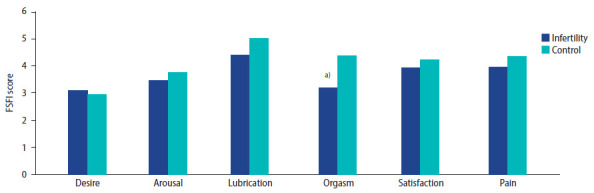
Results: The mean HADS scores for women undergoing IVF/ICSI were 6.35±3.48 (range, 0 to 13) for anxiety and 8.32±3.78 (range, 2 to 15) for depression. However, 12.9% of the women with infertility experienced clinically significant anxiety (HADS-Anxiety score >11), while 32.3% exhibited depression (HADS-Depression score >11). Based on DASS scores, psychological difficulties were more prevalent among women experiencing infertility than among control participants. Total FSFI scores, along with subscale ratings for desire, arousal, lubrication, satisfaction, and pain, were similar between women with infertility and control women. However, the mean score for orgasm was significantly lower in the infertility group (3.16) than among controls. Age, the durations of marriage and infertility, and parity did not significantly influence HADS, DASS, or FSFI scores.
Conclusion: Anxiety and depression were more prevalent among women seeking fertility treatment than among healthy controls. Additionally, women with infertility may experience fewer or diminished orgasms.



 京公网安备 11010802042870号
京ICP备2023020795号-1
京公网安备 11010802042870号
京ICP备2023020795号-1

 分享
分享

 求助内容:
求助内容: 应助结果提醒方式:
 扫码关注我们
