Hongli Li , Na Zhang , Jie Qiang , Yongsheng Cao , Guoyi Qu , Xiuzhu Yu
{"title":"Impact of short-term storage of olive fruits on the quality of virgin olive oil","authors":"Hongli Li , Na Zhang , Jie Qiang , Yongsheng Cao , Guoyi Qu , Xiuzhu Yu","doi":"10.1016/j.foodchem.2025.143640","DOIUrl":null,"url":null,"abstract":"<div><div>Olives are prone to deterioration during storage, and suitable storage conditions must, therefore, be established to maintain the quality of the fruit and oil. This study investigated the effect of storing olives at room temperature (23 ± 2 °C), refrigerated (4 °C), and frozen (−20 °C) conditions for 7 d on the quality of virgin olive oil (VOO). No significant differences (<em>p</em> < 0.05) were observed in the fatty acid, squalene, and phytosterol content of VOO across the three storage conditions. Room temperature storage produced the highest oil yield but resulted in ‘fermentation’ and ‘moldy’ off-flavors. Refrigerated VOO retained a more intense ‘grass’ aroma and higher levels of pigments, α-tocopherol, and total phenols. In contrast, freezing led to significant losses in these components and produced the lowest oil yield. For optimal oil quality, olives should be stored at 4 °C if storage exceeds 24 h.</div></div>","PeriodicalId":318,"journal":{"name":"Food Chemistry","volume":"478 ","pages":"Article 143640"},"PeriodicalIF":9.8000,"publicationDate":"2025-06-30","publicationTypes":"Journal Article","fieldsOfStudy":null,"isOpenAccess":false,"openAccessPdf":"","citationCount":"0","resultStr":null,"platform":"Semanticscholar","paperid":null,"PeriodicalName":"Food Chemistry","FirstCategoryId":"97","ListUrlMain":"https://www.sciencedirect.com/science/article/pii/S030881462500891X","RegionNum":1,"RegionCategory":"农林科学","ArticlePicture":[],"TitleCN":null,"AbstractTextCN":null,"PMCID":null,"EPubDate":"2025/3/1 0:00:00","PubModel":"Epub","JCR":"Q1","JCRName":"CHEMISTRY, APPLIED","Score":null,"Total":0}
引用次数: 0
Abstract
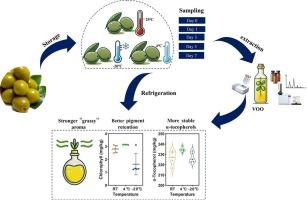
Olives are prone to deterioration during storage, and suitable storage conditions must, therefore, be established to maintain the quality of the fruit and oil. This study investigated the effect of storing olives at room temperature (23 ± 2 °C), refrigerated (4 °C), and frozen (−20 °C) conditions for 7 d on the quality of virgin olive oil (VOO). No significant differences (p < 0.05) were observed in the fatty acid, squalene, and phytosterol content of VOO across the three storage conditions. Room temperature storage produced the highest oil yield but resulted in ‘fermentation’ and ‘moldy’ off-flavors. Refrigerated VOO retained a more intense ‘grass’ aroma and higher levels of pigments, α-tocopherol, and total phenols. In contrast, freezing led to significant losses in these components and produced the lowest oil yield. For optimal oil quality, olives should be stored at 4 °C if storage exceeds 24 h.
期刊介绍:
Food Chemistry publishes original research papers dealing with the advancement of the chemistry and biochemistry of foods or the analytical methods/ approach used. All papers should focus on the novelty of the research carried out.





 京公网安备 11010802042870号
京ICP备2023020795号-1
京公网安备 11010802042870号
京ICP备2023020795号-1

 分享
分享
 求助内容:
求助内容: 应助结果提醒方式:
 扫码关注我们
