{"title":"Mapping Polysulfides in Sodium–Sulfur Batteries","authors":"Esther Lilian Gray, Jung-In Lee, Zhuangnan Li, James Moloney, Ziwei Jeffrey Yang, Manish Chhowalla","doi":"10.1021/acsnano.4c16941","DOIUrl":null,"url":null,"abstract":"Sodium–sulfur (Na–S) batteries provide lithium-free alternatives to lithium–sulfur (Li–S) batteries. Na–S chemistry has been less studied. Thus, the types of polysulfides (PS) and their evolution during charge–discharge of Na–S batteries are not as well understood as those in the Li–S system. We, therefore, study the formation of different PS in tetraethylene glycol dimethyl ether-based electrolyte during battery operation using <i>in situ</i> Raman and <i>ex situ</i> ultraviolet–visible (UV–vis) spectroscopies. We start by making reference solutions with different ratios of sodium sulfide (Na<sub>2</sub>S) to sulfur, ranging from pure Na<sub>2</sub>S to Na<sub>2</sub>S:7S, with the sulfur ratio increasing by one integer per solution. We then correlate the UV–vis and Raman peaks to PS species. Our galvanostatic charge–discharge (GCD) and cyclic voltammetry measurements show a total of ten features. Using <i>ex situ</i> UV–vis on aliquots and <i>in situ</i> Raman spectra from PS solutions at GCD voltage plateaus, we map out sodium polysulfide (NaPS) species at key stages of the charge–discharge cycle. We identify Na<sub>2</sub>S<sub>8</sub>, Na<sub>2</sub>S<sub>4</sub>, and Na<sub>2</sub>S<sub>2</sub> as intermediates and Na<sub>2</sub>S as the final product. We find that intermediate Na<sub>2</sub>S<sub>6</sub> forms from disproportionation of Na<sub>2</sub>S<sub>8</sub> and Na<sub>2</sub>S<sub>4</sub>. We also observe that intermediate PS can also dissociate into S<sub>3</sub><sup>•–</sup> radical species, which contributes to loss of active material. Our results provide detailed insights into Na–S chemistry that will be helpful for the development of high performance and stable batteries.","PeriodicalId":21,"journal":{"name":"ACS Nano","volume":"130 1","pages":""},"PeriodicalIF":16.0000,"publicationDate":"2025-02-28","publicationTypes":"Journal Article","fieldsOfStudy":null,"isOpenAccess":false,"openAccessPdf":"","citationCount":"0","resultStr":null,"platform":"Semanticscholar","paperid":null,"PeriodicalName":"ACS Nano","FirstCategoryId":"88","ListUrlMain":"https://doi.org/10.1021/acsnano.4c16941","RegionNum":1,"RegionCategory":"材料科学","ArticlePicture":[],"TitleCN":null,"AbstractTextCN":null,"PMCID":null,"EPubDate":"","PubModel":"","JCR":"Q1","JCRName":"CHEMISTRY, MULTIDISCIPLINARY","Score":null,"Total":0}
引用次数: 0
Abstract
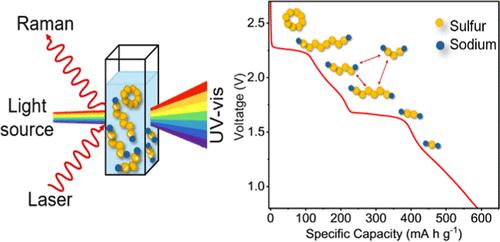
Sodium–sulfur (Na–S) batteries provide lithium-free alternatives to lithium–sulfur (Li–S) batteries. Na–S chemistry has been less studied. Thus, the types of polysulfides (PS) and their evolution during charge–discharge of Na–S batteries are not as well understood as those in the Li–S system. We, therefore, study the formation of different PS in tetraethylene glycol dimethyl ether-based electrolyte during battery operation using in situ Raman and ex situ ultraviolet–visible (UV–vis) spectroscopies. We start by making reference solutions with different ratios of sodium sulfide (Na2S) to sulfur, ranging from pure Na2S to Na2S:7S, with the sulfur ratio increasing by one integer per solution. We then correlate the UV–vis and Raman peaks to PS species. Our galvanostatic charge–discharge (GCD) and cyclic voltammetry measurements show a total of ten features. Using ex situ UV–vis on aliquots and in situ Raman spectra from PS solutions at GCD voltage plateaus, we map out sodium polysulfide (NaPS) species at key stages of the charge–discharge cycle. We identify Na2S8, Na2S4, and Na2S2 as intermediates and Na2S as the final product. We find that intermediate Na2S6 forms from disproportionation of Na2S8 and Na2S4. We also observe that intermediate PS can also dissociate into S3•– radical species, which contributes to loss of active material. Our results provide detailed insights into Na–S chemistry that will be helpful for the development of high performance and stable batteries.
期刊介绍:
ACS Nano, published monthly, serves as an international forum for comprehensive articles on nanoscience and nanotechnology research at the intersections of chemistry, biology, materials science, physics, and engineering. The journal fosters communication among scientists in these communities, facilitating collaboration, new research opportunities, and advancements through discoveries. ACS Nano covers synthesis, assembly, characterization, theory, and simulation of nanostructures, nanobiotechnology, nanofabrication, methods and tools for nanoscience and nanotechnology, and self- and directed-assembly. Alongside original research articles, it offers thorough reviews, perspectives on cutting-edge research, and discussions envisioning the future of nanoscience and nanotechnology.



 京公网安备 11010802042870号
京ICP备2023020795号-1
京公网安备 11010802042870号
京ICP备2023020795号-1

 分享
分享
 求助内容:
求助内容: 应助结果提醒方式:
 扫码关注我们
