Zhongqi Miao, Benjamin Elizalde, Soham Deshmukh, Justin Kitzes, Huaming Wang, Rahul Dodhia, Juan Lavista Ferres
{"title":"Multi-modal Language models in bioacoustics with zero-shot transfer: a case study.","authors":"Zhongqi Miao, Benjamin Elizalde, Soham Deshmukh, Justin Kitzes, Huaming Wang, Rahul Dodhia, Juan Lavista Ferres","doi":"10.1038/s41598-025-89153-3","DOIUrl":null,"url":null,"abstract":"<p><p>Automatically detecting sound events with Artificial Intelligence (AI) has become increas- ingly popular in the field of bioacoustics, ecoacoustics, and soundscape ecology, particularly for wildlife monitoring and conservation. Conventional methods predominantly employ supervised learning techniques that depend on substantial amounts of manually annotated bioacoustic data. However, manual annotation in bioacoustics is tremendously resource- intensive in terms of both human labor and financial resources, and it requires considerable domain expertise. Moreover, the supervised learning framework limits the application scope to predefined categories within a closed setting. The recent advent of Multi-Modal Language Models has markedly enhanced the versatility and possibilities within the realm of AI appli- cations, as this technique addresses many of the challenges that inhibit the deployment of AI in real-world applications. In this paper, we explore the potential of Multi-Modal Language Models in the context of bioacoustics through a case study. We aim to showcase the potential and limitations of Multi-Modal Language Models in bioacoustic applications. In our case study, we applied an Audio-Language Model--a type of Multi-Modal Language Model that aligns language with audio / sound recording data--named CLAP (Contrastive Language-Audio Pretraining) to eight bioacoustic benchmarks covering a wide variety of sounds previously unfamiliar to the model. We demonstrate that CLAP, after simple prompt engineering, can effectively recognize group-level categories such as birds, frogs, and whales across the benchmarks without the need for specific model fine-tuning or additional training, achieving a zero-shot transfer recognition performance comparable to supervised learning baselines. Moreover, we show that CLAP has the potential to perform tasks previously unattainable with supervised bioacoustic approaches, such as estimating relative distances and discovering unknown animal species. On the other hand, we also identify limitations of CLAP, such as the model's inability to recognize fine-grained species-level categories and the reliance on manually engineered text prompts in real-world applications.</p>","PeriodicalId":21811,"journal":{"name":"Scientific Reports","volume":"15 1","pages":"7242"},"PeriodicalIF":3.9000,"publicationDate":"2025-02-28","publicationTypes":"Journal Article","fieldsOfStudy":null,"isOpenAccess":false,"openAccessPdf":"https://www.ncbi.nlm.nih.gov/pmc/articles/PMC11871236/pdf/","citationCount":"0","resultStr":null,"platform":"Semanticscholar","paperid":null,"PeriodicalName":"Scientific Reports","FirstCategoryId":"103","ListUrlMain":"https://doi.org/10.1038/s41598-025-89153-3","RegionNum":2,"RegionCategory":"综合性期刊","ArticlePicture":[],"TitleCN":null,"AbstractTextCN":null,"PMCID":null,"EPubDate":"","PubModel":"","JCR":"Q1","JCRName":"MULTIDISCIPLINARY SCIENCES","Score":null,"Total":0}
引用次数: 0
Abstract
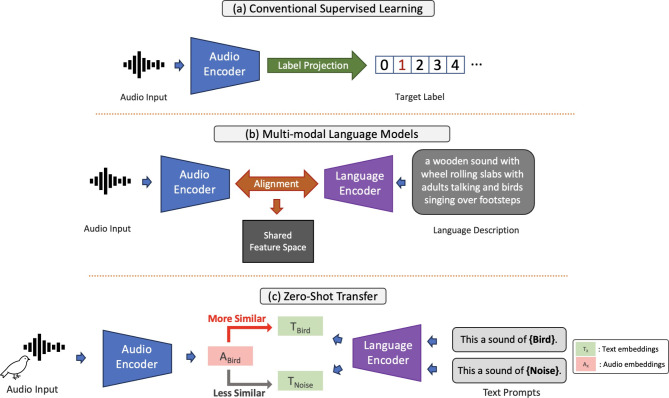
Automatically detecting sound events with Artificial Intelligence (AI) has become increas- ingly popular in the field of bioacoustics, ecoacoustics, and soundscape ecology, particularly for wildlife monitoring and conservation. Conventional methods predominantly employ supervised learning techniques that depend on substantial amounts of manually annotated bioacoustic data. However, manual annotation in bioacoustics is tremendously resource- intensive in terms of both human labor and financial resources, and it requires considerable domain expertise. Moreover, the supervised learning framework limits the application scope to predefined categories within a closed setting. The recent advent of Multi-Modal Language Models has markedly enhanced the versatility and possibilities within the realm of AI appli- cations, as this technique addresses many of the challenges that inhibit the deployment of AI in real-world applications. In this paper, we explore the potential of Multi-Modal Language Models in the context of bioacoustics through a case study. We aim to showcase the potential and limitations of Multi-Modal Language Models in bioacoustic applications. In our case study, we applied an Audio-Language Model--a type of Multi-Modal Language Model that aligns language with audio / sound recording data--named CLAP (Contrastive Language-Audio Pretraining) to eight bioacoustic benchmarks covering a wide variety of sounds previously unfamiliar to the model. We demonstrate that CLAP, after simple prompt engineering, can effectively recognize group-level categories such as birds, frogs, and whales across the benchmarks without the need for specific model fine-tuning or additional training, achieving a zero-shot transfer recognition performance comparable to supervised learning baselines. Moreover, we show that CLAP has the potential to perform tasks previously unattainable with supervised bioacoustic approaches, such as estimating relative distances and discovering unknown animal species. On the other hand, we also identify limitations of CLAP, such as the model's inability to recognize fine-grained species-level categories and the reliance on manually engineered text prompts in real-world applications.
期刊介绍:
We publish original research from all areas of the natural sciences, psychology, medicine and engineering. You can learn more about what we publish by browsing our specific scientific subject areas below or explore Scientific Reports by browsing all articles and collections.
Scientific Reports has a 2-year impact factor: 4.380 (2021), and is the 6th most-cited journal in the world, with more than 540,000 citations in 2020 (Clarivate Analytics, 2021).
•Engineering
Engineering covers all aspects of engineering, technology, and applied science. It plays a crucial role in the development of technologies to address some of the world''s biggest challenges, helping to save lives and improve the way we live.
•Physical sciences
Physical sciences are those academic disciplines that aim to uncover the underlying laws of nature — often written in the language of mathematics. It is a collective term for areas of study including astronomy, chemistry, materials science and physics.
•Earth and environmental sciences
Earth and environmental sciences cover all aspects of Earth and planetary science and broadly encompass solid Earth processes, surface and atmospheric dynamics, Earth system history, climate and climate change, marine and freshwater systems, and ecology. It also considers the interactions between humans and these systems.
•Biological sciences
Biological sciences encompass all the divisions of natural sciences examining various aspects of vital processes. The concept includes anatomy, physiology, cell biology, biochemistry and biophysics, and covers all organisms from microorganisms, animals to plants.
•Health sciences
The health sciences study health, disease and healthcare. This field of study aims to develop knowledge, interventions and technology for use in healthcare to improve the treatment of patients.




 京公网安备 11010802042870号
京ICP备2023020795号-1
京公网安备 11010802042870号
京ICP备2023020795号-1

 分享
分享
 求助内容:
求助内容: 应助结果提醒方式:
 扫码关注我们
