Mohammad Farhadpour , Guimei Liu , Qinglan Zhao , Qihua You , Mingguang Pan , Reza Bagheri , Gholamreza Pircheraghi , Minhua Shao
{"title":"Crosslinked polyfluorene-based membranes with well-balanced properties for anion exchange membrane fuel cells","authors":"Mohammad Farhadpour , Guimei Liu , Qinglan Zhao , Qihua You , Mingguang Pan , Reza Bagheri , Gholamreza Pircheraghi , Minhua Shao","doi":"10.1016/j.cej.2025.161203","DOIUrl":null,"url":null,"abstract":"<div><div>Developing high-performance anion exchange membranes (AEMs) with balanced properties is crucial for the advancement of AEM fuel cells. However, the current performance and durability of AEMs are not promising due to the lack of balance in their properties, where one property, such as swelling ratio, is often sacrificed for another, such as hydroxide conductivity. Consequently, despite recent progress, achieving a trade-off among the various properties of AEMs remains a substantial challenge. Herein, we address this issue through the optimization of crosslinking degree in ether-free polyfluorene-based AEMs. The results demonstrate that an optimal crosslinking degree significantly improves the swelling ratio (<15.9 %), water uptake (<78.0 %), and mechanical properties (>35 MPa), while simultaneously enhancing hydroxide conductivity (>144.6 mS cm <sup>-1</sup>), owing to improved microphase separated morphology. Moreover, the alkaline and oxidative stability of the prepared membranes surpasses that of most state-of-the-art AEMs and represents one of the best-reported chemical stability results, with over 93 – 95 % remaining hydroxide conductivity, ion exchange capacity, and tensile strength after 1080 h in 3 M NaOH solution at 80 °C. Furthermore, the AEM fuel cell achieves a peak power density of 1.03 W cm<sup>−2</sup> and excellent durability with a voltage decay rate of 0.62 mV h<sup>−1</sup>, surpassing the performance of commercial PiperION<sup>TM</sup> AEM under identical testing conditions.</div></div>","PeriodicalId":270,"journal":{"name":"Chemical Engineering Journal","volume":"509 ","pages":"Article 161203"},"PeriodicalIF":13.2000,"publicationDate":"2025-03-03","publicationTypes":"Journal Article","fieldsOfStudy":null,"isOpenAccess":false,"openAccessPdf":"","citationCount":"0","resultStr":null,"platform":"Semanticscholar","paperid":null,"PeriodicalName":"Chemical Engineering Journal","FirstCategoryId":"5","ListUrlMain":"https://www.sciencedirect.com/science/article/pii/S1385894725020248","RegionNum":1,"RegionCategory":"工程技术","ArticlePicture":[],"TitleCN":null,"AbstractTextCN":null,"PMCID":null,"EPubDate":"","PubModel":"","JCR":"Q1","JCRName":"ENGINEERING, CHEMICAL","Score":null,"Total":0}
引用次数: 0
Abstract
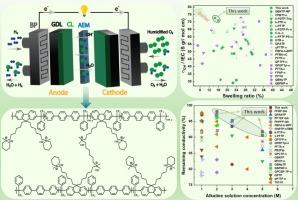
Developing high-performance anion exchange membranes (AEMs) with balanced properties is crucial for the advancement of AEM fuel cells. However, the current performance and durability of AEMs are not promising due to the lack of balance in their properties, where one property, such as swelling ratio, is often sacrificed for another, such as hydroxide conductivity. Consequently, despite recent progress, achieving a trade-off among the various properties of AEMs remains a substantial challenge. Herein, we address this issue through the optimization of crosslinking degree in ether-free polyfluorene-based AEMs. The results demonstrate that an optimal crosslinking degree significantly improves the swelling ratio (<15.9 %), water uptake (<78.0 %), and mechanical properties (>35 MPa), while simultaneously enhancing hydroxide conductivity (>144.6 mS cm -1), owing to improved microphase separated morphology. Moreover, the alkaline and oxidative stability of the prepared membranes surpasses that of most state-of-the-art AEMs and represents one of the best-reported chemical stability results, with over 93 – 95 % remaining hydroxide conductivity, ion exchange capacity, and tensile strength after 1080 h in 3 M NaOH solution at 80 °C. Furthermore, the AEM fuel cell achieves a peak power density of 1.03 W cm−2 and excellent durability with a voltage decay rate of 0.62 mV h−1, surpassing the performance of commercial PiperIONTM AEM under identical testing conditions.
开发性能平衡的高性能阴离子交换膜是推进阴离子交换膜燃料电池发展的关键。然而,由于其性能缺乏平衡,AEMs目前的性能和耐用性并不乐观,其中一种性能(如膨胀比)经常被另一种性能(如氢氧化物导电性)所牺牲。因此,尽管最近取得了进展,但在AEMs的各种特性之间实现权衡仍然是一个重大挑战。本文通过优化无醚聚芴基AEMs的交联度来解决这一问题。结果表明,最佳的交联度显著提高了溶胀率(<15.9 %)、吸水率(<78.0 %)和力学性能(>35 MPa),同时由于改善了微相分离形态,提高了氢氧化物的电导率(>144.6 mS cm -1)。此外,制备的膜的碱性和氧化稳定性超过了大多数最先进的AEMs,并代表了最好的化学稳定性结果之一,在80 °C的3 M NaOH溶液中,在1080 h后,剩余的氢氧化物电导率,离子交换容量和抗拉强度超过93 - 95% %。此外,AEM燃料电池实现了1.03 W cm−2的峰值功率密度和出色的耐久性,电压衰减率为0.62 mV h−1,超过了相同测试条件下的商用PiperIONTM AEM的性能。
期刊介绍:
The Chemical Engineering Journal is an international research journal that invites contributions of original and novel fundamental research. It aims to provide an international platform for presenting original fundamental research, interpretative reviews, and discussions on new developments in chemical engineering. The journal welcomes papers that describe novel theory and its practical application, as well as those that demonstrate the transfer of techniques from other disciplines. It also welcomes reports on carefully conducted experimental work that is soundly interpreted. The main focus of the journal is on original and rigorous research results that have broad significance. The Catalysis section within the Chemical Engineering Journal focuses specifically on Experimental and Theoretical studies in the fields of heterogeneous catalysis, molecular catalysis, and biocatalysis. These studies have industrial impact on various sectors such as chemicals, energy, materials, foods, healthcare, and environmental protection.



 京公网安备 11010802042870号
京ICP备2023020795号-1
京公网安备 11010802042870号
京ICP备2023020795号-1

 分享
分享
 求助内容:
求助内容: 应助结果提醒方式:
 扫码关注我们
