{"title":"Architectural influence of polymer brush-modified tri-compartmental anisotropic particles in stabilizing pickering emulsion","authors":"Subhashree Subhasmita Pradhan , Ashank Upadhyay , Samiksha Shrivastava , Awaneesh Singh , Sampa Saha","doi":"10.1016/j.polymer.2025.128222","DOIUrl":null,"url":null,"abstract":"<div><div>We aimed to create tri-compartmental polymeric particles (TPs), with selective areas conjugated with hydrophilic patches, to produce an array of amphiphilic particles with various architectures. Briefly, the electrohydrodynamic co-jetting technique (EHDC) was employed to produce 4 sets of TPs comprising PLA (polylactide) in one/two compartments and a blend of PLA and a macro-initiator at a ratio of 90/10 in other compartments (s). Upon grafting a hydrophilic polymer brush (poly(2-dimethyl amino ethyl methacrylate) (polyDMAEMA)) onto the surface of macroinitiator (10 wt%) containing compartment using Surface Initiated Atom Transfer Radical Polymerization (SIATRP), particles were expected to become amphiphilic. By locating the macroinitiator in various compartments (TBP 1–4), an array of amphiphilic particles with various architectures was created. This study allowed us to produce a repertoire of anisotropic particles with varying amphiphilicity for investigating their role as Pickering emulsion stabilizers beyond Janus geometry. The relative performance of the brush-modified TPs (TBPs) in stabilizing octanol/water-based emulsion was explained with the aid of their HLB balance, interfacial tension, location of the macroinitiator, and the macroinitiator content/grafting density. The particles having a maximum area of hydrophilic lobes confined to one hemisphere were found to prolong the emulsion stability for the maximum time (∼8 days), thus considered the most efficient one. In addition to polyDMAEMA, strongly hydrophilic poly(ethylene glycol methyl ether methacrylate) (polyEGMA) brushes were also grafted onto TPs to enhance their hydrophilicity, which ultimately yielded an emulsion with prolonged stability (∼11 days).</div></div>","PeriodicalId":405,"journal":{"name":"Polymer","volume":"324 ","pages":"Article 128222"},"PeriodicalIF":4.5000,"publicationDate":"2025-04-17","publicationTypes":"Journal Article","fieldsOfStudy":null,"isOpenAccess":false,"openAccessPdf":"","citationCount":"0","resultStr":null,"platform":"Semanticscholar","paperid":null,"PeriodicalName":"Polymer","FirstCategoryId":"92","ListUrlMain":"https://www.sciencedirect.com/science/article/pii/S0032386125002083","RegionNum":2,"RegionCategory":"化学","ArticlePicture":[],"TitleCN":null,"AbstractTextCN":null,"PMCID":null,"EPubDate":"2025/3/4 0:00:00","PubModel":"Epub","JCR":"Q2","JCRName":"POLYMER SCIENCE","Score":null,"Total":0}
引用次数: 0
Abstract
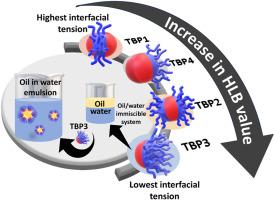
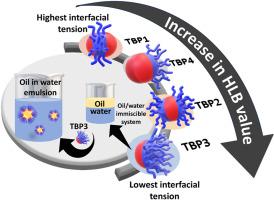
We aimed to create tri-compartmental polymeric particles (TPs), with selective areas conjugated with hydrophilic patches, to produce an array of amphiphilic particles with various architectures. Briefly, the electrohydrodynamic co-jetting technique (EHDC) was employed to produce 4 sets of TPs comprising PLA (polylactide) in one/two compartments and a blend of PLA and a macro-initiator at a ratio of 90/10 in other compartments (s). Upon grafting a hydrophilic polymer brush (poly(2-dimethyl amino ethyl methacrylate) (polyDMAEMA)) onto the surface of macroinitiator (10 wt%) containing compartment using Surface Initiated Atom Transfer Radical Polymerization (SIATRP), particles were expected to become amphiphilic. By locating the macroinitiator in various compartments (TBP 1–4), an array of amphiphilic particles with various architectures was created. This study allowed us to produce a repertoire of anisotropic particles with varying amphiphilicity for investigating their role as Pickering emulsion stabilizers beyond Janus geometry. The relative performance of the brush-modified TPs (TBPs) in stabilizing octanol/water-based emulsion was explained with the aid of their HLB balance, interfacial tension, location of the macroinitiator, and the macroinitiator content/grafting density. The particles having a maximum area of hydrophilic lobes confined to one hemisphere were found to prolong the emulsion stability for the maximum time (∼8 days), thus considered the most efficient one. In addition to polyDMAEMA, strongly hydrophilic poly(ethylene glycol methyl ether methacrylate) (polyEGMA) brushes were also grafted onto TPs to enhance their hydrophilicity, which ultimately yielded an emulsion with prolonged stability (∼11 days).
期刊介绍:
Polymer is an interdisciplinary journal dedicated to publishing innovative and significant advances in Polymer Physics, Chemistry and Technology. We welcome submissions on polymer hybrids, nanocomposites, characterisation and self-assembly. Polymer also publishes work on the technological application of polymers in energy and optoelectronics.
The main scope is covered but not limited to the following core areas:
Polymer Materials
Nanocomposites and hybrid nanomaterials
Polymer blends, films, fibres, networks and porous materials
Physical Characterization
Characterisation, modelling and simulation* of molecular and materials properties in bulk, solution, and thin films
Polymer Engineering
Advanced multiscale processing methods
Polymer Synthesis, Modification and Self-assembly
Including designer polymer architectures, mechanisms and kinetics, and supramolecular polymerization
Technological Applications
Polymers for energy generation and storage
Polymer membranes for separation technology
Polymers for opto- and microelectronics.



 京公网安备 11010802042870号
京ICP备2023020795号-1
京公网安备 11010802042870号
京ICP备2023020795号-1

 分享
分享
 求助内容:
求助内容: 应助结果提醒方式:
 扫码关注我们
