{"title":"WO3/Ru@CeO2 Bilayer Gas Sensor for ppb-Level Xylene Detection Based on a Catalytic-Sensitive Synergistic Mechanism","authors":"Ruijie Qin, Quan Yuan, Jiejie Yu, Jinwu Hu, Wenhui Zhang, Yinsheng Wang, Yanfen Cao, Qingxiang Ma, Shengjuan Li, Guisheng Li, Ding Wang","doi":"10.1021/acsami.4c23012","DOIUrl":null,"url":null,"abstract":"Volatile aromatic hydrocarbons present a significant threat to both the environment and human health. However, due to the low reactivity of toxic gases containing benzene rings and insufficient selectivity of existing sensors, real-time monitoring of benzene series (BTEX) gases remains a challenge. The development of catalytically sensitive synergistic bilayer sensors offers a promising strategy to overcome this challenge. A series of Ru@CeO<sub>2</sub> nanosheets with different Ru doping levels were synthesized by using a simple solvothermal and further calcination method. Interestingly, the incorporation of Ru effectively modulates the morphology of Ce-BDC from nanorods to porous nanosheets. The WO<sub>3</sub>/Ru@CeO<sub>2</sub> bilayer sensor is constructed by using WO<sub>3</sub> nanofibers as the lower sensitive layer and Ru@CeO<sub>2</sub> as the upper catalytic layer. At the operating temperature of 160 °C, the response value (<i>R</i><sub>a</sub>/<i>R</i><sub>g</sub>) of the WO<sub>3</sub>/Ru@CeO<sub>2</sub> bilayer sensor to 5 ppm xylene is 37.04, which is obviously better than that of the WO<sub>3</sub> nanofiber sensor. In addition, the sensor also reacted significantly to low concentrations of xylene, as low as 1 ppb. Additionally, the combination of online mass spectrometry and density functional theory was employed to validate the enhanced sensing performance arising from the synergistic mechanism between the catalytic and sensing materials. Hence, the work presents a new material for detecting ppb level BTEX through an effective bilayer structure design and material selection.","PeriodicalId":5,"journal":{"name":"ACS Applied Materials & Interfaces","volume":"190 1","pages":""},"PeriodicalIF":8.2000,"publicationDate":"2025-03-04","publicationTypes":"Journal Article","fieldsOfStudy":null,"isOpenAccess":false,"openAccessPdf":"","citationCount":"0","resultStr":null,"platform":"Semanticscholar","paperid":null,"PeriodicalName":"ACS Applied Materials & Interfaces","FirstCategoryId":"88","ListUrlMain":"https://doi.org/10.1021/acsami.4c23012","RegionNum":2,"RegionCategory":"材料科学","ArticlePicture":[],"TitleCN":null,"AbstractTextCN":null,"PMCID":null,"EPubDate":"","PubModel":"","JCR":"Q1","JCRName":"MATERIALS SCIENCE, MULTIDISCIPLINARY","Score":null,"Total":0}
引用次数: 0
Abstract
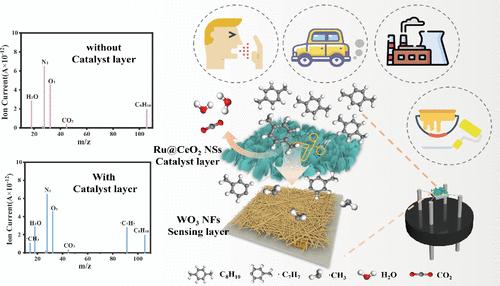
Volatile aromatic hydrocarbons present a significant threat to both the environment and human health. However, due to the low reactivity of toxic gases containing benzene rings and insufficient selectivity of existing sensors, real-time monitoring of benzene series (BTEX) gases remains a challenge. The development of catalytically sensitive synergistic bilayer sensors offers a promising strategy to overcome this challenge. A series of Ru@CeO2 nanosheets with different Ru doping levels were synthesized by using a simple solvothermal and further calcination method. Interestingly, the incorporation of Ru effectively modulates the morphology of Ce-BDC from nanorods to porous nanosheets. The WO3/Ru@CeO2 bilayer sensor is constructed by using WO3 nanofibers as the lower sensitive layer and Ru@CeO2 as the upper catalytic layer. At the operating temperature of 160 °C, the response value (Ra/Rg) of the WO3/Ru@CeO2 bilayer sensor to 5 ppm xylene is 37.04, which is obviously better than that of the WO3 nanofiber sensor. In addition, the sensor also reacted significantly to low concentrations of xylene, as low as 1 ppb. Additionally, the combination of online mass spectrometry and density functional theory was employed to validate the enhanced sensing performance arising from the synergistic mechanism between the catalytic and sensing materials. Hence, the work presents a new material for detecting ppb level BTEX through an effective bilayer structure design and material selection.
期刊介绍:
ACS Applied Materials & Interfaces is a leading interdisciplinary journal that brings together chemists, engineers, physicists, and biologists to explore the development and utilization of newly-discovered materials and interfacial processes for specific applications. Our journal has experienced remarkable growth since its establishment in 2009, both in terms of the number of articles published and the impact of the research showcased. We are proud to foster a truly global community, with the majority of published articles originating from outside the United States, reflecting the rapid growth of applied research worldwide.



 京公网安备 11010802042870号
京ICP备2023020795号-1
京公网安备 11010802042870号
京ICP备2023020795号-1

 分享
分享
 求助内容:
求助内容: 应助结果提醒方式:
 扫码关注我们
