The fabrication of 1,2-dicarbonyl compound-caging isothermal exponential amplification strategy and its application in the highly sensitive detection of tumor exosomal miRNA†
{"title":"The fabrication of 1,2-dicarbonyl compound-caging isothermal exponential amplification strategy and its application in the highly sensitive detection of tumor exosomal miRNA†","authors":"Hui-Yu Pan, Jia-Hui Dong, Xu-Yang Shen, Ling-Li Zhao, Ying Liu, Yu-Nan Chen, Zi-Qin Huang, Ying-Lin Zhou and Xin-Xiang Zhang","doi":"10.1039/D4AN01515K","DOIUrl":null,"url":null,"abstract":"<p >Exponential amplification reaction (EXPAR) possesses the advantage of high amplification efficiency, producing large amount of short nucleic acids in a short time. However, primer-independent DNA autosynthesis and nonspecific amplification caused by <em>ab initio</em> DNA self-synthesis increase the risk of high background signals, limiting its application in the fabrication of ultrasensitive sensors. In this study, we developed a new strategy called 1,2-dicarbonyl compound-caging EXPAR (caging-EXPAR) by innovatively modifying EXPAR templates with 1,2-dicarbonyl compounds. Five 1,2-dicarbonyl compounds including glyoxal and ninhydrin were chosen, all of which were proved to specifically bind to guanosine on the EXPAR template, efficiently reducing the background amplification of EXPAR and exhibiting an improved discrimination between the target and background. Possible mechanisms for the role of 1,2-dicarbonyl compounds in EXPAR were proposed, and three potential factors that could induce serious nonspecific amplification were investigated and verified. Caging-EXPAR provided a general, simple, convenient and beneficial strategy to slow down the generation of EXPAR background signals. Based on this method, choosing miRNA let-7a as a model, the minimum detectable amount was 10 zmol, which is 3 orders of magnitude less compared to traditional EXPAR. Most importantly, the strategy was successfully applied to monitor the expression level of the low-abundant miRNA in MCF-7 cell-derived exosomes. This highly portable and cost-effective method enhanced the real-time quantitative detection of specific nucleic acids in many fields such as clinical diagnosis and prognostic treatment and provided a complementary theoretical support for EXPAR background amplification, potentially improving and expanding the application of other amplification reactions.</p>","PeriodicalId":63,"journal":{"name":"Analyst","volume":" 8","pages":" 1623-1631"},"PeriodicalIF":3.3000,"publicationDate":"2025-03-04","publicationTypes":"Journal Article","fieldsOfStudy":null,"isOpenAccess":false,"openAccessPdf":"","citationCount":"0","resultStr":null,"platform":"Semanticscholar","paperid":null,"PeriodicalName":"Analyst","FirstCategoryId":"92","ListUrlMain":"https://pubs.rsc.org/en/content/articlelanding/2025/an/d4an01515k","RegionNum":3,"RegionCategory":"化学","ArticlePicture":[],"TitleCN":null,"AbstractTextCN":null,"PMCID":null,"EPubDate":"","PubModel":"","JCR":"Q2","JCRName":"CHEMISTRY, ANALYTICAL","Score":null,"Total":0}
引用次数: 0
Abstract
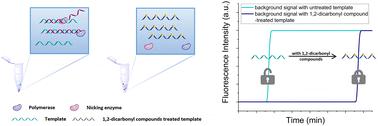
Exponential amplification reaction (EXPAR) possesses the advantage of high amplification efficiency, producing large amount of short nucleic acids in a short time. However, primer-independent DNA autosynthesis and nonspecific amplification caused by ab initio DNA self-synthesis increase the risk of high background signals, limiting its application in the fabrication of ultrasensitive sensors. In this study, we developed a new strategy called 1,2-dicarbonyl compound-caging EXPAR (caging-EXPAR) by innovatively modifying EXPAR templates with 1,2-dicarbonyl compounds. Five 1,2-dicarbonyl compounds including glyoxal and ninhydrin were chosen, all of which were proved to specifically bind to guanosine on the EXPAR template, efficiently reducing the background amplification of EXPAR and exhibiting an improved discrimination between the target and background. Possible mechanisms for the role of 1,2-dicarbonyl compounds in EXPAR were proposed, and three potential factors that could induce serious nonspecific amplification were investigated and verified. Caging-EXPAR provided a general, simple, convenient and beneficial strategy to slow down the generation of EXPAR background signals. Based on this method, choosing miRNA let-7a as a model, the minimum detectable amount was 10 zmol, which is 3 orders of magnitude less compared to traditional EXPAR. Most importantly, the strategy was successfully applied to monitor the expression level of the low-abundant miRNA in MCF-7 cell-derived exosomes. This highly portable and cost-effective method enhanced the real-time quantitative detection of specific nucleic acids in many fields such as clinical diagnosis and prognostic treatment and provided a complementary theoretical support for EXPAR background amplification, potentially improving and expanding the application of other amplification reactions.



 京公网安备 11010802042870号
京ICP备2023020795号-1
京公网安备 11010802042870号
京ICP备2023020795号-1

 分享
分享
 求助内容:
求助内容: 应助结果提醒方式:
 扫码关注我们
