{"title":"Association between constipation and the urine albumin-to-creatinine ratio in adults: the NHANES 2009-2010.","authors":"Yuying Yang, Siyi Rao, Yongjie Zhuo, Yuan Fang, Jianxin Wan, Danyu You","doi":"10.3389/fnut.2025.1477148","DOIUrl":null,"url":null,"abstract":"<p><strong>Objective: </strong>This study aimed to analyze the association between constipation and the urine albumin-to-creatinine ratio (ACR) using data from the National Health and Nutrition Examination Survey (NHANES) 2009-2010.</p><p><strong>Methods: </strong>In this cross-sectional study, a sample of 4,282 adults aged 20 and older was selected from the NHANES 2009-2010. Constipation was defined as having fewer than three bowel movements per week. The average of the two ACR measurements was used as the outcome variable. Logistic regression models (non-adjusted and multivariate adjusted models) were used to examine the relationship between constipation and ACR. Subgroup and interaction analyses related to gender, age, smoking, alcohol consumption, body mass index (BMI), hypertension, and diabetes were also conducted to assess the stability of the association between constipation and ACR.</p><p><strong>Results: </strong>In this study population of 4,282 individuals, 352 individuals with an ACR of 30 mg/g or higher were considered to have albuminuria. The prevalence of constipation was higher in the albuminuria group compared to the non-albuminuric group (6.4% vs. 3.5%, <i>p</i> = 0.002). The unadjusted model (Model I) showed an increased risk of ACR associated with constipation (OR 1.81, 95% CI 1.13-2.91, <i>p</i> = 0.014). After controlling for gender, age, race/ethnicity, marital status, and education level in Model II, the association between constipation and ACR remained significant (OR 2.20, 95% CI 1.34-3.60, <i>p</i> = 0.002). Upon further adjustment for BMI, smoking status, alcohol consumption, diabetes, hypertension, arthritis, asthma, coronary heart disease, liver disease, cancer, blood urea nitrogen (BUN), serum creatinine (Scr), uric acid (UA) and estimated glomerular filtration rate (eGFR) in Model III, the positive association between constipation and ACR was still significant (OR 1.88, 95% CI 1.09-3.23, <i>p</i> = 0.023). Subgroup analyses, stratified by gender, age, smoking status, alcohol consumption, BMI, hypertension, and diabetes, showed no statistically significant interactions (<i>p</i> > 0.05).</p><p><strong>Conclusion: </strong>In summary, this study found a positive association between constipation and urinary albumin excretion rate. The significant association between constipation and ACR highlights the need for clinicians to monitor urinary albumin levels in patients with constipation.</p>","PeriodicalId":12473,"journal":{"name":"Frontiers in Nutrition","volume":"12 ","pages":"1477148"},"PeriodicalIF":4.0000,"publicationDate":"2025-02-17","publicationTypes":"Journal Article","fieldsOfStudy":null,"isOpenAccess":false,"openAccessPdf":"https://www.ncbi.nlm.nih.gov/pmc/articles/PMC11872728/pdf/","citationCount":"0","resultStr":null,"platform":"Semanticscholar","paperid":null,"PeriodicalName":"Frontiers in Nutrition","FirstCategoryId":"97","ListUrlMain":"https://doi.org/10.3389/fnut.2025.1477148","RegionNum":2,"RegionCategory":"农林科学","ArticlePicture":[],"TitleCN":null,"AbstractTextCN":null,"PMCID":null,"EPubDate":"2025/1/1 0:00:00","PubModel":"eCollection","JCR":"Q2","JCRName":"NUTRITION & DIETETICS","Score":null,"Total":0}
引用次数: 0
Abstract
Objective: This study aimed to analyze the association between constipation and the urine albumin-to-creatinine ratio (ACR) using data from the National Health and Nutrition Examination Survey (NHANES) 2009-2010.
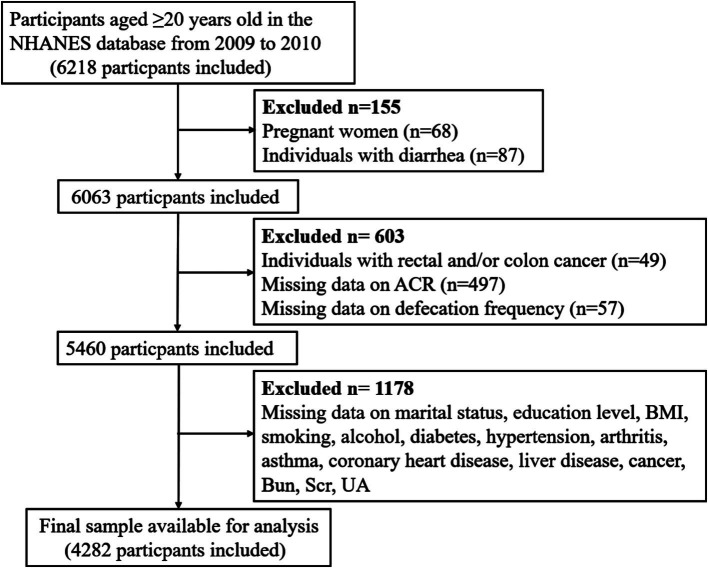
Methods: In this cross-sectional study, a sample of 4,282 adults aged 20 and older was selected from the NHANES 2009-2010. Constipation was defined as having fewer than three bowel movements per week. The average of the two ACR measurements was used as the outcome variable. Logistic regression models (non-adjusted and multivariate adjusted models) were used to examine the relationship between constipation and ACR. Subgroup and interaction analyses related to gender, age, smoking, alcohol consumption, body mass index (BMI), hypertension, and diabetes were also conducted to assess the stability of the association between constipation and ACR.
Results: In this study population of 4,282 individuals, 352 individuals with an ACR of 30 mg/g or higher were considered to have albuminuria. The prevalence of constipation was higher in the albuminuria group compared to the non-albuminuric group (6.4% vs. 3.5%, p = 0.002). The unadjusted model (Model I) showed an increased risk of ACR associated with constipation (OR 1.81, 95% CI 1.13-2.91, p = 0.014). After controlling for gender, age, race/ethnicity, marital status, and education level in Model II, the association between constipation and ACR remained significant (OR 2.20, 95% CI 1.34-3.60, p = 0.002). Upon further adjustment for BMI, smoking status, alcohol consumption, diabetes, hypertension, arthritis, asthma, coronary heart disease, liver disease, cancer, blood urea nitrogen (BUN), serum creatinine (Scr), uric acid (UA) and estimated glomerular filtration rate (eGFR) in Model III, the positive association between constipation and ACR was still significant (OR 1.88, 95% CI 1.09-3.23, p = 0.023). Subgroup analyses, stratified by gender, age, smoking status, alcohol consumption, BMI, hypertension, and diabetes, showed no statistically significant interactions (p > 0.05).
Conclusion: In summary, this study found a positive association between constipation and urinary albumin excretion rate. The significant association between constipation and ACR highlights the need for clinicians to monitor urinary albumin levels in patients with constipation.
目的:本研究旨在利用2009-2010年国家健康与营养调查(NHANES)的数据分析便秘与尿白蛋白与肌酐比值(ACR)的关系。方法:在本横断面研究中,从NHANES 2009-2010中选择了4282名20岁及以上的成年人。便秘被定义为每周排便少于三次。两个ACR测量值的平均值作为结果变量。采用Logistic回归模型(非调整模型和多变量调整模型)检验便秘与ACR之间的关系。还进行了与性别、年龄、吸烟、饮酒、体重指数(BMI)、高血压和糖尿病相关的亚组和相互作用分析,以评估便秘与ACR之间关系的稳定性。结果:在这项4282人的研究中,352名ACR为30 mg/g或更高的人被认为患有蛋白尿。蛋白尿组的便秘发生率高于非蛋白尿组(6.4% vs. 3.5%, p = 0.002)。未经调整的模型(模型I)显示ACR与便秘相关的风险增加(OR 1.81, 95% CI 1.13-2.91, p = 0.014)。在模型II中控制了性别、年龄、种族/民族、婚姻状况和教育水平后,便秘与ACR之间的相关性仍然显著(OR 2.20, 95% CI 1.34-3.60, p = 0.002)。在模型III中进一步调整BMI、吸烟、饮酒、糖尿病、高血压、关节炎、哮喘、冠心病、肝病、癌症、血尿素氮(BUN)、血清肌酐(Scr)、尿酸(UA)和肾小球滤过率(eGFR)后,便秘与ACR之间仍有显著正相关(OR 1.88, 95% CI 1.09-3.23, p = 0.023)。亚组分析,按性别、年龄、吸烟状况、饮酒、BMI、高血压和糖尿病分层,没有统计学上显著的相互作用(p > 0.05)。结论:综上所述,本研究发现便秘与尿白蛋白排泄率呈正相关。便秘和ACR之间的显著关联强调了临床医生监测便秘患者尿白蛋白水平的必要性。
期刊介绍:
No subject pertains more to human life than nutrition. The aim of Frontiers in Nutrition is to integrate major scientific disciplines in this vast field in order to address the most relevant and pertinent questions and developments. Our ambition is to create an integrated podium based on original research, clinical trials, and contemporary reviews to build a reputable knowledge forum in the domains of human health, dietary behaviors, agronomy & 21st century food science. Through the recognized open-access Frontiers platform we welcome manuscripts to our dedicated sections relating to different areas in the field of nutrition with a focus on human health.
Specialty sections in Frontiers in Nutrition include, for example, Clinical Nutrition, Nutrition & Sustainable Diets, Nutrition and Food Science Technology, Nutrition Methodology, Sport & Exercise Nutrition, Food Chemistry, and Nutritional Immunology. Based on the publication of rigorous scientific research, we thrive to achieve a visible impact on the global nutrition agenda addressing the grand challenges of our time, including obesity, malnutrition, hunger, food waste, sustainability and consumer health.





 京公网安备 11010802042870号
京ICP备2023020795号-1
京公网安备 11010802042870号
京ICP备2023020795号-1

 分享
分享
 求助内容:
求助内容: 应助结果提醒方式:
 扫码关注我们
