Amanda Burnell, Maison Hardin, Dr. Matthias Zeller, Prof. Sergiy V. Rosokha
{"title":"Charge-transfer Adducts vs Iodine(I) Complexes: Dual Role of Halogen Bonding in Reactions of Diiodine with N-donor Bases","authors":"Amanda Burnell, Maison Hardin, Dr. Matthias Zeller, Prof. Sergiy V. Rosokha","doi":"10.1002/cphc.202500076","DOIUrl":null,"url":null,"abstract":"<p>The interaction of diiodine with quinuclidine (QN) and 4-dimethylaminopyridine (DMAP) in solutions with 1 : 1 molar ratio of reactants at room temperature produced (in essentially quantitative yields) pure charge-transfer QN⋅I<sub>2</sub> adducts and iodine(I) salt [DMAP-I-DMAP]I<sub>3</sub>, respectively. In comparison, the quantitative formation of pure iodine (I) salt [QN-I-QN]I<sub>5</sub> was observed for the room-temperature reactions of QN with a 50 % excess of I<sub>2</sub>, and the charge-transfer adducts of I<sub>2</sub> with DMAP (and other pyridines) were formed when reactions were carried out at low temperatures. Computational analysis related the switch from the formation of charge-transfer adducts to iodine(I) complexes in these systems to the strength of the halogen bonding of diiodine to the N-donor bases. It shows that while the halogen-bonded adducts represent critical intermediates in the formation of iodine(I) complexes, exceedingly strong halogen bonding between diiodine and the base prevents any subsequent transformations. In other words, while halogen bonding usually facilitates electron and halogen transfer, the halogen-bonded complexes may serve as “black holes” hindering any follow-up processes if this intermolecular interaction is too strong.</p>","PeriodicalId":9819,"journal":{"name":"Chemphyschem","volume":"26 11","pages":""},"PeriodicalIF":2.2000,"publicationDate":"2025-03-04","publicationTypes":"Journal Article","fieldsOfStudy":null,"isOpenAccess":false,"openAccessPdf":"","citationCount":"0","resultStr":null,"platform":"Semanticscholar","paperid":null,"PeriodicalName":"Chemphyschem","FirstCategoryId":"92","ListUrlMain":"https://chemistry-europe.onlinelibrary.wiley.com/doi/10.1002/cphc.202500076","RegionNum":3,"RegionCategory":"化学","ArticlePicture":[],"TitleCN":null,"AbstractTextCN":null,"PMCID":null,"EPubDate":"","PubModel":"","JCR":"Q3","JCRName":"CHEMISTRY, PHYSICAL","Score":null,"Total":0}
引用次数: 0
Abstract
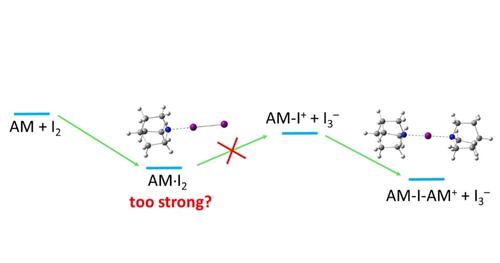
The interaction of diiodine with quinuclidine (QN) and 4-dimethylaminopyridine (DMAP) in solutions with 1 : 1 molar ratio of reactants at room temperature produced (in essentially quantitative yields) pure charge-transfer QN⋅I2 adducts and iodine(I) salt [DMAP-I-DMAP]I3, respectively. In comparison, the quantitative formation of pure iodine (I) salt [QN-I-QN]I5 was observed for the room-temperature reactions of QN with a 50 % excess of I2, and the charge-transfer adducts of I2 with DMAP (and other pyridines) were formed when reactions were carried out at low temperatures. Computational analysis related the switch from the formation of charge-transfer adducts to iodine(I) complexes in these systems to the strength of the halogen bonding of diiodine to the N-donor bases. It shows that while the halogen-bonded adducts represent critical intermediates in the formation of iodine(I) complexes, exceedingly strong halogen bonding between diiodine and the base prevents any subsequent transformations. In other words, while halogen bonding usually facilitates electron and halogen transfer, the halogen-bonded complexes may serve as “black holes” hindering any follow-up processes if this intermolecular interaction is too strong.
期刊介绍:
ChemPhysChem is one of the leading chemistry/physics interdisciplinary journals (ISI Impact Factor 2018: 3.077) for physical chemistry and chemical physics. It is published on behalf of Chemistry Europe, an association of 16 European chemical societies.
ChemPhysChem is an international source for important primary and critical secondary information across the whole field of physical chemistry and chemical physics. It integrates this wide and flourishing field ranging from Solid State and Soft-Matter Research, Electro- and Photochemistry, Femtochemistry and Nanotechnology, Complex Systems, Single-Molecule Research, Clusters and Colloids, Catalysis and Surface Science, Biophysics and Physical Biochemistry, Atmospheric and Environmental Chemistry, and many more topics. ChemPhysChem is peer-reviewed.





 京公网安备 11010802042870号
京ICP备2023020795号-1
京公网安备 11010802042870号
京ICP备2023020795号-1

 分享
分享
 求助内容:
求助内容: 应助结果提醒方式:
 扫码关注我们
