Patterns of outpatient antibiotic prescribing in older adults by social determinants of healthcare access: a population-based retrospective cohort study
Mia E. Sapin , Colleen J. Maxwell , Anna E. Clarke , Curtis Cooper , Miranda So , Kevin L. Schwartz , Nick Daneman , Sharmistha Mishra , Derek R. MacFadden
{"title":"Patterns of outpatient antibiotic prescribing in older adults by social determinants of healthcare access: a population-based retrospective cohort study","authors":"Mia E. Sapin , Colleen J. Maxwell , Anna E. Clarke , Curtis Cooper , Miranda So , Kevin L. Schwartz , Nick Daneman , Sharmistha Mishra , Derek R. MacFadden","doi":"10.1016/j.cmi.2025.02.025","DOIUrl":null,"url":null,"abstract":"<div><h3>Objectives</h3><div>Strategies to improve antibiotic use may exacerbate health inequities if they do not consider existing barriers to healthcare access. We examined associations between social determinants of healthcare access (SDOH) and antibiotic prescribing and variations in these associations pre- and post-COVID-19 emergence.</div></div><div><h3>Methods</h3><div>We conducted a retrospective cohort study of community-dwelling adults aged ≥66 years in Ontario, Canada, between March 2018 and March 2020 (pre-pandemic period) and March 2020 and March 2022 (pandemic period). Multivariable Fine-Gray subdistribution hazard models were used to examine associations between three SDOH variables (neighbourhood-level income and proportion racialized, and individual-level recent immigration) and incident antibiotic prescriptions, accounting for mortality as a competing risk. We assessed for potential effect modification by the pandemic period.</div></div><div><h3>Results</h3><div>The pre-pandemic (<em>n</em> = 2 567 382) and pandemic (<em>n</em> = 2 744 337) cohorts were similar in average age (75 years). Antibiotic prescribing was slightly higher among residents in the highest income neighbourhoods in pre-pandemic (subdistribution hazard ratio [sHR], 1.03 [95% CI, 1.02–1.04], compared with lowest income) and pandemic (sHR, 1.02 [1.01–1.03]) periods. Prescribing was higher among recent immigrants (vs. long-term residents) in both periods, with a more pronounced difference observed during the pandemic (sHR, 1.21 [1.18–1.25]) than pre-pandemic (sHR, 1.12 [1.09–1.16]) period. Prescribing was lower among residents living in the most diverse neighbourhoods (vs. least diverse) in both periods, with a more pronounced difference during the pandemic (sHR, 0.81 [0.80–0.82]) than pre-pandemic (sHR, 0.92 [0.91–0.93]) period.</div></div><div><h3>Discussion</h3><div>SDOH variables are associated with antibiotic prescribing patterns over time among older outpatients, and the COVID-19 pandemic further modified some of these associations.</div></div>","PeriodicalId":10444,"journal":{"name":"Clinical Microbiology and Infection","volume":"31 7","pages":"Pages 1196-1202"},"PeriodicalIF":8.5000,"publicationDate":"2025-03-01","publicationTypes":"Journal Article","fieldsOfStudy":null,"isOpenAccess":false,"openAccessPdf":"","citationCount":"0","resultStr":null,"platform":"Semanticscholar","paperid":null,"PeriodicalName":"Clinical Microbiology and Infection","FirstCategoryId":"3","ListUrlMain":"https://www.sciencedirect.com/science/article/pii/S1198743X25000862","RegionNum":1,"RegionCategory":"医学","ArticlePicture":[],"TitleCN":null,"AbstractTextCN":null,"PMCID":null,"EPubDate":"","PubModel":"","JCR":"Q1","JCRName":"INFECTIOUS DISEASES","Score":null,"Total":0}
引用次数: 0
Abstract
Objectives
Strategies to improve antibiotic use may exacerbate health inequities if they do not consider existing barriers to healthcare access. We examined associations between social determinants of healthcare access (SDOH) and antibiotic prescribing and variations in these associations pre- and post-COVID-19 emergence.
Methods
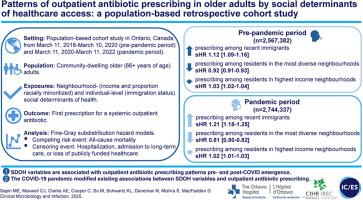
We conducted a retrospective cohort study of community-dwelling adults aged ≥66 years in Ontario, Canada, between March 2018 and March 2020 (pre-pandemic period) and March 2020 and March 2022 (pandemic period). Multivariable Fine-Gray subdistribution hazard models were used to examine associations between three SDOH variables (neighbourhood-level income and proportion racialized, and individual-level recent immigration) and incident antibiotic prescriptions, accounting for mortality as a competing risk. We assessed for potential effect modification by the pandemic period.
Results
The pre-pandemic (n = 2 567 382) and pandemic (n = 2 744 337) cohorts were similar in average age (75 years). Antibiotic prescribing was slightly higher among residents in the highest income neighbourhoods in pre-pandemic (subdistribution hazard ratio [sHR], 1.03 [95% CI, 1.02–1.04], compared with lowest income) and pandemic (sHR, 1.02 [1.01–1.03]) periods. Prescribing was higher among recent immigrants (vs. long-term residents) in both periods, with a more pronounced difference observed during the pandemic (sHR, 1.21 [1.18–1.25]) than pre-pandemic (sHR, 1.12 [1.09–1.16]) period. Prescribing was lower among residents living in the most diverse neighbourhoods (vs. least diverse) in both periods, with a more pronounced difference during the pandemic (sHR, 0.81 [0.80–0.82]) than pre-pandemic (sHR, 0.92 [0.91–0.93]) period.
Discussion
SDOH variables are associated with antibiotic prescribing patterns over time among older outpatients, and the COVID-19 pandemic further modified some of these associations.
期刊介绍:
Clinical Microbiology and Infection (CMI) is a monthly journal published by the European Society of Clinical Microbiology and Infectious Diseases. It focuses on peer-reviewed papers covering basic and applied research in microbiology, infectious diseases, virology, parasitology, immunology, and epidemiology as they relate to therapy and diagnostics.



 京公网安备 11010802042870号
京ICP备2023020795号-1
京公网安备 11010802042870号
京ICP备2023020795号-1

 分享
分享
 求助内容:
求助内容: 应助结果提醒方式:
 扫码关注我们
