Anna Carlén, Thomas Lindow, Nicholas Cauwenberghs, Viktor Elmberg, Lars Brudin, Francisco B Ortega, Magnus Ekström, Kristofer Hedman
{"title":"Patterns of systolic blood pressure response at the end of exercise and mortality and morbidity in patients referred for exercise testing.","authors":"Anna Carlén, Thomas Lindow, Nicholas Cauwenberghs, Viktor Elmberg, Lars Brudin, Francisco B Ortega, Magnus Ekström, Kristofer Hedman","doi":"10.1136/openhrt-2025-003246","DOIUrl":null,"url":null,"abstract":"<p><strong>Objectives: </strong>Peak exercise systolic blood pressure (SBP) is associated with future cardiovascular disease (CVD) and mortality. We aimed to evaluate the predictive value of different SBP patterns at the end of exercise with these outcomes.</p><p><strong>Methods: </strong>We studied 6329 adults (45% women) referred for exercise testing, with test duration of 6-14 min, maximal effort and valid SBP measurements at the end of exercise. The two last SBPs were indexed to work rate (mmHg/Watt), defining responses as: <i>drop</i> (negative change), <i>plateau</i> (no change), <i>slow</i> (lower tertile of increase), <i>intermediate</i> (middle tertile) and <i>steep</i> (upper tertile). Data were cross-linked with nationwide disease and mortality registries. Associations with all-cause mortality and incident CVD were analysed using Cox proportional hazards regression (hazard ratio (HR), 95% confidence interval), using slow SBP increase as reference, adjusted for sex, age, body mass index, baseline CVD (mortality analysis only), beta-blockers and exercise capacity (peak Watt).</p><p><strong>Results: </strong>The prevalence of SBP responses at the end of exercise were drop (1.1%), plateau (15.0%), slow (30.4%), intermediate (25.2%) and steep increase (28.3%). Follow-up was 8.8±3.4 years. Compared with a slow increase, the adjusted all-cause mortality risks were not statistically different for a drop (HR 1.16 (0.50-2.65)), plateau (HR 1.19 (0.85-1.66)), intermediate (HR 1.24 (0.93-1.66)) or steep SBP increase (HR 1.16 (0.89-1.52)). CVD risk was increased in those with a SBP drop (HR 3.10 (1.85-5.19), but not significantly for plateau (HR 1.17 (0.92-1.48)), intermediate or steep SBP increases (HRs 0.99-1.00).</p><p><strong>Conclusion: </strong>Subjects with a slow SBP increase at the end of exercise tended to have the lowest mortality risk, although no SBP response pattern predicted all-cause mortality independently. CVD risk was strongly increased in patients with a drop in SBP and tended to be increased (non-significantly) also in patients with a plateau in SBP at the end of exercise, in comparison with increasing SBP.</p>","PeriodicalId":19505,"journal":{"name":"Open Heart","volume":"12 1","pages":""},"PeriodicalIF":2.8000,"publicationDate":"2025-03-03","publicationTypes":"Journal Article","fieldsOfStudy":null,"isOpenAccess":false,"openAccessPdf":"https://www.ncbi.nlm.nih.gov/pmc/articles/PMC11883881/pdf/","citationCount":"0","resultStr":null,"platform":"Semanticscholar","paperid":null,"PeriodicalName":"Open Heart","FirstCategoryId":"1085","ListUrlMain":"https://doi.org/10.1136/openhrt-2025-003246","RegionNum":0,"RegionCategory":null,"ArticlePicture":[],"TitleCN":null,"AbstractTextCN":null,"PMCID":null,"EPubDate":"","PubModel":"","JCR":"Q2","JCRName":"CARDIAC & CARDIOVASCULAR SYSTEMS","Score":null,"Total":0}
引用次数: 0
Abstract
Objectives: Peak exercise systolic blood pressure (SBP) is associated with future cardiovascular disease (CVD) and mortality. We aimed to evaluate the predictive value of different SBP patterns at the end of exercise with these outcomes.
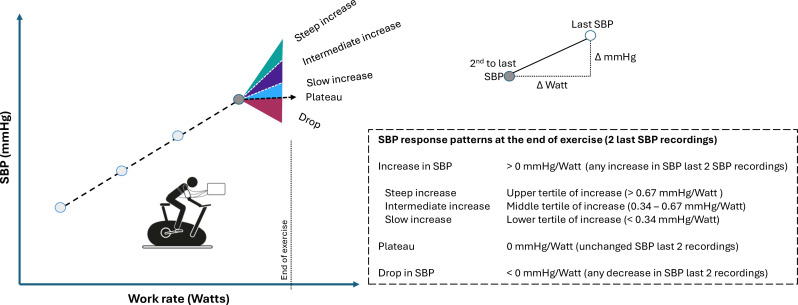
Methods: We studied 6329 adults (45% women) referred for exercise testing, with test duration of 6-14 min, maximal effort and valid SBP measurements at the end of exercise. The two last SBPs were indexed to work rate (mmHg/Watt), defining responses as: drop (negative change), plateau (no change), slow (lower tertile of increase), intermediate (middle tertile) and steep (upper tertile). Data were cross-linked with nationwide disease and mortality registries. Associations with all-cause mortality and incident CVD were analysed using Cox proportional hazards regression (hazard ratio (HR), 95% confidence interval), using slow SBP increase as reference, adjusted for sex, age, body mass index, baseline CVD (mortality analysis only), beta-blockers and exercise capacity (peak Watt).
Results: The prevalence of SBP responses at the end of exercise were drop (1.1%), plateau (15.0%), slow (30.4%), intermediate (25.2%) and steep increase (28.3%). Follow-up was 8.8±3.4 years. Compared with a slow increase, the adjusted all-cause mortality risks were not statistically different for a drop (HR 1.16 (0.50-2.65)), plateau (HR 1.19 (0.85-1.66)), intermediate (HR 1.24 (0.93-1.66)) or steep SBP increase (HR 1.16 (0.89-1.52)). CVD risk was increased in those with a SBP drop (HR 3.10 (1.85-5.19), but not significantly for plateau (HR 1.17 (0.92-1.48)), intermediate or steep SBP increases (HRs 0.99-1.00).
Conclusion: Subjects with a slow SBP increase at the end of exercise tended to have the lowest mortality risk, although no SBP response pattern predicted all-cause mortality independently. CVD risk was strongly increased in patients with a drop in SBP and tended to be increased (non-significantly) also in patients with a plateau in SBP at the end of exercise, in comparison with increasing SBP.
期刊介绍:
Open Heart is an online-only, open access cardiology journal that aims to be “open” in many ways: open access (free access for all readers), open peer review (unblinded peer review) and open data (data sharing is encouraged). The goal is to ensure maximum transparency and maximum impact on research progress and patient care. The journal is dedicated to publishing high quality, peer reviewed medical research in all disciplines and therapeutic areas of cardiovascular medicine. Research is published across all study phases and designs, from study protocols to phase I trials to meta-analyses, including small or specialist studies. Opinionated discussions on controversial topics are welcomed. Open Heart aims to operate a fast submission and review process with continuous publication online, to ensure timely, up-to-date research is available worldwide. The journal adheres to a rigorous and transparent peer review process, and all articles go through a statistical assessment to ensure robustness of the analyses. Open Heart is an official journal of the British Cardiovascular Society.






 京公网安备 11010802042870号
京ICP备2023020795号-1
京公网安备 11010802042870号
京ICP备2023020795号-1

 分享
分享
 求助内容:
求助内容: 应助结果提醒方式:
 扫码关注我们
