{"title":"Bias in physics peer recognition does not explain gaps in perceived peer recognition","authors":"Meagan Sundstrom, N. G. Holmes","doi":"10.1038/s41567-025-02789-w","DOIUrl":null,"url":null,"abstract":"Gaining recognition as a physics person by peers is an important contributor to undergraduate students’ physics identity and their success in physics courses. Previous research has separately demonstrated that women perceive less recognition from peers than men in their physics courses (perceived peer recognition) and that women receive fewer nominations from their peers for being strong in their physics course than men (received peer recognition). The relation between perceived and received peer recognition for men and women, however, is not well understood. Here we test three plausible models for this relation and find that, for students receiving the same amount of recognition from peers as measured from private nominations on a survey, women report significantly lower perceived peer recognition than men. We did this by conducting a quantitative study of over 1,700 students enrolled in introductory physics courses at eight institutions in the United States. We directly compare student gender, perceived peer recognition and received peer recognition, controlling for race and ethnicity, academic year and major, and course-level variability. These findings offer important implications for testable instructional interventions. The degree to which students perceive recognition as a physics person from their peers is known to be important. Now, women report lower perceived peer recognition than men, even after controlling for the amount of peer recognition received.","PeriodicalId":19100,"journal":{"name":"Nature Physics","volume":"21 4","pages":"524-529"},"PeriodicalIF":18.4000,"publicationDate":"2025-03-05","publicationTypes":"Journal Article","fieldsOfStudy":null,"isOpenAccess":false,"openAccessPdf":"","citationCount":"0","resultStr":null,"platform":"Semanticscholar","paperid":null,"PeriodicalName":"Nature Physics","FirstCategoryId":"101","ListUrlMain":"https://www.nature.com/articles/s41567-025-02789-w","RegionNum":1,"RegionCategory":"物理与天体物理","ArticlePicture":[],"TitleCN":null,"AbstractTextCN":null,"PMCID":null,"EPubDate":"","PubModel":"","JCR":"Q1","JCRName":"PHYSICS, MULTIDISCIPLINARY","Score":null,"Total":0}
引用次数: 0
Abstract
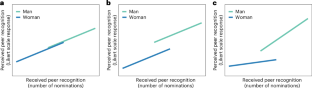
Gaining recognition as a physics person by peers is an important contributor to undergraduate students’ physics identity and their success in physics courses. Previous research has separately demonstrated that women perceive less recognition from peers than men in their physics courses (perceived peer recognition) and that women receive fewer nominations from their peers for being strong in their physics course than men (received peer recognition). The relation between perceived and received peer recognition for men and women, however, is not well understood. Here we test three plausible models for this relation and find that, for students receiving the same amount of recognition from peers as measured from private nominations on a survey, women report significantly lower perceived peer recognition than men. We did this by conducting a quantitative study of over 1,700 students enrolled in introductory physics courses at eight institutions in the United States. We directly compare student gender, perceived peer recognition and received peer recognition, controlling for race and ethnicity, academic year and major, and course-level variability. These findings offer important implications for testable instructional interventions. The degree to which students perceive recognition as a physics person from their peers is known to be important. Now, women report lower perceived peer recognition than men, even after controlling for the amount of peer recognition received.
期刊介绍:
Nature Physics is dedicated to publishing top-tier original research in physics with a fair and rigorous review process. It provides high visibility and access to a broad readership, maintaining high standards in copy editing and production, ensuring rapid publication, and maintaining independence from academic societies and other vested interests.
The journal presents two main research paper formats: Letters and Articles. Alongside primary research, Nature Physics serves as a central source for valuable information within the physics community through Review Articles, News & Views, Research Highlights covering crucial developments across the physics literature, Commentaries, Book Reviews, and Correspondence.




 京公网安备 11010802042870号
京ICP备2023020795号-1
京公网安备 11010802042870号
京ICP备2023020795号-1

 分享
分享
 求助内容:
求助内容: 应助结果提醒方式:
 扫码关注我们
