Ellen J. Dolan, Ismael Soto, Jaimie T. A. Dick, Fengzhi He, Ross N. Cuthbert
{"title":"Riverine Barrier Removals Could Proliferate Biological Invasions","authors":"Ellen J. Dolan, Ismael Soto, Jaimie T. A. Dick, Fengzhi He, Ross N. Cuthbert","doi":"10.1111/gcb.70093","DOIUrl":null,"url":null,"abstract":"<p>Multiple stressors, such as pollution, climate change, invasive species and fragmentation, threaten global ecosystems, requiring holistic management actions. Freshwater ecosystems are disproportionately biodiverse and particularly impacted by fragmentation and biological invasions. Artificial barriers, such as dams and weirs, are long-standing features of global landscapes, with a divergence of views on their benefits and disbenefits. Recognition of the negative impacts of barriers on the river continuum and native biota, particularly for migratory aquatic species, has led to a rapid rate of barrier removals in recent decades, especially in North America and Europe. However, since the rise in riverine barrier construction centuries ago, global biological invasion rates have concurrently surged. Artificial barriers can paradoxically slow the spread of invasive species through freshwaters, and barrier removal efforts thus risk proliferating invasive species that disperse rapidly through connected habitats. Despite well-intended plans for river restoration through barrier removals, the subsequent spread and colonisation of invasive species have been largely overlooked. This presents a ‘connectivity conundrum’: the removal of barriers intuitively addresses the issues of native species migrations and dispersals, but could perversely exacerbate the spread of invasive species. Basin-scale data collection around the short- and long-term impacts on invasive species will help to underpin future restoration projects and maximise the potential beneficial outcomes of barrier removals for native species.</p>","PeriodicalId":175,"journal":{"name":"Global Change Biology","volume":"31 3","pages":""},"PeriodicalIF":12.0000,"publicationDate":"2025-03-05","publicationTypes":"Journal Article","fieldsOfStudy":null,"isOpenAccess":false,"openAccessPdf":"https://onlinelibrary.wiley.com/doi/epdf/10.1111/gcb.70093","citationCount":"0","resultStr":null,"platform":"Semanticscholar","paperid":null,"PeriodicalName":"Global Change Biology","FirstCategoryId":"93","ListUrlMain":"https://onlinelibrary.wiley.com/doi/10.1111/gcb.70093","RegionNum":1,"RegionCategory":"环境科学与生态学","ArticlePicture":[],"TitleCN":null,"AbstractTextCN":null,"PMCID":null,"EPubDate":"","PubModel":"","JCR":"Q1","JCRName":"BIODIVERSITY CONSERVATION","Score":null,"Total":0}
引用次数: 0
Abstract
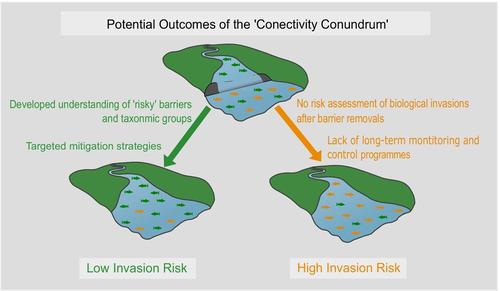
Multiple stressors, such as pollution, climate change, invasive species and fragmentation, threaten global ecosystems, requiring holistic management actions. Freshwater ecosystems are disproportionately biodiverse and particularly impacted by fragmentation and biological invasions. Artificial barriers, such as dams and weirs, are long-standing features of global landscapes, with a divergence of views on their benefits and disbenefits. Recognition of the negative impacts of barriers on the river continuum and native biota, particularly for migratory aquatic species, has led to a rapid rate of barrier removals in recent decades, especially in North America and Europe. However, since the rise in riverine barrier construction centuries ago, global biological invasion rates have concurrently surged. Artificial barriers can paradoxically slow the spread of invasive species through freshwaters, and barrier removal efforts thus risk proliferating invasive species that disperse rapidly through connected habitats. Despite well-intended plans for river restoration through barrier removals, the subsequent spread and colonisation of invasive species have been largely overlooked. This presents a ‘connectivity conundrum’: the removal of barriers intuitively addresses the issues of native species migrations and dispersals, but could perversely exacerbate the spread of invasive species. Basin-scale data collection around the short- and long-term impacts on invasive species will help to underpin future restoration projects and maximise the potential beneficial outcomes of barrier removals for native species.
期刊介绍:
Global Change Biology is an environmental change journal committed to shaping the future and addressing the world's most pressing challenges, including sustainability, climate change, environmental protection, food and water safety, and global health.
Dedicated to fostering a profound understanding of the impacts of global change on biological systems and offering innovative solutions, the journal publishes a diverse range of content, including primary research articles, technical advances, research reviews, reports, opinions, perspectives, commentaries, and letters. Starting with the 2024 volume, Global Change Biology will transition to an online-only format, enhancing accessibility and contributing to the evolution of scholarly communication.




 京公网安备 11010802042870号
京ICP备2023020795号-1
京公网安备 11010802042870号
京ICP备2023020795号-1

 分享
分享
 求助内容:
求助内容: 应助结果提醒方式:
 扫码关注我们
