Multifunctional nanoparticle-mediated targeting of metabolic reprogramming and DNA damage response pathways to treat drug-resistant triple-negative breast cancer
Sifeng Zhu , Chao Sun , Zimin Cai , Jibin Wu , Xu Han , Jue Wang , Cheng Wang
{"title":"Multifunctional nanoparticle-mediated targeting of metabolic reprogramming and DNA damage response pathways to treat drug-resistant triple-negative breast cancer","authors":"Sifeng Zhu , Chao Sun , Zimin Cai , Jibin Wu , Xu Han , Jue Wang , Cheng Wang","doi":"10.1016/j.jconrel.2025.113601","DOIUrl":null,"url":null,"abstract":"<div><div>Multi-drug resistance and immunosuppressive triple-negative breast cancer (TNBC) is triggered by the Warburg effect, which promotes homologous recombination repair (HRR) and upregulates expression of P-glycoprotein (P-gp), in turn preventing DNA damage from chemotherapy and creating an immunosuppressive microenvironment. It is therefore of clinical relevance to develop an effective delivery system that targets metabolic reprogramming and DNA damage response pathways for the treatment of drug-resistant TNBC. Herein, a P-gp-inhibiting and GSH-responsive multifunctional drug carrier targeting integrin αvβ3 was synthesised for the delivery of Lonidamine-prodrug (M1, glycolysis inhibitor) and Senaparib (Se, Poly [ADP-ribose] polymerase inhibitor). The nanodrug delivery system (iPR@M1/Se nanoparticles) exhibit effective tumour penetration and P-gp inhibition, effectively inducing DNA damage and apoptosis in Olaparib-resistant TNBC cells <em>in vitro</em>, as well as a higher tumour inhibitory rate compared with that of Se (81.82 % ± 2.31 % <em>vs</em> 43.91 % ± 4.65 %) <em>in vivo</em>. Mechanistically, iPR@M1/Se nanoparticles not only reshaped the immunosuppressive microenvironment resulting from tumour glycolysis, but also downregulated the expression of HRR-related protein, fostering the cytoplasmic accumulation of DNA damage fragments, which induced activation of the cyclic GMP–AMP synthase (cGAS)/stimulator of interferon gene (STING) pathway. Experimental results show that iPR@M1/Se nanoparticles effectively promote dendritic cell maturation and T lymphocyte activation, which elicits long-term immune memory responses, and prevents tumour recurrence and lung metastasis. Therefore, these multifunctional nanoparticles have great potential and provide a clinically relevant and valuable option for Olaparib-resistant TNBC.</div></div>","PeriodicalId":15450,"journal":{"name":"Journal of Controlled Release","volume":"381 ","pages":"Article 113601"},"PeriodicalIF":11.5000,"publicationDate":"2025-05-10","publicationTypes":"Journal Article","fieldsOfStudy":null,"isOpenAccess":false,"openAccessPdf":"","citationCount":"0","resultStr":null,"platform":"Semanticscholar","paperid":null,"PeriodicalName":"Journal of Controlled Release","FirstCategoryId":"3","ListUrlMain":"https://www.sciencedirect.com/science/article/pii/S016836592500210X","RegionNum":1,"RegionCategory":"医学","ArticlePicture":[],"TitleCN":null,"AbstractTextCN":null,"PMCID":null,"EPubDate":"2025/3/5 0:00:00","PubModel":"Epub","JCR":"Q1","JCRName":"CHEMISTRY, MULTIDISCIPLINARY","Score":null,"Total":0}
引用次数: 0
Abstract
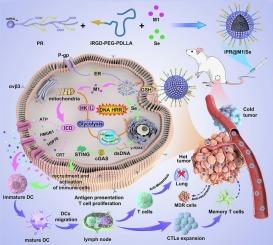
Multi-drug resistance and immunosuppressive triple-negative breast cancer (TNBC) is triggered by the Warburg effect, which promotes homologous recombination repair (HRR) and upregulates expression of P-glycoprotein (P-gp), in turn preventing DNA damage from chemotherapy and creating an immunosuppressive microenvironment. It is therefore of clinical relevance to develop an effective delivery system that targets metabolic reprogramming and DNA damage response pathways for the treatment of drug-resistant TNBC. Herein, a P-gp-inhibiting and GSH-responsive multifunctional drug carrier targeting integrin αvβ3 was synthesised for the delivery of Lonidamine-prodrug (M1, glycolysis inhibitor) and Senaparib (Se, Poly [ADP-ribose] polymerase inhibitor). The nanodrug delivery system (iPR@M1/Se nanoparticles) exhibit effective tumour penetration and P-gp inhibition, effectively inducing DNA damage and apoptosis in Olaparib-resistant TNBC cells in vitro, as well as a higher tumour inhibitory rate compared with that of Se (81.82 % ± 2.31 % vs 43.91 % ± 4.65 %) in vivo. Mechanistically, iPR@M1/Se nanoparticles not only reshaped the immunosuppressive microenvironment resulting from tumour glycolysis, but also downregulated the expression of HRR-related protein, fostering the cytoplasmic accumulation of DNA damage fragments, which induced activation of the cyclic GMP–AMP synthase (cGAS)/stimulator of interferon gene (STING) pathway. Experimental results show that iPR@M1/Se nanoparticles effectively promote dendritic cell maturation and T lymphocyte activation, which elicits long-term immune memory responses, and prevents tumour recurrence and lung metastasis. Therefore, these multifunctional nanoparticles have great potential and provide a clinically relevant and valuable option for Olaparib-resistant TNBC.
期刊介绍:
The Journal of Controlled Release (JCR) proudly serves as the Official Journal of the Controlled Release Society and the Japan Society of Drug Delivery System.
Dedicated to the broad field of delivery science and technology, JCR publishes high-quality research articles covering drug delivery systems and all facets of formulations. This includes the physicochemical and biological properties of drugs, design and characterization of dosage forms, release mechanisms, in vivo testing, and formulation research and development across pharmaceutical, diagnostic, agricultural, environmental, cosmetic, and food industries.
Priority is given to manuscripts that contribute to the fundamental understanding of principles or demonstrate the advantages of novel technologies in terms of safety and efficacy over current clinical standards. JCR strives to be a leading platform for advancements in delivery science and technology.




 京公网安备 11010802042870号
京ICP备2023020795号-1
京公网安备 11010802042870号
京ICP备2023020795号-1

 分享
分享
 求助内容:
求助内容: 应助结果提醒方式:
 扫码关注我们
