Marco Block , Achim Grube , Achim Göpferich , Christoph Saal , Blessing C. Ilochonwu , Álvaro Cárcamo-Martínez , Grazia Giorgio , Remko A. Bakker , Richard Deanne , Joachim Schäfer , Brennan Walder , Roman Simon
{"title":"Surface-coated silica microparticles: In vitro and ex vivo evaluation of a preclinical extended release platform conceived for intravitreal injection","authors":"Marco Block , Achim Grube , Achim Göpferich , Christoph Saal , Blessing C. Ilochonwu , Álvaro Cárcamo-Martínez , Grazia Giorgio , Remko A. Bakker , Richard Deanne , Joachim Schäfer , Brennan Walder , Roman Simon","doi":"10.1016/j.jconrel.2025.113602","DOIUrl":null,"url":null,"abstract":"<div><div>Current standard pharmacological treatment of retinal vascular diseases requires frequent intravitreal injection every 4–12 weeks. Active pharmaceutical ingredients (APIs) with better pharmacokinetics (PK), allowing less frequent administrations, remain to be discovered and developed. In preclinical stage mostly small molecule New Chemical Entities (NCEs) and peptides represent promising candidates. However, they typically suffer from fast clearance from the eye upon intravitreal injection, which confines support of animal models as sufficient exposure over 1–4 weeks in the eye is not reached. Addressing this need of extended-release (XR) formulations to enable such animal models, we hereby present chitosan embedded silica particles in suspension (CHESS). We identified non-mesoporous silica matrix particles as suitable biodegradable XR formulation and established a preparation method to control their degree of condensation, erosion rate and finally the release rate. Applicability for different API candidates was demonstrated by successful embedding of two model small molecules and one model peptide at high drug loads of >20 %, respectively. The ability to control release rate was demonstrated <em>in vitro</em>. High intravitreal mobility, which is a disadvantage of uncoated silica microparticles and other intravitreally applied XR microparticle formulations, was reduced by surface-coating with a polycationic chitosan-derivative. This leads to formation of stable depots in the vitreous after injection, which can be easily separated from the retina, facilitating PK analysis and pharmacodynamic (PD) readouts. Furthermore, we showed good tolerability and low toxicity on ARPE-19 cells.</div></div>","PeriodicalId":15450,"journal":{"name":"Journal of Controlled Release","volume":"381 ","pages":"Article 113602"},"PeriodicalIF":11.5000,"publicationDate":"2025-05-10","publicationTypes":"Journal Article","fieldsOfStudy":null,"isOpenAccess":false,"openAccessPdf":"","citationCount":"0","resultStr":null,"platform":"Semanticscholar","paperid":null,"PeriodicalName":"Journal of Controlled Release","FirstCategoryId":"3","ListUrlMain":"https://www.sciencedirect.com/science/article/pii/S0168365925002111","RegionNum":1,"RegionCategory":"医学","ArticlePicture":[],"TitleCN":null,"AbstractTextCN":null,"PMCID":null,"EPubDate":"2025/3/5 0:00:00","PubModel":"Epub","JCR":"Q1","JCRName":"CHEMISTRY, MULTIDISCIPLINARY","Score":null,"Total":0}
引用次数: 0
Abstract
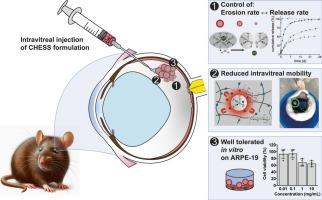
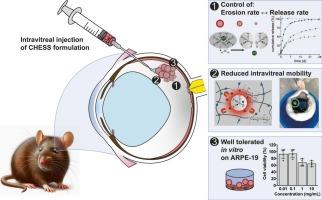
Current standard pharmacological treatment of retinal vascular diseases requires frequent intravitreal injection every 4–12 weeks. Active pharmaceutical ingredients (APIs) with better pharmacokinetics (PK), allowing less frequent administrations, remain to be discovered and developed. In preclinical stage mostly small molecule New Chemical Entities (NCEs) and peptides represent promising candidates. However, they typically suffer from fast clearance from the eye upon intravitreal injection, which confines support of animal models as sufficient exposure over 1–4 weeks in the eye is not reached. Addressing this need of extended-release (XR) formulations to enable such animal models, we hereby present chitosan embedded silica particles in suspension (CHESS). We identified non-mesoporous silica matrix particles as suitable biodegradable XR formulation and established a preparation method to control their degree of condensation, erosion rate and finally the release rate. Applicability for different API candidates was demonstrated by successful embedding of two model small molecules and one model peptide at high drug loads of >20 %, respectively. The ability to control release rate was demonstrated in vitro. High intravitreal mobility, which is a disadvantage of uncoated silica microparticles and other intravitreally applied XR microparticle formulations, was reduced by surface-coating with a polycationic chitosan-derivative. This leads to formation of stable depots in the vitreous after injection, which can be easily separated from the retina, facilitating PK analysis and pharmacodynamic (PD) readouts. Furthermore, we showed good tolerability and low toxicity on ARPE-19 cells.
期刊介绍:
The Journal of Controlled Release (JCR) proudly serves as the Official Journal of the Controlled Release Society and the Japan Society of Drug Delivery System.
Dedicated to the broad field of delivery science and technology, JCR publishes high-quality research articles covering drug delivery systems and all facets of formulations. This includes the physicochemical and biological properties of drugs, design and characterization of dosage forms, release mechanisms, in vivo testing, and formulation research and development across pharmaceutical, diagnostic, agricultural, environmental, cosmetic, and food industries.
Priority is given to manuscripts that contribute to the fundamental understanding of principles or demonstrate the advantages of novel technologies in terms of safety and efficacy over current clinical standards. JCR strives to be a leading platform for advancements in delivery science and technology.




 京公网安备 11010802042870号
京ICP备2023020795号-1
京公网安备 11010802042870号
京ICP备2023020795号-1

 分享
分享
 求助内容:
求助内容: 应助结果提醒方式:
 扫码关注我们
