Victor Vanpeene, Olga Stamati, Cyril Guilloud, Rémi Tucoulou, Benjamin Holliger, Marion Chandesris, Sandrine Lyonnard, Julie Villanova
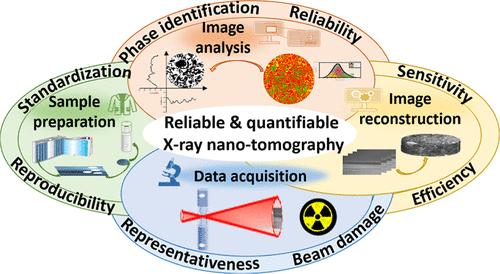
{"title":"Comparative Study of the Quantitative Analysis of Battery Materials with X-ray Nano-tomography: From Ex Situ toward Operando Measurements","authors":"Victor Vanpeene, Olga Stamati, Cyril Guilloud, Rémi Tucoulou, Benjamin Holliger, Marion Chandesris, Sandrine Lyonnard, Julie Villanova","doi":"10.1021/acsnano.4c16419","DOIUrl":null,"url":null,"abstract":"Improving battery materials calls for nondestructive techniques capable of delivering high-resolution microstructural information in real time. In this context, X-ray phase contrast nano-tomography is a technique of choice as it enables multiscale 3D characterization. In this study, we propose a feedback loop-integrated workflow for X-ray nano-tomography, based on systematic evaluation of six state-of-the-art battery anode and cathode materials to benchmark key procedures ensuring reliable, reproducible, quality-assessed characterization and subsequent 3D morphological quantification, thus avoiding potential bias in the scientific conclusions. As a result for this phase contrast technique, the sample size and energy used appear as key factors for the final resolution, which enhances imaging capabilities for separating the different material phases of the electrode microstructures. But, it is crucial to adapt these parameters to the materials in order to mitigate errors in the morphological parameter estimation. Moreover, an empirical law based on the heterogeneity and the average particle size distribution has been established to calculate the minimum representative elementary volume to be imaged, showing that volumes of 102 × 102 × 102 μm<sup>3</sup> (50 nm voxel size) are sufficiently representative for the six microstructures studied. Ultimately, guidelines have been established for in situ/<i>operando</i> X-ray nano-tomography measurements, with a proposed/validated in-house setup and cell design that preserve both the image resolution and electrochemistry. A detailed evaluation of the X-ray beam interaction is also presented, exploring the relationship between the dose received by the electrolyte and material and the reliable monitoring of electrochemistry and tomography.","PeriodicalId":21,"journal":{"name":"ACS Nano","volume":"85 4 1","pages":""},"PeriodicalIF":17.3000,"publicationDate":"2025-03-04","publicationTypes":"Journal Article","fieldsOfStudy":null,"isOpenAccess":false,"openAccessPdf":"","citationCount":"0","resultStr":null,"platform":"Semanticscholar","paperid":null,"PeriodicalName":"ACS Nano","FirstCategoryId":"88","ListUrlMain":"https://doi.org/10.1021/acsnano.4c16419","RegionNum":1,"RegionCategory":"材料科学","ArticlePicture":[],"TitleCN":null,"AbstractTextCN":null,"PMCID":null,"EPubDate":"","PubModel":"","JCR":"Q1","JCRName":"CHEMISTRY, MULTIDISCIPLINARY","Score":null,"Total":0}
引用次数: 0
Abstract
Improving battery materials calls for nondestructive techniques capable of delivering high-resolution microstructural information in real time. In this context, X-ray phase contrast nano-tomography is a technique of choice as it enables multiscale 3D characterization. In this study, we propose a feedback loop-integrated workflow for X-ray nano-tomography, based on systematic evaluation of six state-of-the-art battery anode and cathode materials to benchmark key procedures ensuring reliable, reproducible, quality-assessed characterization and subsequent 3D morphological quantification, thus avoiding potential bias in the scientific conclusions. As a result for this phase contrast technique, the sample size and energy used appear as key factors for the final resolution, which enhances imaging capabilities for separating the different material phases of the electrode microstructures. But, it is crucial to adapt these parameters to the materials in order to mitigate errors in the morphological parameter estimation. Moreover, an empirical law based on the heterogeneity and the average particle size distribution has been established to calculate the minimum representative elementary volume to be imaged, showing that volumes of 102 × 102 × 102 μm3 (50 nm voxel size) are sufficiently representative for the six microstructures studied. Ultimately, guidelines have been established for in situ/operando X-ray nano-tomography measurements, with a proposed/validated in-house setup and cell design that preserve both the image resolution and electrochemistry. A detailed evaluation of the X-ray beam interaction is also presented, exploring the relationship between the dose received by the electrolyte and material and the reliable monitoring of electrochemistry and tomography.
期刊介绍:
ACS Nano, published monthly, serves as an international forum for comprehensive articles on nanoscience and nanotechnology research at the intersections of chemistry, biology, materials science, physics, and engineering. The journal fosters communication among scientists in these communities, facilitating collaboration, new research opportunities, and advancements through discoveries. ACS Nano covers synthesis, assembly, characterization, theory, and simulation of nanostructures, nanobiotechnology, nanofabrication, methods and tools for nanoscience and nanotechnology, and self- and directed-assembly. Alongside original research articles, it offers thorough reviews, perspectives on cutting-edge research, and discussions envisioning the future of nanoscience and nanotechnology.





 京公网安备 11010802042870号
京ICP备2023020795号-1
京公网安备 11010802042870号
京ICP备2023020795号-1

 分享
分享
 求助内容:
求助内容: 应助结果提醒方式:
 扫码关注我们
