Bifunctional tubular step-scheme Co3S4/CdS heterostructure for highly efficient photoelectrochemical detection coupled with the degradation of tetracycline
Luping Feng , Jianghong Wang , Xiao Zhuang , Yujie Fan , Leyao Jin , Enjun Chen , Xinfeng Li , Peisong Tang , Lixiang Zhang
{"title":"Bifunctional tubular step-scheme Co3S4/CdS heterostructure for highly efficient photoelectrochemical detection coupled with the degradation of tetracycline","authors":"Luping Feng , Jianghong Wang , Xiao Zhuang , Yujie Fan , Leyao Jin , Enjun Chen , Xinfeng Li , Peisong Tang , Lixiang Zhang","doi":"10.1016/j.foodchem.2025.143746","DOIUrl":null,"url":null,"abstract":"<div><div>A bifunctional tubular step-scheme Co<sub>3</sub>S<sub>4</sub>/CdS heterostructure was successfully synthesized for efficient photoelectrochemical (PEC) detection coupled with the degradation of tetracycline (TC). It was found that so-obtained heterostructure could effectively suppress the recombination of photo-generated carriers and display larger PEC responses owing to the internal electrostatic field. Upon adding TC, the photocurrent signal of Co<sub>3</sub>S<sub>4</sub>/CdS heterostructure was specifically activated due to the direct consumption of holes in CdS component by TC, resulting in significantly enhanced charge separation. Crucially, the photo-induced holes in CdS and produced <sup>•</sup>OH radicals can realize catalytic degradation of TC during its detection and the possible intermediates and degradation pathways were speculated. A dual-functional PEC sensing platform has thereby been developed for detection and degradation of TC with ultra-low detection limit and high degradation efficiency. Additionally, the developed sensor displayed excellent selectivity and high stability, demonstrating its potential for TC detection and degradation in tap-water and milk samples.</div></div>","PeriodicalId":318,"journal":{"name":"Food Chemistry","volume":"478 ","pages":"Article 143746"},"PeriodicalIF":9.8000,"publicationDate":"2025-06-30","publicationTypes":"Journal Article","fieldsOfStudy":null,"isOpenAccess":false,"openAccessPdf":"","citationCount":"0","resultStr":null,"platform":"Semanticscholar","paperid":null,"PeriodicalName":"Food Chemistry","FirstCategoryId":"97","ListUrlMain":"https://www.sciencedirect.com/science/article/pii/S0308814625009975","RegionNum":1,"RegionCategory":"农林科学","ArticlePicture":[],"TitleCN":null,"AbstractTextCN":null,"PMCID":null,"EPubDate":"2025/3/5 0:00:00","PubModel":"Epub","JCR":"Q1","JCRName":"CHEMISTRY, APPLIED","Score":null,"Total":0}
引用次数: 0
Abstract
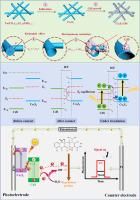
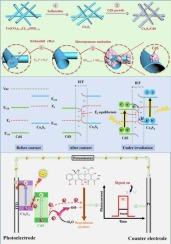
A bifunctional tubular step-scheme Co3S4/CdS heterostructure was successfully synthesized for efficient photoelectrochemical (PEC) detection coupled with the degradation of tetracycline (TC). It was found that so-obtained heterostructure could effectively suppress the recombination of photo-generated carriers and display larger PEC responses owing to the internal electrostatic field. Upon adding TC, the photocurrent signal of Co3S4/CdS heterostructure was specifically activated due to the direct consumption of holes in CdS component by TC, resulting in significantly enhanced charge separation. Crucially, the photo-induced holes in CdS and produced •OH radicals can realize catalytic degradation of TC during its detection and the possible intermediates and degradation pathways were speculated. A dual-functional PEC sensing platform has thereby been developed for detection and degradation of TC with ultra-low detection limit and high degradation efficiency. Additionally, the developed sensor displayed excellent selectivity and high stability, demonstrating its potential for TC detection and degradation in tap-water and milk samples.
期刊介绍:
Food Chemistry publishes original research papers dealing with the advancement of the chemistry and biochemistry of foods or the analytical methods/ approach used. All papers should focus on the novelty of the research carried out.




 京公网安备 11010802042870号
京ICP备2023020795号-1
京公网安备 11010802042870号
京ICP备2023020795号-1

 分享
分享
 求助内容:
求助内容: 应助结果提醒方式:
 扫码关注我们
