Ashrumochan Mohanty , Bhabagrahi Sahoo , Ravindra Vitthal Kale
{"title":"A coupled optimized hedging rule-based reservoir operation and hydrodynamic model framework for riverine flood risk management","authors":"Ashrumochan Mohanty , Bhabagrahi Sahoo , Ravindra Vitthal Kale","doi":"10.1016/j.watres.2025.123443","DOIUrl":null,"url":null,"abstract":"<div><div>Long-term changes in reservoir inflow due to climate change and human interferences violate the assumptions of hydrologic stationarity, especially in the reservoir operation during high flood season for managing the downstream critical levee (DCL) sections from overtopping. Utilization of uncertain inflow forecast into a reservoir using the operating rule curve of certain forecast horizon reflects the challenges imposed by nonstationary conditions, downstream flood intensification with spatiotemporally distributed lateral flux and floodplain dynamics. Addressing these issues, this study develops four hierarchical frameworks considering single-stage hedging (1SH) and two-stage hedging (2SH) rules-based reservoir operation models optimized with Particle Swarm Optimization (PSO) and informed with rating curve uncertainty at DCL section. Further, these two frameworks are coupled with HEC-RAS-2D (H2D) hydrodynamic model to reduce the existing flood risk at DCL section. The efficiency of the advocated 1SH-PSO, 2SH-PSO, 1SH-PSO<img>H2D and 2SH-PSO<img>H2D are tested in the Rengali reservoir on the Brahmani River in eastern India. The inflow forecasts into the reservoir are simulated by the coupled SWAT-Pothole and Wavelet-based Bidirectional Long-Short-Term Memory (WBiLSTM) models forced with the bias-corrected GFS weather forecasts with up to 10 days’ lead-times. The results demonstrate that the best-performing 2SH-PSO<img>H2D framework-based reservoir operation could reduce the average peak flow depth at the DCL station by 21 % from the baseline with an average reduction in levee failure risk by 22.28 % leading to effective management of high flood events. This advocated framework could be used in other reservoir systems worldwide in reducing the downstream flood hazards through enhanced reservoir operation.</div></div>","PeriodicalId":443,"journal":{"name":"Water Research","volume":"279 ","pages":"Article 123443"},"PeriodicalIF":12.8000,"publicationDate":"2025-07-01","publicationTypes":"Journal Article","fieldsOfStudy":null,"isOpenAccess":false,"openAccessPdf":"","citationCount":"0","resultStr":null,"platform":"Semanticscholar","paperid":null,"PeriodicalName":"Water Research","FirstCategoryId":"93","ListUrlMain":"https://www.sciencedirect.com/science/article/pii/S0043135425003562","RegionNum":1,"RegionCategory":"环境科学与生态学","ArticlePicture":[],"TitleCN":null,"AbstractTextCN":null,"PMCID":null,"EPubDate":"2025/3/5 0:00:00","PubModel":"Epub","JCR":"Q1","JCRName":"ENGINEERING, ENVIRONMENTAL","Score":null,"Total":0}
引用次数: 0
Abstract
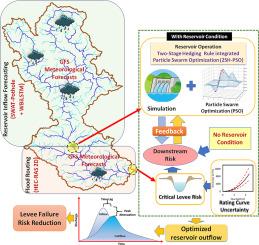
Long-term changes in reservoir inflow due to climate change and human interferences violate the assumptions of hydrologic stationarity, especially in the reservoir operation during high flood season for managing the downstream critical levee (DCL) sections from overtopping. Utilization of uncertain inflow forecast into a reservoir using the operating rule curve of certain forecast horizon reflects the challenges imposed by nonstationary conditions, downstream flood intensification with spatiotemporally distributed lateral flux and floodplain dynamics. Addressing these issues, this study develops four hierarchical frameworks considering single-stage hedging (1SH) and two-stage hedging (2SH) rules-based reservoir operation models optimized with Particle Swarm Optimization (PSO) and informed with rating curve uncertainty at DCL section. Further, these two frameworks are coupled with HEC-RAS-2D (H2D) hydrodynamic model to reduce the existing flood risk at DCL section. The efficiency of the advocated 1SH-PSO, 2SH-PSO, 1SH-PSOH2D and 2SH-PSOH2D are tested in the Rengali reservoir on the Brahmani River in eastern India. The inflow forecasts into the reservoir are simulated by the coupled SWAT-Pothole and Wavelet-based Bidirectional Long-Short-Term Memory (WBiLSTM) models forced with the bias-corrected GFS weather forecasts with up to 10 days’ lead-times. The results demonstrate that the best-performing 2SH-PSOH2D framework-based reservoir operation could reduce the average peak flow depth at the DCL station by 21 % from the baseline with an average reduction in levee failure risk by 22.28 % leading to effective management of high flood events. This advocated framework could be used in other reservoir systems worldwide in reducing the downstream flood hazards through enhanced reservoir operation.
期刊介绍:
Water Research, along with its open access companion journal Water Research X, serves as a platform for publishing original research papers covering various aspects of the science and technology related to the anthropogenic water cycle, water quality, and its management worldwide. The audience targeted by the journal comprises biologists, chemical engineers, chemists, civil engineers, environmental engineers, limnologists, and microbiologists. The scope of the journal include:
•Treatment processes for water and wastewaters (municipal, agricultural, industrial, and on-site treatment), including resource recovery and residuals management;
•Urban hydrology including sewer systems, stormwater management, and green infrastructure;
•Drinking water treatment and distribution;
•Potable and non-potable water reuse;
•Sanitation, public health, and risk assessment;
•Anaerobic digestion, solid and hazardous waste management, including source characterization and the effects and control of leachates and gaseous emissions;
•Contaminants (chemical, microbial, anthropogenic particles such as nanoparticles or microplastics) and related water quality sensing, monitoring, fate, and assessment;
•Anthropogenic impacts on inland, tidal, coastal and urban waters, focusing on surface and ground waters, and point and non-point sources of pollution;
•Environmental restoration, linked to surface water, groundwater and groundwater remediation;
•Analysis of the interfaces between sediments and water, and between water and atmosphere, focusing specifically on anthropogenic impacts;
•Mathematical modelling, systems analysis, machine learning, and beneficial use of big data related to the anthropogenic water cycle;
•Socio-economic, policy, and regulations studies.





 京公网安备 11010802042870号
京ICP备2023020795号-1
京公网安备 11010802042870号
京ICP备2023020795号-1

 分享
分享
 求助内容:
求助内容: 应助结果提醒方式:
 扫码关注我们
