Tinglian Yuan, Xiaofei Guo, Stephen Anthony Lee, Sadie Brasel, Amrita Chakraborty, David J. Masiello, Stephan Link
{"title":"Chemical Interface Damping Revealed by Single-Particle Absorption Spectroscopy","authors":"Tinglian Yuan, Xiaofei Guo, Stephen Anthony Lee, Sadie Brasel, Amrita Chakraborty, David J. Masiello, Stephan Link","doi":"10.1021/acsnano.4c17894","DOIUrl":null,"url":null,"abstract":"Plasmon-induced interfacial charge separation is a promising way to efficiently extract energetic carriers through direct plasmon decay. This mechanism of charge transfer has been investigated by single-particle scattering spectroscopy, which measures the homogeneous plasmon line width. The line width is broadened by charge transfer, generally known as chemical interface damping. However, conflicting reports exist regarding the effect of chemical interface damping on the corresponding single-particle absorption spectrum, which is needed to accurately determine absolute light conversion efficiencies. This work aims to resolve this question by directly correlating absorption and scattering spectra of individual gold nanorods in the presence and absence of a charge-accepting interface. We find that for TiO<sub>2</sub> coated nanorods, the absorption line width is indeed broadened due to chemical interface damping but is overall narrower than the scattering line width. Chemical interface damping is furthermore found to increase with larger resonance energies. The observed differences in line widths between absorption and scattering are elucidated within the context of an analytically tractable model describing the lowest energy optically bright and higher-order optically dark plasmon modes of the nanorod, including bulk, radiative, and chemical interface damping effects. Taken together, these results establish that single-particle absorption spectroscopy is capable of revealing interfacial charge injection by direct plasmon decay.","PeriodicalId":21,"journal":{"name":"ACS Nano","volume":"13 1","pages":""},"PeriodicalIF":16.0000,"publicationDate":"2025-03-04","publicationTypes":"Journal Article","fieldsOfStudy":null,"isOpenAccess":false,"openAccessPdf":"","citationCount":"0","resultStr":null,"platform":"Semanticscholar","paperid":null,"PeriodicalName":"ACS Nano","FirstCategoryId":"88","ListUrlMain":"https://doi.org/10.1021/acsnano.4c17894","RegionNum":1,"RegionCategory":"材料科学","ArticlePicture":[],"TitleCN":null,"AbstractTextCN":null,"PMCID":null,"EPubDate":"","PubModel":"","JCR":"Q1","JCRName":"CHEMISTRY, MULTIDISCIPLINARY","Score":null,"Total":0}
引用次数: 0
Abstract
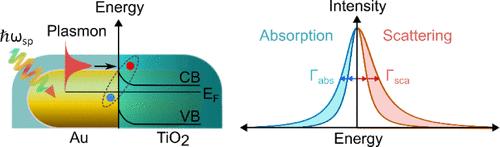
Plasmon-induced interfacial charge separation is a promising way to efficiently extract energetic carriers through direct plasmon decay. This mechanism of charge transfer has been investigated by single-particle scattering spectroscopy, which measures the homogeneous plasmon line width. The line width is broadened by charge transfer, generally known as chemical interface damping. However, conflicting reports exist regarding the effect of chemical interface damping on the corresponding single-particle absorption spectrum, which is needed to accurately determine absolute light conversion efficiencies. This work aims to resolve this question by directly correlating absorption and scattering spectra of individual gold nanorods in the presence and absence of a charge-accepting interface. We find that for TiO2 coated nanorods, the absorption line width is indeed broadened due to chemical interface damping but is overall narrower than the scattering line width. Chemical interface damping is furthermore found to increase with larger resonance energies. The observed differences in line widths between absorption and scattering are elucidated within the context of an analytically tractable model describing the lowest energy optically bright and higher-order optically dark plasmon modes of the nanorod, including bulk, radiative, and chemical interface damping effects. Taken together, these results establish that single-particle absorption spectroscopy is capable of revealing interfacial charge injection by direct plasmon decay.
期刊介绍:
ACS Nano, published monthly, serves as an international forum for comprehensive articles on nanoscience and nanotechnology research at the intersections of chemistry, biology, materials science, physics, and engineering. The journal fosters communication among scientists in these communities, facilitating collaboration, new research opportunities, and advancements through discoveries. ACS Nano covers synthesis, assembly, characterization, theory, and simulation of nanostructures, nanobiotechnology, nanofabrication, methods and tools for nanoscience and nanotechnology, and self- and directed-assembly. Alongside original research articles, it offers thorough reviews, perspectives on cutting-edge research, and discussions envisioning the future of nanoscience and nanotechnology.




 京公网安备 11010802042870号
京ICP备2023020795号-1
京公网安备 11010802042870号
京ICP备2023020795号-1

 分享
分享
 求助内容:
求助内容: 应助结果提醒方式:
 扫码关注我们
